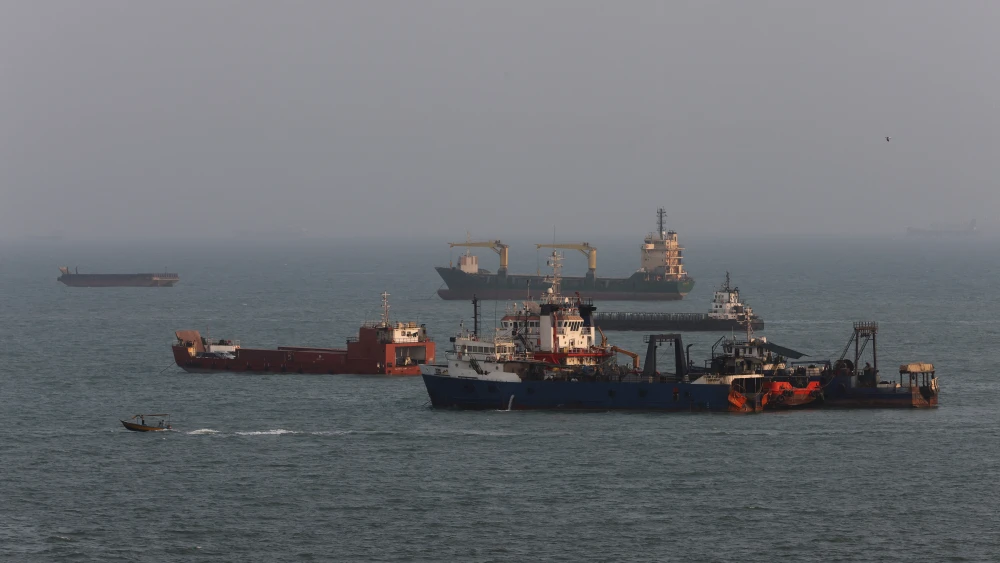
U.S. President Donald Trump told reporters at the White House on Monday that the U.S. Navy has “100%” control of the Strait of Hormuz and is enforcing an “infallible” blockade of Iranian ports that he characterized as a “steel wall.”
“We let people in that we want to let in and those people come in, they’ve been coming, and they’re going out. So it’s actually open,” he said, referring to the strait. “We do not let them go into Iran. They’re not admitted into the strait to go to Iran. But it’s open for others.” The president added that American forces have “mine-swept the entire strait.”
Shipping traffic through the Strait of Hormuz fell to six vessels on Monday, compared with a 10-day average of about 11, Reuters reported, citing Kpler data; before the war, about 130 to 140 ships typically transited the waterway daily.
Iran is “broke, totally broke” and is not paying its soldiers, Trump said. “They have inflation of 300%. As of last night, I heard 309%.”
The Islamic Republic can still “make trouble” but lacks the money to do so, he added.
Tehran had been “the bully of the Middle East” for 50 years, said Trump, noting that it had killed hundreds of thousands and wounded and maimed others with roadside bombings throughout the region.
“They’re very proud of it, and now they’re paying a price,” he concluded.
Trump said in a Truth Social post on Monday that he would seek compensation from Iran in future negotiations for Americans killed and wounded in attacks attributed to Tehran, as well as for Iranian protesters the regime has killed, responding to Iranian demands for compensation over damage sustained during the five-month conflict with the United States.
U.S. Ambassador to the United Nations Mike Waltz said Iran’s economic crisis and restricted access to cash and frozen assets were increasing pressure on Tehran to negotiate, arguing that U.S. sanctions and a blockade would prove more consequential than military strikes.
In an appearance on Fox News, Waltz said Iran’s currency was falling and inflation had reached its highest level in 80 years, which he attributed to the Trump administration’s “Operation Economic Fury” and Treasury Secretary Scott Bessent’s sanctions campaign.
“When they’re coming to the table, to our negotiators, they are talking about cash, cash, cash, because they’ll absorb the bombings. They don’t care about their military. They don’t care about their soldiers or even the Iranian people after they massacred 40,000 of them,” said Waltz. “But what are they worried about? They’re worried about that their currency is tanking, inflation is the highest in 80 years; the IRGC controls half of the economy.”
Iran is ruled by a “corrupt, elite, religious fanatic regime that has devastated that country for many decades,” Waltz continued. “They are constantly asking for access to cash, access to their assets that we’ve frozen, and what the president is talking about is that’s the squeeze. That, coupled with the blockade, that’s what is eventually going to get the Iranians to move.”
Iranian Foreign Ministry spokesman Esmaeil Baqaei rejected the U.S. pressure campaign, accusing Washington of using sanctions when it was unable to pursue diplomacy. He said Iran had demonstrated over decades that it would not be “strangled” by sanctions and warned that the policy could undermine U.S. prospects for resolving the crisis.
Sanctions pressure mounts on IRGC
Ella Rosenberg, senior expert on counterterrorist financing at the Jerusalem Center for Security and Foreign Affairs, told JNS that the Islamic Revolutionary Guard Corps’ financial position appeared to have worsened in the past three to four weeks. Rosenberg attributed the reversal to what she called a “compound effect” of U.S. and European sanctions enforcement, reduced Iranian oil exports and heightened scrutiny of IRGC funding amid the war.
“I do see the IRGC economy at a free fall,” she said. “And this was not the case almost a month ago.”
She emphasized that the campaign must be maintained to be effective. “In order for a policy to work, it has to be enforced over time,” she told JNS. “In order for sanctions to work, you need to enforce them over time” to create compounding effects on the economy.
Rosenberg said that, in her assessment, continued and more rigorously enforced sanctions could significantly weaken the regime, although she stressed that she was not an expert in dismantling governments. “The economic state within the state of Iran is very dire,” she said. “The IRGC is beginning to suffer financially—not enough, but it is beginning to suffer financially.”
Iran’s shrinking leverage
Alex Grinberg, an Iran expert at the Jerusalem Institute for Strategy and Security, said Trump was correct that Iran does not control the Strait of Hormuz, though he cautioned that the crisis had not been resolved.
“There is a crisis because vessels refuse to go through Hormuz because of insurance prices, and the Iranians can still launch missiles at ships,” Grinberg told JNS. “But, on the other hand, the Iranians can no longer blackmail the vessels and no one pays their protection money.”
Grinberg said Tehran’s inability to receive imports through its ports, combined with the blockade, was intensifying pressure on an economy already strained by decaying infrastructure, a water crisis and fuel shortages.
“Sanctions policy is working, but it cannot deal a final blow in a short period of time. It’s an accumulating effect,” he said. “But combined with all other limitations—war, lack of imports and the destroyed military and industrial infrastructure of Iran—all that ushers in this effect of an economy in shambles.”
He said Iran was progressively losing the leverage it derives from the strategic waterway as countries seek alternatives to the Hormuz route.
“As long as the Hormuz crisis continues, more and more countries will end up finding ways to bypass Hormuz,” Grinberg said. “As long as it continues, Iran is losing its last leverage, because except for Hormuz, they have nothing.”
While Iran could theoretically resume missile fire against Israel, Grinberg said such attacks would be “an annoyance, not a strategic threat.” He added that a broader U.S. military campaign against Iran would carry the risk of American casualties, making it less likely if the present pressure campaign is viewed as effective.