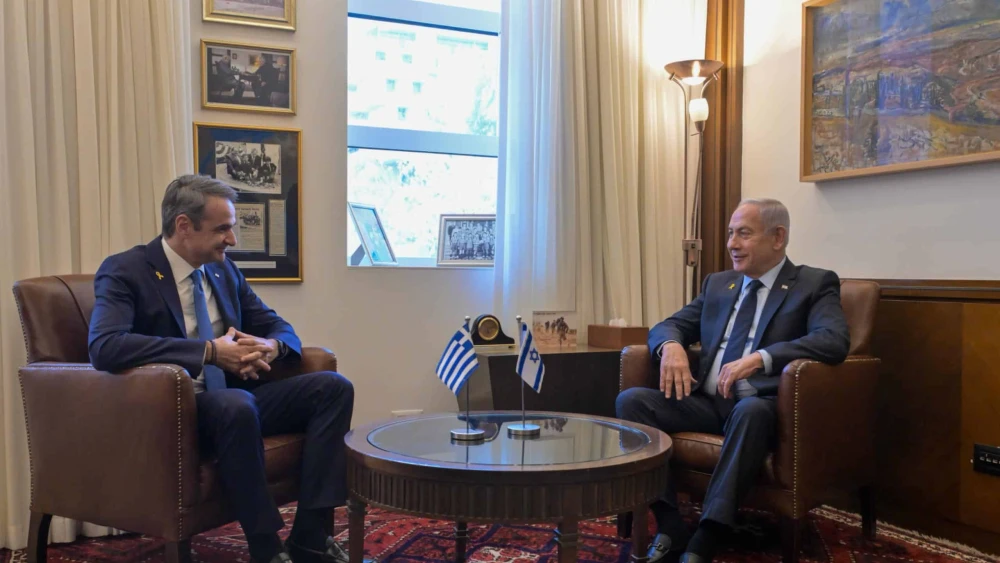
Israeli Prime Minister Benjamin Netanyahu met with his Greek counterpart, Kyriakos Mitsotakis, at his Jerusalem office on Sunday evening.
“Welcome, Prime Minister Mitsotakis, my good friend Kyriakos,” said the Israeli premier at a joint press conference ahead of a series of meetings. Israel and Greece, he continued, represented “two ancient peoples. Our free civilizations started in Athens and Jerusalem.” The two countries share common values, a common interest and also common challenges, he added.
“Our ties are constantly increasing. I know of many Israelis that are going to Greece, investing in Greece, which is a vote of confidence,” said Netanyahu, adding that they would discuss “security challenges, the economic opportunities and the ways that we can increase the chances for a lasting peace in our region, something that I know that you want.”
For his part, Mitsotakis described Greece’s cooperation with the Jewish state as a “strategic partnership that has significant depth,” and said the meetings would address the “many security challenges that we need to address in order to return our common region to a state of peace.”
Mitsotakis added, “I want to focus also on our economic cooperation, but also on our defense cooperation, which is particularly important to us in Greece. ... We always have very frank and open interactions and thank you so much for receiving me in Jerusalem today.”
Ahead of the meeting with Netanyahu on Sunday night, Mitsotakis spoke with Israeli President Isaac Herzog at his Jerusalem residence.
The Israeli head of state invited Dimitrios and Urania Karussis—Greek medical researchers whose son was murdered on Oct. 2, 2024, when Hamas terrorists opened fire at a Tel Aviv light rail station—to the meeting.
“Thank you for being supportive and being with us in this incredible partnership between Greece and Israel, which is embodied also in another tragedy of the Karussis family, whose son Yona, Ionas, was killed in a terrible terror attack in Jaffa,” said Herzog.
“You’re a dear friend of mine and of the State of Israel, and I want to welcome you on this very important visit,” continued the head of state.
The Greek premier thanked Herzog “for this very warm welcome and for honoring me with your friendship,” adding, “You know how much value we place in the strategic partnership between Greece and Israel.”
“Let me also again express my heartfelt sympathy, and on behalf of all the Greek people, my condolences to the parents of Ionas,” Mitsotakis said. “I had the opportunity to meet them in Athens, and we will be very pleased very soon to announce a scholarship program honoring Ionas to bring young students who want to study in Israel.”
As Israel struggles to further its relations with the European Union, it has increasingly turned to regional allies and Western-aligned liberal democracies, such as Greece and Cyprus, for greater cooperation.
In November 2024, it was reported that Athens was in talks with the Israeli government to develop a €2 billion ($2.17 billion) anti-aircraft and missile defense system similar to Jerusalem’s successful Iron Dome.
The deal was said to be part of an ambitious 10-year plan to modernize Greece’s military capabilities amid intermittent tensions with arch-rival Turkey, whose Islamist president has repeatedly threatened Greece.