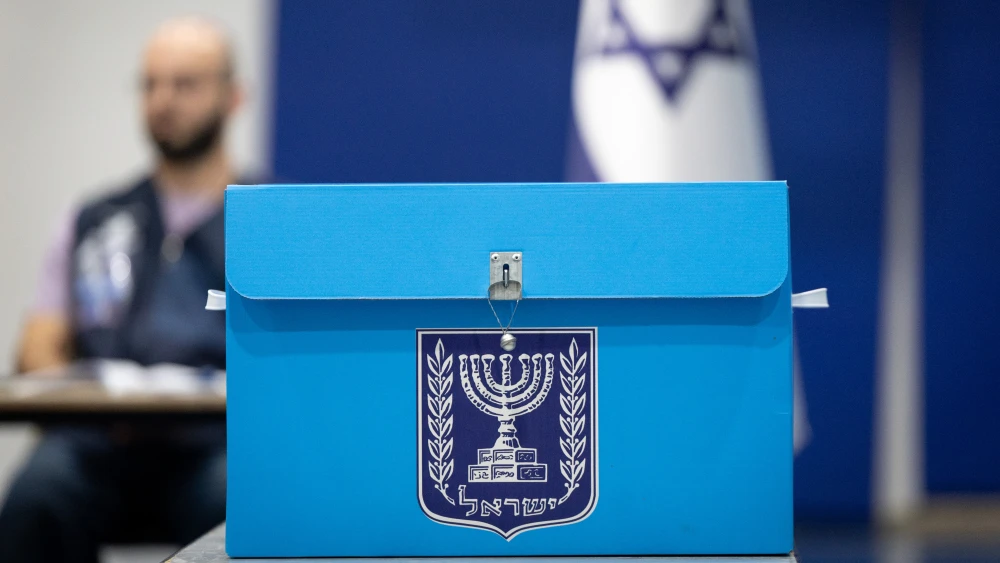

Neither candidate secured a clear victory in Tuesday’s election. This has made observers hesitant to draw an overriding message from the results. On one thing they can agree—Israelis have faith in their system. Voter turnout reaching 77.7%, the highest recorded since 1999.
“It was a vote of confidence in democracy. When people don’t feel their vote means something, they don’t vote,” Ilana Shpaizman, a senior lecturer at the Department of Political Studies at Bar Ilan University in Ramat Gan, told JNS.
The biggest surprise was the Arab vote, where turnout reached 80%, securing the Arab parties a record 19 Knesset seats (with 85% of the votes counted).
“Arabs had 15 seats in 2020. But it wasn’t seen as important because they weren’t expected to form part of a governing coalition. Now everyone is talking about whether the Arabs can be part of the government. I think this is a game-changer. This is a new discourse that was not present before,” Shpaizman said.
Sharona Zablodovsky, a member of Forum Dvorah, a women’s group comprising experts in foreign affairs and national security, said, “The high turnout among Arab voters shows that they were able to unite despite their internal disagreements. Some voters also see this as an opportunity to express a clearly anti-Zionist agenda.”
National Security Minister Itamar Ben-Gvir of the Otzma Yehudit Party, who cracked down on illegal Arab construction and toughened conditions for Arab prisoners, acted as a “catalyst” that brought out the Arab vote, she said. “Their increased participation may have been a counter-response to those measures.”

Shpaizman agreed that the Arab vote was, in part, a protest vote against Ben-Gvir.
A referendum on Netanyahu?
Israeli Prime Minister Benjamin Netanyahu himself was a central issue, Zablodovsky said, but “for the Jewish public, it was about much more than Bibi or no Bibi. It was also about security perceptions and policy goals.”
The opposition put Netanyahu at the center of its campaign, promising to do everything to oust him. Gadi Eisenkot, head of the Yashar Party, on track to win 21 Knesset seats and become the largest of the opposition parties, said that he would form a minority government if he fell short of the minimum 61 Knesset seats in the 120-seat parliament. An unlikely scenario, it nonetheless sent the message that he would neither work with Netanyahu nor permit him to continue leading as head of a transitional government.
“The left focused primarily on the message of ‘Anyone but Netanyahu.’ In practice, however, its messaging about what it would actually do better was not clear or compelling enough. Many new figures entered the political arena on the left, but the public is not yet familiar with them,” Zablodovsky said.
The opposition approach appears to have failed. “There is a clear expression of confidence in Netanyahu among a large segment of the Israeli public. He was elected with a majority of the votes and leads the largest party,” she said. “The left is losing public support, mainly because part of Israeli society shifted its political stance after Oct. 7.”
The vote of confidence in Netanyahu presumably means concomitant support to continue the war against Iran and its proxies. “Netanyahu seeks a decisive victory and the dismantling of Iran’s nuclear capabilities in order to remove an existential threat to Israel and, indirectly, to help protect the Western world,” she said. “In contrast, the opposition conveyed messages favoring the containment of a nuclear-armed Iran and expressed a willingness to partner with segments of the Arab electorate whose agenda is associated with Hamas.”
If Netanyahu forms the next government, “extensive military operations are likely to continue,” Zablodovsky said.
Bar-Ilan’s Shpaizman took a more cynical view of Netanyahu’s campaign warnings, including his posting of an AI-generated picture of a mushroom cloud engulfing Tel Aviv. “The Likud sent cars into Likud cities, saying things along the lines of, ‘There’s going to be a war. We’re going to die. So vote Netanyahu.’ I don’t know if it worked,” she said.
The opposition also made haredi enlistment a central issue. Haredi, or ultra-Orthodox, Jews, view military service as a distraction from study and fear those who are drafted will turn away from religion. With the Gaza war, public pressure has mounted for the ultra-Orthodox to share more of the military burden.
At least one ultra-Orthodox party suffered in the polls as a result. Shas, which attracts not only haredim, but also Sephardi Jews, lost support in areas that had been considered strongholds. These people send their children to the army. They don’t appreciate that ultra-Orthodox yeshiva students aren’t serving, Shpaizman explained.
Shas is set to win seven Knesset seats, down from 11 in 2022.

For many years, the haredi parties have been among the most consistent coalition partners for Netanyahu. Could they switch to the opposition given their anger at Netanyahu for his failure to pass a haredi draft law? It will be difficult as the opposition has painted them as illegitimate due to their antagonism to military service, Shpaizman said. “Now the big question is, who is more illegitimate—the Arabs or the haredim?”
How things will turn out, Zablodovsky wouldn’t venture to guess. “It is too early to say what will happen, as there are still around half a million votes left to count, so we need to wait for the final results.”