
It is impossible to analyze the Israel Defense Forces’ performance in this war with professional integrity without holding two truths in mind at the same time.
The first: Oct. 7, 2023, was one of the gravest strategic, intelligence and systemic failures in the history of the State of Israel.
The second: The fighting force that recovered from that surprise subsequently demonstrated extraordinary tactical and operational adaptability.
Anyone who erases the first is engaging in apologetics. Anyone who erases the second is engaging in propaganda.
Serious military analysis should engage in neither.
After the initial shock, the IDF moved within a relatively short period from a state of systemic surprise to a complex, joint, multidimensional offensive campaign. This is a clear case of operational adaptation, the ability of a military organization to learn, change its methods and rebuild operational effectiveness while fighting.
An army is not measured solely by whether it failed. Armies fail, sometimes catastrophically. It is also measured by what it is capable of doing in the minute after failure. The celebrated American General George Patton said, “Success is how high you bounce when you hit bottom.”
And this is where an entirely different story begins.
When intelligence stops being a presentation and becomes firepower
One of the defining characteristics of the campaign has been the development of information- and network-centric warfare.
The ability to connect intelligence from a wide range of sensors, command-and-control systems, UAVs and drones, intelligence units, maneuvering forces and fire-support elements makes it possible to dramatically shorten the sensor-to-shooter/sensor-to-effector cycle.
And this is not just another gadget.
It is the difference between an army that possesses a great deal of technology and an army whose technology has become an operational architecture.
In the old model, information traveled up the chain of command, was processed, and then came back down in the form of an order, sometimes reaching the force after the target had already gone elsewhere for coffee.
In the networked model, the aspiration is different: the sensor that detects, the system that analyzes, the commander who decides and the element that fires all become part of a single network. Information is no longer a “product” traveling through the system. It is raw material that is rapidly converted into operational effect.
This is a more profound change than another tank, another missile, or another drone.
The most important weapon on the modern battlefield is not necessarily the one that shoots the farthest, but the system that knows faster what to shoot at, who should shoot and when.
The International Institute for Strategic Studies has identified Ukraine and Gaza as two prominent cases in which the military use of artificial intelligence has moved from theoretical discussion to the actual battlefield, including in intelligence analysis, decision support and assistance in target identification processes.
Put simply, while some commentators are still debating whether the “digital military” is a marketing slogan, militaries and research institutes around the world are already trying to understand what can be learned from it.
A war on two levels
The ground challenge in Gaza has been exceptional even by international standards.
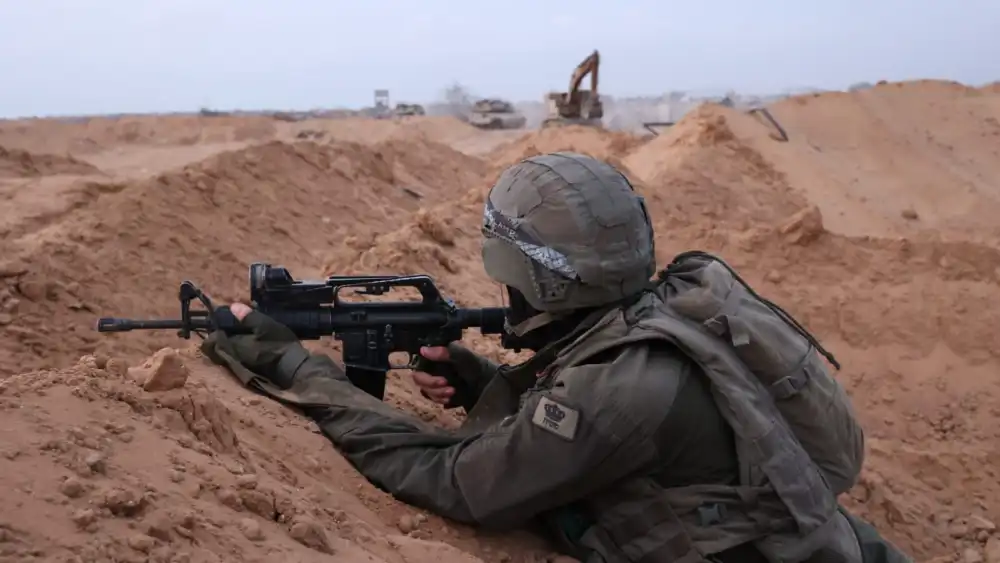
The IDF has had to employ infantry, armor, combat engineers, intelligence, special forces, stand-off fire and airpower within a dense urban environment, against an enemy that spent years constructing a system specifically designed to reduce the advantages of a conventional military.
Ambushes, explosive devices, anti-tank weapons, concealed infrastructure, combat from within civilian areas, and beneath all of that, another world.
The tunnels transformed the battlefield from three-dimensional in the metaphorical sense into three-dimensional in the literal sense. Above ground, one battle is being fought. Below ground, another is taking place. The real challenge is managing both as a single battle. And this is precisely where it is worth listening not only to what we say about ourselves, but also to what others say about what they see.
In 2025, the U.S. Army’s Center for Army Lessons Learned published a detailed study titled Subterranean Operations: Israeli Defense Force Lessons from Gaza. The study is not necessarily a paean to the IDF. It analyzes difficulties, limitations, techniques and lessons. What is noteworthy, however, is that the Israeli experience in Gaza was considered significant enough for the U.S. Army to examine potential changes to its doctrine, organization and training for subterranean warfare. The study explicitly notes the need to examine and update U.S. doctrine based on the IDF’s experience in Gaza.
‘Fiendishly difficult’
It is also worth listening to Gen. David Petraeus, who commanded U.S. forces in Iraq and Afghanistan and later served as director of the CIA.
Petraeus described the fighting in Gaza as “the most fiendishly difficult context for urban operations since 1945,” an exceptionally difficult urban combat environment. He compared it with Ramadi, Fallujah and Baqubah, and concluded that Gaza was considerably more challenging.
On the northern front, Israel faced a different kind of adversary.
Hezbollah is what’s known as a “hybrid armed actor,” an organization that combines characteristics of guerrilla warfare and terrorism with capabilities that resemble those of a conventional military: rocket and missile forces, anti-tank capabilities, UAVs, command-and-control systems, trained infantry units and operational infrastructure built over many years.
The IDF’s achievements against it must therefore be assessed against the enemy that actually existed, not against a caricature of it.
The severe degradation of Hezbollah’s command structures, infrastructure and organized capabilities, through a combination of fire, intelligence and ground maneuver, does not make every Israeli decision correct, nor does it erase failures. But it does make the thesis that we are looking at an army that has lost its ability to fight somewhat harder to sustain.
None of the above grants the senior military command or the political leadership even an ounce of immunity from criticism. On the contrary. The problem lies precisely in the gap between impressive tactical and technological capabilities and the strategic outcome.
For years, a concept developed in Israel that, in many cases, favored deterrence, containment and risk management over a clear concept of decisive victory. Israel built a force with exceptional technological and operational capabilities, but its strategic concept for employing that force did not always evolve at the same pace.
On Oct. 7, the bill came due, and it was terrible.
Criticism of the military leadership is therefore not merely legitimate. It is essential. Those responsible for the prevailing conception, the warning failure, force deployment and readiness must be held accountable. But there is an enormous difference between criticizing the command of an army and dismissing the capabilities of the army. There is a difference between “the system failed” and “the soldiers and units do not know how to fight.”
The political leadership is not watching from the stands
You cannot demand that an army “win” without defining what victory means. And that is not a question for a deputy battalion commander in the Golani Brigade.
Responsibility lies first and foremost with Israeli Prime Minister Benjamin Netanyahu and the political leadership. Throughout the campaign, decision-making was at times slow and cautious, with a high degree of sensitivity to international constraints, above all the relationship with the United States, as well as difficulty in defining and implementing a clear desired end state.
An army can capture territory, destroy infrastructure, eliminate commanders and dismantle combat formations. It cannot decide on its own what political reality is supposed to emerge the day after. And here lies one of the great confusions in the Israeli debate: We expect the chief of the General Staff to provide an answer to a question that the government is supposed to provide, and then blame the tank when there is no strategy.
Petraeus also warned against a model of “clear and leave,” going in, clearing an area and then withdrawing, emphasizing that a military achievement that is not connected to holding, stabilization and the construction of a different reality allows the enemy to regroup. That is precisely the point. Tactical victory is a military event. Strategic victory is the ability to turn that event into a new reality. The first is primarily the work of the military. The second is the shared responsibility of the military and political leaders, above all those who define for the military what it is fighting to achieve.
The Israeli experience is already being studied outside Israel. Does that mean that the IDF is “the best army in the world”? No. That is an easy claim to make and an extremely difficult one to measure seriously. There is no global league table for armies, no standings, and no final in which Israel’s Golani Brigade meets the Marines at Wembley.
But there is no doubt that today, after nearly three years of fighting, the IDF is better prepared than ever for the challenges we face.