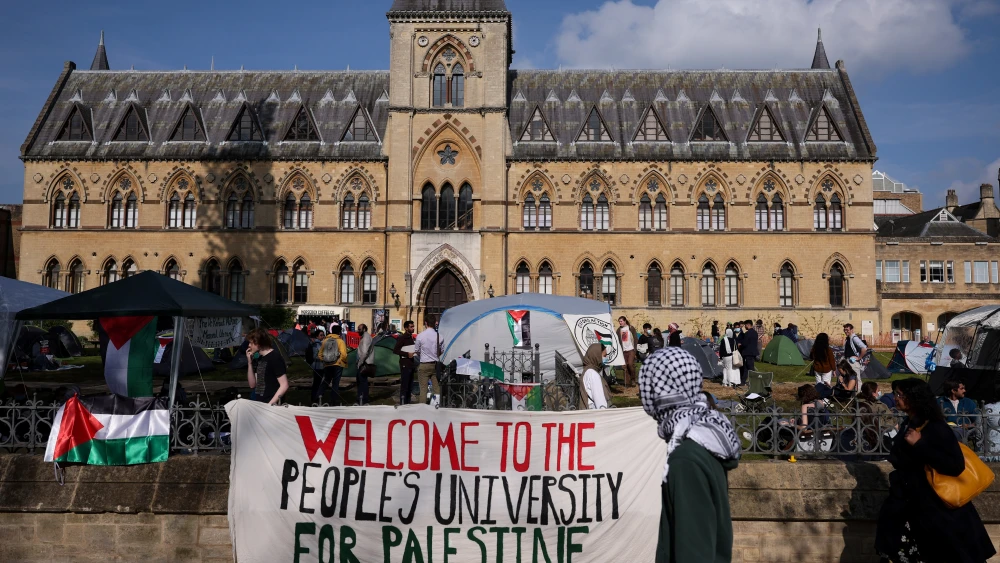

At a prestigious British university with millions of dollars in funding from Qatar, a London-born student leader who identifies as a Palestinian is under police investigation for allegedly celebrating Hamas publicly.
Two decades ago, this scenario would have seemed unlikely at Oxford University, a symbol of British intellectual authority. Now, the outgoing president of the Oxford Union, the world-famous debating society at Oxford University, Arwa Elrayess, is suspected of celebrating terrorism when she said that Hamas may be “lauded as heroes.”
This controversy at Oxford is the latest in a string of incidents that, to critics, indicate moral and academic decline not only in the institutions that make up that bucolic center of higher learning, but throughout British universities.
Amid foreign influences, U.K. campuses have become hubs of hatred of “Zionists”—a term of abuse that’s often applied to any Jews who don’t vocally condemn Israel.
In October, Oxford student Samuel Williams drew attention to this trend, and to the hate that accompanies it, when he was filmed ecstatically leading the chant “Gaza, Gaza, make us proud, put the Zios in the ground” at a London demonstration, saying it had been “workshopped in Oxford.”
Williams is facing racist incitement charges and has been suspended from Oxford’s Balliol College, but his behavior was part of rhetoric that’s consistently directed at Jews at Oxford, watchdog groups say.
Jewish academics and students submitted to Oxford’s vice chancellor a dossier containing over 70 allegations of antisemitism that occurred on campus in 2023-2024. The abuse caused one student, Madeline Bryant, to resign as a student leader after saying she was targeted for being Jewish.
Ben Ashworth, a student who had run for a leadership position within the Oxford Union, described the debating society as a “breeding ground for anti-Jewish hatred,” following a campaign against him during his run for president. Ashworth is not Jewish but was targeted for attending a fact-finding trip to Israel.
The Oxford Union is a student-led framework that’s not officially part of the colleges and institutions that make up the university, but its leaders are students and it is widely seen as emblematic of the university’s spirit. The forum has hosted addresses by Nelson Mandela, Ronald Reagan, Mother Teresa, the Dalai Lama and Albert Einstein, and debates featuring leading politicians and philosophers.
The Oxford Union has become “a microcosm of the apparent capture of institutions, even whole regions, in the U.K.,” prominent Jewish Oxford alumnus and broadcaster Jonathan Sacerdoti told JNS.
An Oxford University spokesperson told JNS that it “condemns, in the strongest possible terms, any language urging violence against groups of people or expressing any form of racial hatred.” The university has taken “a number of actions in recent months, in collaboration with Jewish students and staff, to strengthen our approach to tackling antisemitism and fostering an inclusive environment,” the spokesperson said. This included “issuing targeted communications to students highlighting the Inclusive Student Life platform,” and delivering “Equality, Diversity and Inclusion inductions for students.”
The Oxford Union did not reply by press time to queries sent by JNS requesting its reactions to the allegations made by critics.

Sacerdoti was confronted with the shift at Oxford about two years before police began their investigation of Elrayess. She is suspected of violating British laws against glorifying terrorism in a 2025 WhatsApp chat involving dozens of participants. She has denied this, claiming her critics have misquoted her.
In 2024, Sacerdoti attended an Oxford Union debate titled “This House Believes Israel is an Apartheid State Responsible for Genocide.” This was under Elrayess’s predecessor, Ebrahim Osman-Mowafy, who was born in Egypt. The debate descended into disruptions, jeers and the ejection of a pro-Israel debater, and was a “low point” in its history, Sacerdoti said.
Gerald Steinberg, founder and president of NGO Monitor, a nonprofit that researches funding for anti-Israel activities, said, “The headline of the debate—during which many hecklers hurled insults in English and Arabic for minutes at Sacerdoti and another pro-Israel debater—signaled the Oxford Union’s “intellectual descent from serious debate to a kangaroo court with foregone conclusions.”
Steinberg had been invited to that debate but declined. The motion, defended at the debate by Norman Finkelstein and three other anti-Israel activists, passed by 278 votes to 59. One anti-Israel debater, Miko Peled, called the Hamas attacks “acts of heroism,” denied they constituted terrorism and advocated creation of a Palestinian state “from the [Jordan] River to the [Mediterranean] Sea.”
More than 300 academics signed an open letter addressed to William Hague, the newly elected Oxford chancellor, stating that the debate featured illegal glorification of terrorism.
Peled was not sanctioned at the debate. Pro-Israel debater Yoseph Haddad was ejected after displaying a shirt reading “Your terrorist is dead.” Some anti-Israel incitement was omitted from the video recording of the debate published by the Oxford Union, prompting allegations of an attempt to hide evidence.
“Not only institutions but local councils, mayoralties, whole regions—they appear to have been somehow captured by people of a singular outlook, ideologically or politically,” Sacerdoti said.
Einat Wilf, head of Israeli centrist political party Oz, who earned her Ph.D. at Cambridge, attended the latest Oxford Union debate on Israel in June, titled “This House Believes Israel Never Truly Wanted Peace with Palestine.” Wilf’s team lost, receiving about a third of the votes.
“Pretty early in the debate, I noticed something unexpected: Our opponents didn’t even bother to address the proposition and treated it as self-evident, and rushed to an action plan, namely dismantling Israel, that had nothing to do with the proposition being debated. They displayed a strikingly low level of debating skill,” she said of anti-Israel historian Ilan Pappé, journalists Sami Hamdi and David Hearst, and Palestinian activist Ghada Karmi.
These and other debates have chipped away at the reputation of the Oxford Union, Wilf said, as the university’s prestige also took hits for its politicization and the targeting of Jews on campus by some students.
Gavriella Epstein-Lightman, a Jewish first-year history student at Oxford, described, in a recent column in The Telegraph, the atmosphere on campus as “a conspicuous silence when it comes to calling out antisemitism. Outrage over prejudice on campus appears selective rather than principled. The double standard is increasingly difficult to ignore.”
When Tommy Robinson, the right-wing activist known for his criticism of Muslim immigration and his support of Israel, came to speak at Oxford, his arrival agitated robust opposition by students. But when the antisemitic streamer Hasan Piker was scheduled to speak, there was no such mobilization, she said.
BREAKING @FoxNews Digital: Hasan Piker just read aloud that the UK is denying him entry, rejecting his request for an “Electronic Travel Authorization.” Jewish groups advocated for him to be barred for his anti-semitism. The UK government didn’t respond to a request for comment. pic.twitter.com/QlMV6iX1d8
— Asra Nomani (@AsraNomani) May 31, 2026
Piker has referred to ultra-Orthodox Jews as “inbred” and called a Jewish online viewer a “bloodthirsty violent pig dog,” Epstein-Lightman noted. Piker had also said: “It doesn’t matter if rape happened on Oct. 7.” He has argued that “Hamas is a thousand times better” than the Israeli state.
Piker was barred from entering the U.K. and was not able to appear in person. The Oxford Union arranged for him and Cenk Uygur, another anti-Israeli pundit, to participate remotely. Piker read the British notice aloud in a video posted on X, while Uygur wrote that he had been barred from the country.
At Oxford, the capture was sudden, according to Ronnie Fraser, a historian and former prominent activist in the fight against boycott of Israel in British academia.
Oxford was the setting of one of the earliest cases of an open boycott against Israelis in 2003, when a professor, Andrew Wilkie, informed an Israeli applicant that he wouldn’t be considered for a lab position due to his IDF service. Wilkie was suspended for two months without pay for violating the university’s anti-discrimination policy.
“One wonders whether that would happen today,” Fraser said.
In the wake of that affair, which was unusual at Oxford, the university did not emerge as a major hub of anti-Israel activity until after Oct. 7, 2023, when anti-Israel activists set up encampments on campus, Fraser said.
Sacerdoti and others interviewed for this article said it was unclear whether Oxford’s shift was linked to the fact that the university has received at least $9.8 million in Qatari state-linked donations since 2009, according to its public records.
Oxford’s funding from Middle Eastern states, including Qatar, whose media operations spread anti-Israel propaganda and which is a major financier of Hamas, increased a hundredfold from 2001 to 2014, according to a 2021 report by Professor John Heathershaw of the University of Exeter and three other researchers.
Britain’s limited disclosure requirements mean the complete sum is unknown, Steinberg told JNS. The Institute for the Study of Global Antisemitism and Policy (ISGAP) is currently researching the issue of foreign funding for Oxford University-affiliated institutions, an ISGAP spokesperson said.
An Oxford University student, Ben Ashworth, told JNS he’s noticed the prominence of Al Jazeera, the Qatari-funded satellite network, as the go-to news source. “Few people consuming Al Jazeera seem to know it’s funded by Qatar,” he said.
Oxford University’s records show a steep increase in the share of foreigners studying there. In 2000, they accounted for about 13% of attendees. Today, overseas students constitute more than 40% of a student body of about 26,000.
In 2025, some 3,000 of the foreigners were from China and India. About 1,000 were from Muslim-majority countries, according to Oxford University’s records.
Wilf said Israel’s allies need to keep showing up on campus and at debates despite their hostile atmosphere, because prestigious universities are “where the whole war is being waged by laundering libels through institutions of prestige.”
Then there’s the need to stand by Jewish students at those institutions, who “no longer have the option to remain neutral,” Wilf said. “If they find the courage to speak up when they inhabit such a hostile environment, then we can do the same as visitors.”