


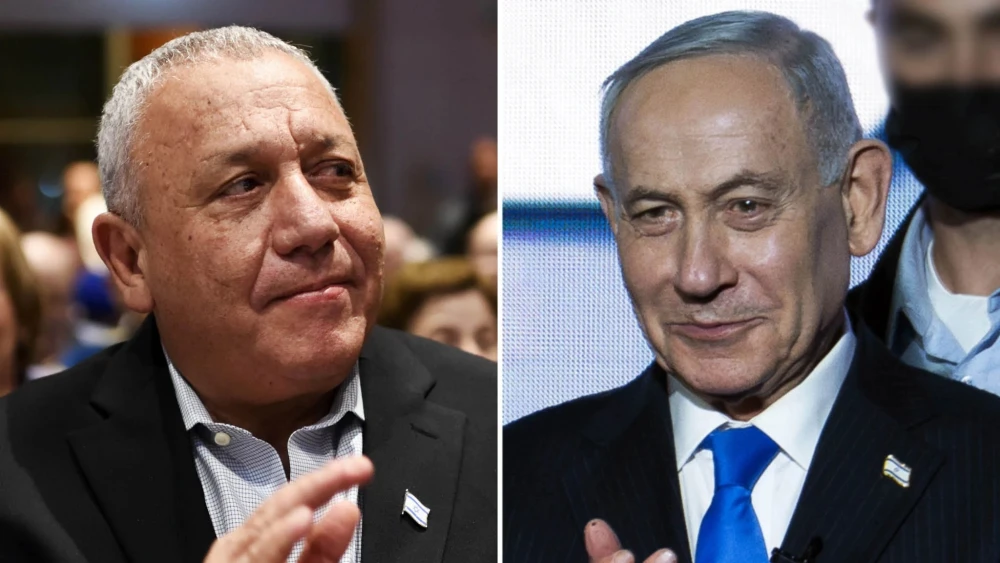

Israel has achieved significant military successes against its adversaries under Prime Minister Benjamin Netanyahu’s leadership, but whoever emerges victorious from the country’s Oct. 27 election will face ongoing challenges in defense, the economy and international relations.
Israel has yet to achieve victory in its multi-front “War of Revival,” leaving the newly elected prime minister with the task of bringing the war to a successful conclusion, observers told JNS.
The Israel Defense Forces has devastated Hamas’s senior leadership, taken control of the majority of the Gaza Strip and destroyed most of the terror group’s military infrastructure. Yet Hamas remains the central power in Gaza and the movement’s leaders defiantly refuse to disarm.
In the north, Israel beheaded Hezbollah, degraded its missile and rocket arsenal and drove it out of Southern Lebanon. Yet, here, too, the terror group still stands, works to rebuild its arsenal as evidenced by several failed weapons smuggling attempts, and remains part of the Lebanese government.
Against Iran, it is the same story. The U.S.-Israel alliance wiped out much of the Islamic regime’s top leadership and significantly reduced its capabilities. The ayatollahs nevertheless cling to power. On Oct. 21, Netanyahu admitted work remains to be done. “As long as they are here, as long as they strive to acquire horrific weapons, the State of Israel faces an existential threat,” the prime minister said, directing the IDF, the Mossad intelligence agency and other security branches to pursue the overthrow of the regime.
According to Brig. Gen. (res.) Amir Avivi, who recently left his position as chairman of the Israel Defense and Security Forum (IDSF), a group of thousands of former security officers, to join the Likud, Israel’s situation will be dire if the opposition bloc wins. This, he said, is because the far-left Democrats Party led by Yair Golan, and the Arab parties, will dictate policy. “It’s a parliamentary system, and if the government cannot exist without them, they will determine what’s going to happen,” he said.
“With them in power, we’re going to lose the war. We are on the verge of winning decisively. We’re getting ready to attack Iran and then dismantle Hezbollah and Hamas. And a minority government dependent on the Arab parties and the radical left will bring an end to the war. This will have devastating consequences for the State of Israel,” Avivi told JNS.
Moreover, he continued, U.S. President Donald Trump won’t continue the war on Iran without Netanyahu as leader in Israel. He cited Trump’s Oct. 18 endorsement of Netanyahu, in which he wrote: “If Israel has the wrong leader, which would be anyone other than Bibi, America will have to do this work ourselves, and I am not inclined to do so.
“This is existential for Israel. We need to finish the job with the United States,” said Avivi.
The reason the war has continued for three years without a decisive victory is that Israel is fighting on seven fronts, he said. “Until the United States joined, we fought alone on all these seven fronts, with huge success. There is a very clear strategy we are pursuing. Anybody who understands anything about warfare and the challenges we are facing, understood from the beginning that this is going to be a long war. In fact, I think it’s much shorter than we thought. All of us were surprised by how fast we brought Hezbollah to its knees.”
According to Gideon Israel, founder and president of the Jerusalem-Washington Center, an institute that works to strengthen the U.S.-Israel alliance, none of these achievements is permanent.
“Yes, there have been tactical accomplishments. We’re in control of about 60% of Gaza. We’re inside Lebanon. We’re inside Syria. Iran’s been degraded. But it’s all reversible. We could be forced to leave Gaza, Lebanon and Syria. In no arena have we decisively won,” he told JNS.

Eytan Gilboa, director of the Center for International Communication and a senior research associate at the BESA Center for Strategic Studies at Bar-Ilan University, agreed that dealing with Israel’s multiple fronts will be the No. 1 issue for the next prime minister. “We have Gaza, Lebanon and Iran. All of them are open and they have to be closed,” he told JNS.
The opposition bloc led by Gadi Eisenkot, head of the Yashar party, would have an easier time accomplishing this than Netanyahu, he said, arguing that the prime minister was trapped by his own promises and had become anathema in Europe and an increasingly controversial figure in America.
Gideon Israel, however, rejected this notion. “Certainly not Eisenkot; he’s part of the problem,” he said. “All the generals in the past 15 years are part of the problem,” he added, citing as an example Eisenkot’s role in reducing the size of the Israeli military.
In 2015, Eisenkot, then a lieutenant general and IDF chief of staff, introduced a plan to reduce the army by 100,000 reservists and 40,000 career personnel. The idea was that a smaller army could make up its numbers with advanced technology.
“How did that work out on Oct. 7? We trusted general after general. They’re given awesome powers and awesome amounts of money to keep the country safe. In retrospect, Hamas was moving forward while everybody was playing violins on the deck of the Titanic,” Israel told JNS.
The IDF needs an overhaul; to be rebuilt on the “right foundations,” which requires fresh ideas, he argued. “We need someone who can change the way the defense establishment thinks. We need people who think about war in terms of winning, about crushing the enemy,” he said.

Another issue that the next prime minister must grapple with, and which Israel and Gilboa highlighted, is the country’s deteriorating standing in the world. “This would be the No. 2 priority. Europe is already implementing sanctions against Israel. Even in the United States, they are talking about sanctioning the extremists,” Gilboa said, referring to the phenomenon of “settler violence” in Judea and Samaria.
In two years, Israel may find itself facing a hostile U.S. president, he noted. American presidents have harbored unfavorable attitudes toward the Jewish state before, but their animus was tempered by a pro-Israel Congress, he continued. When U.S. President Barack Obama demanded a total settlement freeze, famously saying in 2009 “not a single brick,” he received pushback from the Democratic Party. “Today, there would be no pushback,” Gilboa said.
The economy is the third major issue. High taxes and rising prices are perennial problems. Real-estate prices put owning property out of reach for many. The average cost for an Israeli apartment rose 84% since the summer of 2011 while the average salary rose 67%, Ynet reported in July. Limited competition (three importers control more than 85% of Israel’s new-car market), import duties and regulation make it hard for foreign products to enter Israel’s market. Israelis pay an 83% purchase tax on gas-powered cars.
The diplomatic and economic problems impact defense. Israel must prepare for the possibility of sanctions on weapons shipments.
Israel compared the incoming prime minister to the biblical Joseph, who when he became viceroy of Egypt needed to prepare for seven years of famine.
“We might have difficult years ahead of us. Will we be independent enough in our munitions production? Will our economy be strong enough to survive potential sanctions? Will we have alliances diverse enough to offset a Democratic administration in the United States turning on Israel? These are the serious questions which our next prime minister must face,” he said.


