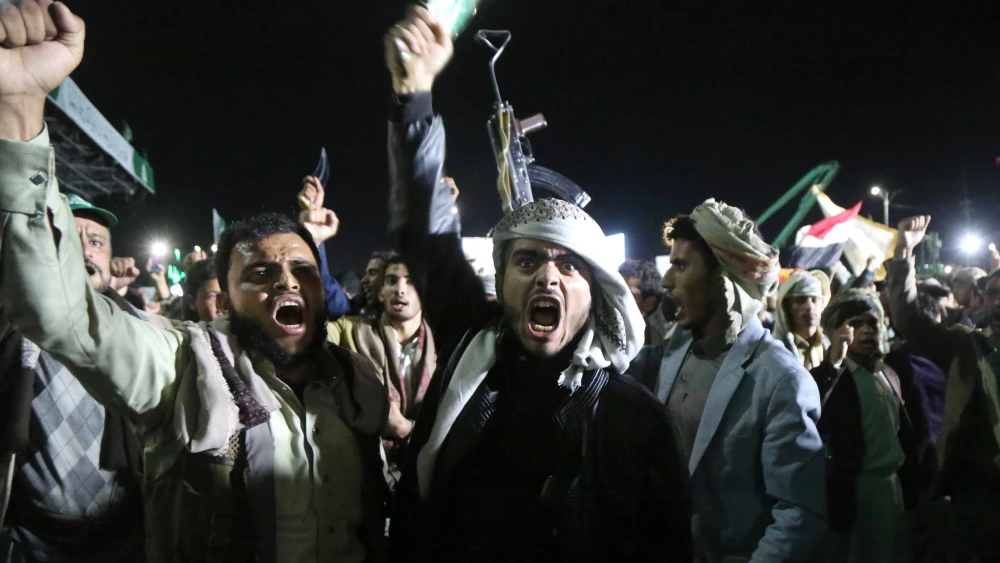

The Iranian-backed Houthi movement’s lightning seizure of the Bab el-Mandeb Strait on Yemen’s Red Sea coastline, along with its drone and missile strikes deep inside Saudi Arabia, has pushed Riyadh into an unprecedented posture of potential quiet dependence on Israeli intelligence.
Alongside the Houthi attack, which threatens Saudi shipping and oil exports through the Red Sea, Iranian-backed militias from Iraq struck Saudi Arabia’s strategic East-West oil pipeline on Sept. 10. The 1,200-kilometer (745-mile) pipeline carries millions of barrels of crude per day from Abqaiq to the Red Sea port of Yanbu, allowing Saudi Arabia to bypass the Strait of Hormuz. A refinery at Yanbu was also reportedly targeted on Wednesday.
A Western observer, speaking to JNS, said the Saudi request should be viewed as an opportunity. He added that Israel’s willingness to assist Saudi Arabia should hinge on securing tangible returns rather than acting as a silent partner.
“The answer should be, in principle, yes, but under what conditions—that’s a very delicate matter. After all, Israel does not want to be the mistress; it wants recognition and normalization,” the observer said. “I’m not convinced the Saudi government is ripe for that today. Remember, Saudi Arabia stood the whole time and wanted to stop the war against Iran. The moment it takes a small slap and its entire military structure collapses, then they come to Israel.”
Israel could also request assets such as Saudi oil supplies, he assessed.
The observer cautioned that open assistance to Riyadh carries risks given the Houthis’ current restraint toward Israel.
“Right now the Houthis are not attacking Israel. Open help to Saudi Arabia could end with them indeed attacking Israel. In short, it’s exactly the same complex political mosaic of give-and-take, part of which is payment in an overt manner,” he stated.
On Israel’s broader position, the observer added: “The cards have been redistributed in the Middle East, all of them, and now Israel’s position, its hand is a strong hand, it has quite a few cards in it, it’s a process of trying to extract them.”
A strategic threat beyond Saudi Arabia
Addressing the Houthi takeover of Bab el-Mandeb directly, the observer warned that its effects would not remain confined to Saudi Arabia.
“That’s not good for Israel,” he argued. “The Houthis right now are not demanding anything, they’re only acting against Saudi Arabia. But I estimate that it’s only a matter of a week’s time until it comes to Israel too.”
The source noted that the Red Sea port of Eilat has returned to operation since the Houthis ended their Red Sea attacks on Israel-bound vessels.
The Saudi pipeline shutdown came as the Houthis completed a rapid takeover of Yemen’s Red Sea coastline, seizing the port city of Mocha on Sept. 10 and the strait-straddling Perim Island the following day, before expanding onto the Greater and Lesser Hanish islands by Sept. 14, according to Reuters.
The Houthis vowed to block passage only for Saudi-flagged vessels while allowing other international shipping to continue, as Brent crude prices spiraled.
Saudi Crown Prince Mohammed bin Salman has responded by appealing for help across the region, including, according to Israel Hayom, an indirect approach to Israel via U.S. Central Command, asking for intelligence and other assistance aimed at preventing a Houthi blockade of Bab el-Mandeb.
On Tuesday, regional diplomats told Kan News that Israel and Saudi Arabia held mediated talks via CENTCOM on intelligence assistance. They added that the IDF recommended that the Israeli political echelon avoid unilateral strikes on the Houthis and focus instead on building an international coalition.
Axios reported that CENTCOM chief Adm. Brad Cooper hosted a regional military summit in Germany last week, reportedly bringing together IDF Chief of Staff Lt. Gen. Eyal Zamir and military chiefs from Saudi Arabia, the United Arab Emirates, Qatar, Kuwait, Bahrain, Jordan and Egypt to coordinate against Houthi territorial gains.
‘Secret requests should not be enough’
Hussain Abdul-Hussain, a research fellow at the Washington-based Foundation for Defense of Democracies and author of “The Arab Case for Israel,” told JNS in recent days that any Israeli assistance to Saudi Arabia should come with public acknowledgment attached.
“Israel should only extend support to Saudi Arabia if Riyadh publicly asks Jerusalem and publicly recognizes Israel’s participation and help,” Abdul-Hussain said.
Abdul-Hussain said the Houthis’ selective blockade shapes the calculation.
“The Houthis announced that they will block passage for Saudi ships only, suggesting that Israeli ships will not be targeted,” he said. “If Israel gets involved in this, there is a political and economic price that it might have to pay when the Houthis start targeting ships heading to Israel.”
He added that quiet cooperation would shortchange Jerusalem.
“If the Jewish state is going to lend its muscle to help the Saudis, at a cost with the Houthis, then the Saudis should make Israeli participation worthwhile by publicly asking and recognizing it. Secret and behind-the-scenes requests and gratitude should not be enough,” Abdul-Hussain said.
Both Pakistan and Turkey, co-signatories of the so-called Mecca defense pact, have declined to assist Saudi Arabia in its hour of need. Pakistan claimed the pact only covers wars that began after it was signed, while Turkey said the pact has yet to be ratified by parliament.
Houthis strengthen their hand
Bridget Toomey, a research analyst at the Foundation for Defense of Democracies, said the Houthi territorial gains strengthen the group well beyond Yemen’s borders.
“The Houthi seizure of Yemen’s Red Sea coast and strategic islands strengthens the group’s hand in Yemen and regionally, so long as they can hold the territory and exert operational control. By controlling the territory in and around Bab al-Mandeb directly, the Houthis would have an expanded capacity to threaten international shipping,” Toomey said.
“They can deploy fast attack craft with small arms and other shorter-range systems instead of relying on longer-range drones and anti-ship cruise and ballistic missiles, which are harder to replace. They likely hope to use this threat to extort political and financial gains in Yemen or as a starting point for further military aggression which would take these gains by force.”
Toomey said the offensive also degrades the ability of internationally recognized pro-Saudi Yemeni forces to monitor Houthi weapons smuggling.
“Consolidating influence on Yemen’s west coast, and uprooting forces aligned with Yemen’s internationally recognized government, removes a counter-Houthi presence that was effective at interdicting weapons smuggling to the group and monitoring some of its maritime activity,” she warned.
Toomey assessed that Israel remains squarely within the group’s sights regardless of the current lull.
“While Israeli Red Sea shipping hasn’t recovered from the Houthi campaign begun in 2023, the country itself is still at the top of the Houthi enemy list. Any gains that the Houthis make in consolidating their power in Yemen and accessing additional resources can be funneled into anti-Israel activity or attacks in the future,” Toomey said.