




In an unprecedented move, Iran warned Syria against taking action against Hezbollah, an option President Donald Trump has raised on several occasions, arguing that Syria would handle the group more effectively than Israel. Tehran made clear that it would strike more than a hundred targets inside Syria should Damascus act.
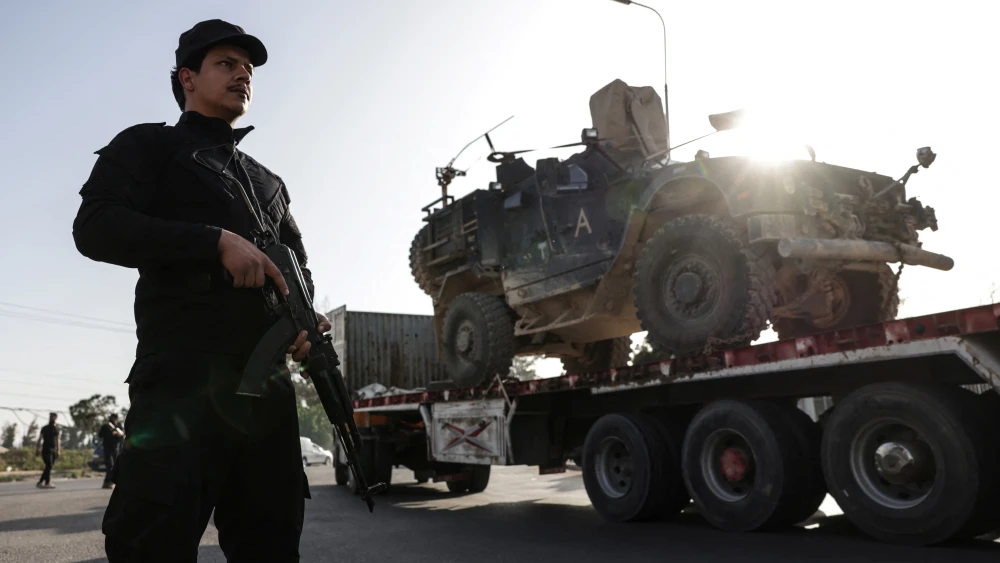
Damascus chose to disregard the warning, continuing instead to pursue Iranian weapons shipments moving along the so-called “land bridge” from Iran through Iraq to the Lebanese border, while actively working to disrupt Hezbollah’s logistics network inside Syrian territory. Syrian security forces intercepted a major Iranian arms shipment at the Al-Tanf crossing on the Iraqi border, concealed inside an oil tanker bound for the Banias refinery and destined for Hezbollah in Lebanon. A separate shipment of Grad rockets, long-range missiles and advanced drones, smuggled across the same Iraqi corridor from stockpiles held by Iranian-backed militias, was also seized.
This anti-Iranian, and by extension anti-Hezbollah, posture reflects a broader Syrian orientation that has hardened as regional hostilities have escalated. From its earliest days, the interim government in Damascus pursued a deliberate policy of distancing itself from Tehran, prompting Iran’s threat as an attempt to deter Syria from lending active support to the U.S.–Israeli campaign against Hezbollah. Hezbollah Secretary-General Naim Qassem floated a reconciliation proposal, essentially urging both sides to “let bygones be bygones,” but Damascus declined to take the bait. Instead, Syria deployed more than four divisions, including former fighters who had taken part in the campaign against Bashar Assad, along its border with Lebanon, targeting areas long used as smuggling routes for weapons, fighters and narcotics.
Tensions deepened further once Tehran recognized that Damascus was openly backing Lebanese state efforts to disarm Hezbollah while simultaneously conducting sweeps against Iranian-backed supply lines along the border. It remains far from clear, however, that Iran would actually strike inside Syria, or what threshold would trigger such a decision. Still, in a regional environment where strategic logic often gives way to improvisation, Iran has targeted several of its neighbors, including sites inside Jordan, suggesting that an operation against Syria cannot be ruled out.
A fragile state in the making
Damascus, for its part, is far from passive. Under the interim government of President Ahmed al-Sharaa, the geopolitical landscape surrounding Syria has come to revolve around several interlocking dynamics, chief among them the Israeli-Syrian effort to manage border security, sovereignty and regional proxy threats. Central issues include halting the transit of Iranian arms to Hezbollah, establishing a demilitarized buffer zone in southern Syria, and addressing the deep Israeli military incursions and airstrikes conducted across Syrian territory since Assad’s fall. Despite persistent tensions on the ground, Syria, Israel and the United States signed the Syria-Israel Joint Communication Mechanism Agreement in Paris in January 2026, establishing a “Joint Fusion Mechanism” to coordinate intelligence, prevent military miscalculation, and manage border friction. A comprehensive peace and security treaty, however, remains stalled over conflicting demands regarding the Golan buffer zone.
Yet the new Syrian regime remains far from consolidated. The unity Damascus projects to the outside world conceals a military structure still built from former factions, regional commanders and armed groups whose loyalties were forged during the civil war and have not automatically transferred to a unified national command. The 62nd Division, commanded by Mohammed al-Jassem, known as Abu Amsha, and built around the former Turkish-backed Sultan Suleiman Shah formation, exemplifies this structural weakness. Reports of friction and even outright insubordination among commanders of such formations should be read as a meaningful warning sign, even where individual claims are difficult to verify independently. The core issue is that the new Syrian army has yet to become a genuinely homogeneous national institution; Damascus still has to demonstrate that it can impose an undisputed chain of command over powerful field commanders who retain their own fighters, local networks and foreign patrons.
This internal fragility is compounded by the unresolved sectarian question. The bloody confrontations involving the Druze in Sweida, alongside the massacres and retaliatory violence targeting the Alawite community, have shown that Assad’s fall did not automatically produce a stable or inclusive political order. Government forces, affiliated armed groups, tribal formations and local militias have all been implicated in serious abuses. The scale of the violence, and the limited accountability that has followed, raises legitimate questions about the capacity and the willingness of the new authorities to protect minorities and discipline the armed formations acting in their name. Washington and European governments have condemned some of these episodes, but their broader policy has remained focused on stabilizing and reintegrating Damascus. In practice, the West appears willing to tolerate a great deal to prevent Syria from collapsing again and to keep it out of Iran’s orbit.
This Western tolerance is particularly striking in the economic sphere. The United States and Europe moved swiftly to remove or suspend much of the sanctions architecture that had isolated Syria, opening the door to reconstruction, investment and diplomatic normalization, well before the new regime had built a track record of political inclusion, minority protection or full accountability for abuses committed during the transition. Damascus offered assurances and benefited from its break with Iran, but the sanctions relief it received arguably outweighed the concessions it delivered in return. Ahmed al-Sharaa thus secured one of the most valuable instruments of international legitimacy and economic recovery at a relatively early stage of the transition.
The Turkish question
Closely related to both of these dynamics, Turkey has emerged as Damascus’s primary security partner. Under formal defense and advisory agreements, Ankara is actively training and restructuring the Syrian national army: the Turkish Armed Forces are providing commando training, establishing military academies and helping integrate Syrian forces, including the absorption of SDF-administered, Kurdish-held areas west of the Euphrates into state control.
This Turkish dimension deserves particular attention from Israel. Ankara’s role goes well beyond political sponsorship: Turkey has become deeply involved in training, advising and rebuilding the Syrian armed forces, and Turkish officials have openly discussed supplying the new army with weapons and military assistance. There has also been discussion of an additional Turkish military deployment, potentially including the use of Syrian bases or the stationing of air and air-defense assets. Such a development would fundamentally alter the strategic equation, placing the armed forces of a powerful regional state much closer to Israel’s borders and sharply constraining Israel’s freedom of action over Syrian airspace and territory.
Preventing Syria from becoming a Turkish forward military position should therefore be a central Israeli objective. Turkey is not Iran and should not be treated as such by default, but neither should Israel assume that Turkish and Israeli strategic interests in Syria will remain aligned indefinitely. Ankara’s growing influence over the Syrian army, combined with its political relationship with al-Sharaa, could eventually allow Turkey to shape the military balance across southern and central Syria. Israel should therefore insist that any emerging security arrangement with Damascus include clear limits on foreign military deployments, particularly Turkish combat aircraft, air-defense systems and permanent bases that could constrain Israeli operational freedom.
Russia steps back
Damascus and Moscow reached an agreement in August 2026 to formally restructure Russia’s long-standing military presence in the country. Under the deal, Russia is relinquishing sole military control, and Khmeimim Air Base and the Tartus naval facility, including its commercial berths, are being converted into joint Syrian-Russian training centers and civilian-managed infrastructure.
Israel’s positions and US pressure
Israel, for its part, continues to hold positions inside Syrian territory following the collapse of the Assad regime, arguing that these deployments are necessary to keep hostile forces away from its border and to preserve a security buffer in an exceptionally unstable environment. Maintaining this position diplomatically, however, is likely to become increasingly difficult. Washington has already pressed Israel to begin redeploying from Syrian territory, while Damascus and other international actors continue to demand a return to the arrangements that preceded Assad’s fall. Growing American and European pressure on Israel to withdraw, as negotiations with Damascus advance, should therefore be expected. Israel should not surrender strategically valuable positions in exchange for promises alone; any withdrawal should instead be tied to enforceable security arrangements: demilitarization, protection of the Druze population in southern Syria, prevention of hostile deployments, and credible guarantees regarding foreign military forces.
The American and Saudi role
The American administration functions as the central diplomatic mediator, facilitating the Syria-Israel talks, and as the anchor of counter-ISIS security efforts. Saudi Arabia is coordinating political and economic backing, helping pull Damascus out of Iran’s orbit while offering a financial bridge for Syrian recovery. President Donald Trump appointed Tom Barrack, the U.S. ambassador to Turkey, as special presidential envoy for Syria and Iraq. In this dual role, Barrack oversees U.S. diplomatic engagement in Damascus and Baghdad, coordinating border security, economic alignment, and the dismantling of Iranian militia networks. He is deeply involved in day-to-day policymaking and, in effect, holds many of the cards shaping Syria’s geopolitical positioning amid the broader transformation now underway across the Middle East.
The bottom line for Israel
Syria thus presents Israel with both an opportunity and a risk. On one hand, the removal of the Assad regime from Iran’s axis, the interdiction of Iranian weapons routes, and Damascus’s willingness to confront Hezbollah’s logistics network could all help forge a regional balance against Tehran. If sustained, Syria’s separation from Iran could sever one of Hezbollah’s most important strategic lifelines and make rebuilding the organization’s military capabilities far more difficult. This is a development Israel has every reason to encourage.
On the other hand, Israel should not mistake a temporary convergence of interests for a durable strategic alliance. The al-Sharaa regime remains internally fragile, its army is still being assembled from competing armed formations, sectarian tensions remain unresolved, and Turkey is rapidly expanding its military and political footprint. Israel should therefore monitor developments closely and avoid extending concessions to Damascus in exchange for declarations of moderation alone; every Israeli concession should be matched by a concrete, verifiable Syrian commitment. Above all, Israel should make clear that replacing Iranian military influence with a significant Turkish military presence is not an acceptable strategic outcome. The objective should be a stable Syria that blocks Iran and Hezbollah, respects its minority communities, and does not become the forward military platform of another regional power.


