
In the aftermath of the Israeli airstrike on a Syrian airbase, reportedly to prevent the installation of an advanced Turkish radar and surface to air missile system that could have jeopardized Israeli Air Force freedom of movement, Jerusalem continues to view Ankara’s ambitions in Syria with deep suspicion.
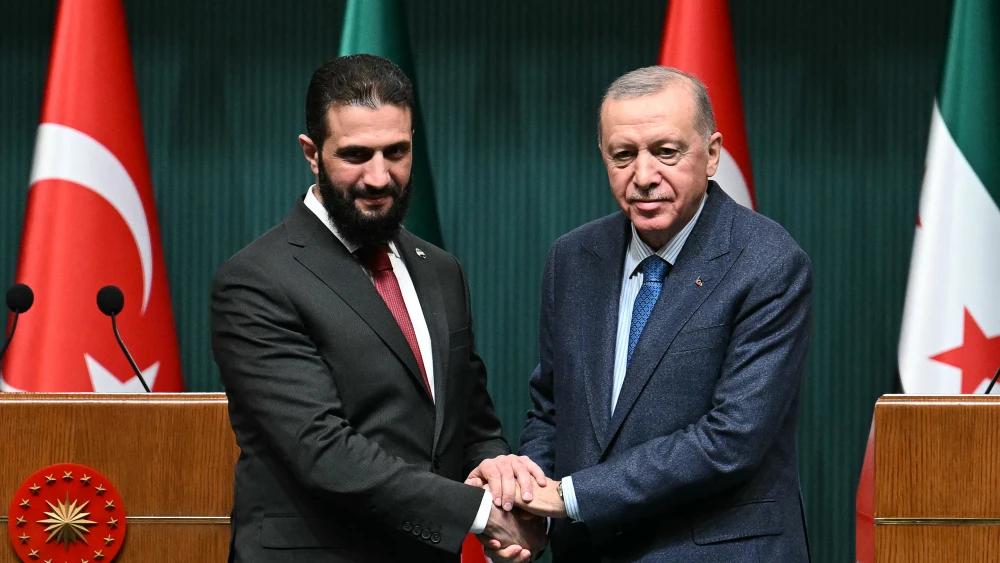
President Recep Tayyip Erdoğan is following a neo-Ottoman trajectory seeking to assert Turkish dominance throughout the region, with Syria in particular in his sights following the December 2024 rise to power of Ahmed al-Sharaa and Hayat al-Tahrir, whom Turkey had backed for years as rebels against the Assad regime.
Lt. Col. (res.) Marco Moreno, a former senior officer in the IDF Human Intelligence Unit 504 responsible for the Lebanon and Syria arenas, told JNS that Israel’s Aug. 18 strike on the Abu al-Duhur airbase in Idlib, not far from the Turkish border, showed that Jerusalem sees Damascus’s rebuilding of its military relationship with Ankara as an immediate strategic concern.
Moreno, who established and commanded “Operation Good Neighbor” from 2012 to 2016, which provided humanitarian aid to Syrians during the civil war, said the airstrike demonstrated that “a strategic Syrian decision has been made to link up with Turkey in order to rebuild the Syrian army’s military capabilities, with an emphasis in the first stage on its air array, air force and air defense.”
He said Turkish intelligence has become highly influential inside Syria, both in helping rebuild the government and in helping preserve it. Reports that Turkey intended to transfer an anti-aircraft system to Syria raised the possibility of capabilities that could challenge Israel’s freedom of action in Syrian airspace, he said.
“The IDF uses Syria as a transit route to Iran,” Moreno said, arguing that the reported Turkish role showed Ankara had established a major foothold in Syria after replacing Iran as the central external player.
For Israel, Moreno said, the risk lies not only in Syria’s own rearmament, but in the prospect of an increasingly permanent Turkish military presence on territory close to Israel’s northern frontier.
He described Turkey as a “turning point state” in Israeli military terminology, short of a declared enemy state, but moving in that direction. If Turkish military power becomes embedded in Syria, “an advanced military presence is moving toward us,” he said.
Moreno said this would be strategically harmful for Israel over the long term and praised the Israeli action at Abu al-Duhur as a firm effort to prevent the development before it took root.
Moreno added that the Syrian regime’s conduct toward minorities is unlikely to change for the better. “This regime is made up of jihadist figures. That is their DNA, starting with the president and throughout his cabinet and advisers,” he said. Moreno predicted continued pressure on Druze, Christians and Alawites, arguing that the senior figures around al-Sharaa are shaped by their past service in Sunni jihadist organizations.
Syrian state media said Israeli aircraft carried out eight strikes on Abu al-Duhur early on Aug. 18, hitting runways and storage facilities, while Turkey condemned it as an act of aggression against Syrian sovereignty.
The United States is working to establish a trilateral deconfliction mechanism for Israel, Turkey and Syria. On Tuesday, Defense Minister Israel Katz visited the Israeli-controlled peak of Mount Hermon in southern Syria, stating, “We will not budge from the Hermon and from the security zone so long as there are jihadist threats to the State of Israel. The message to the Syrian president is clear: When you wake up in the morning in the Damascus palace and look up the Hermon and see the IDF, you know we are here to protect our communities and border.”
Doesn’t want to be a Turkish puppet
Professor Eyal Zisser, vice rector of Tel Aviv University and holder of the Yona and Dina Ettinger Chair in Contemporary History of the Middle East, told JNS that the emerging Syrian order cannot be reduced to a simple picture of Turkish control.
Al-Sharaa is deeply dependent on Turkish President Recep Tayyip Erdoğan, Zisser said, because Erdoğan supported him while he led a rebel movement in northern Syria and remains essential to Syria’s stabilization and reconstruction of state power. “But I do not think he wants to be a Turkish puppet,” the professor said.
Al-Sharaa is grateful to Ankara and will have to accept Turkish dictates, Zisser said, but he is also trying to maneuver around that dependence by improving ties with Gulf states, especially Saudi Arabia, drawing closer to the United States and engaging Israel.
That balancing effort helps explain why Damascus has sought diplomatic engagement with Gulf states such as Saudi Arabia, moved closer to the United States, and held a dialogue with Israel, Zisser assessed. “The picture, in short, is complex,” he said.
Zisser said the same duality defines the nature of al-Sharaa’s government. Al-Sharaa “rose with the support of personnel, some of whom remain jihadists, and he continues to depend on them, Zisser said. “On the one hand, he understands that he needs to show pragmatism; on the other, these are his people, and in some cases he thinks like them,” Zisser said. The result, he added, is likely to be pragmatic rhetoric accompanied by continued incidents involving undisciplined members of his armed forces.