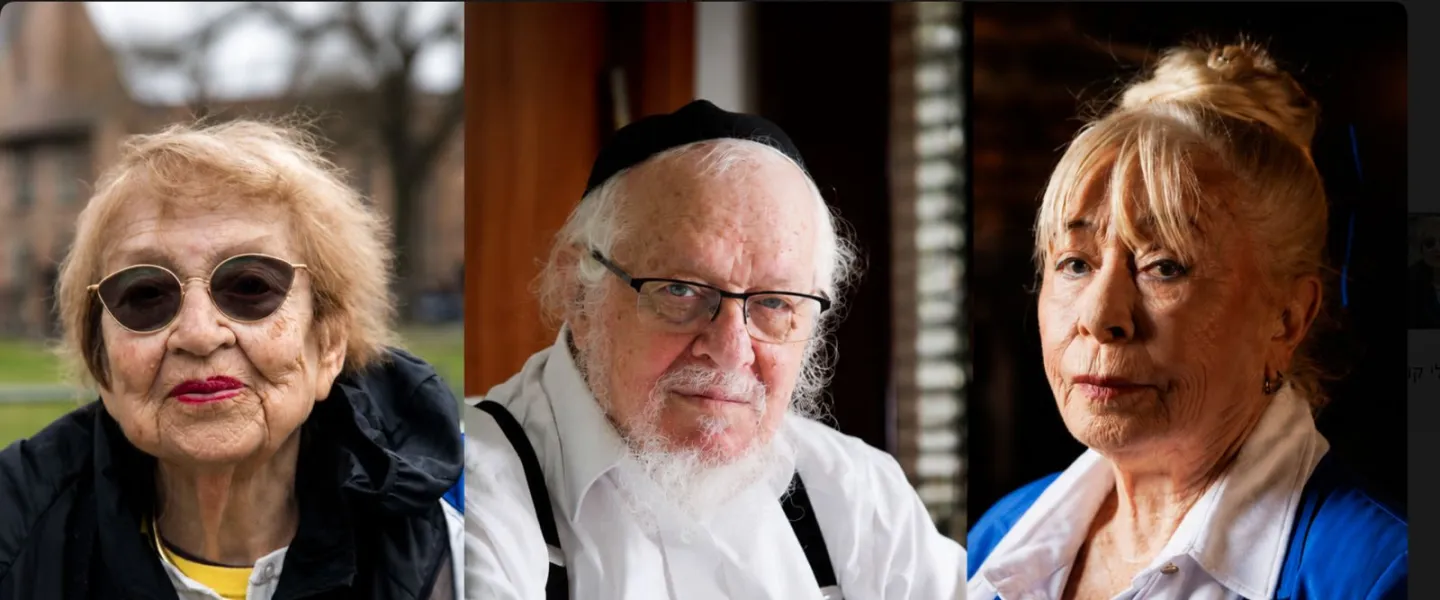
Ahead of Tisha B’Av, which begins at sundown on Wednesday and lasts after nightfall on Thursday, three Holocaust survivors who participated in the International March of the Living are urging Israelis to reject internal division and embrace national unity. The annual Jewish holiday, marked with a 25-hour fast, commemorates the destruction of the First and Second Temples in Jerusalem.
The three survivors, all of whom witnessed the destruction of European Jewry as children before rebuilding their lives in Israel, shared with JNS their concerns about the future of the Jewish people, warning that growing internal divisions threaten Israel’s resilience and the unity of the Jewish people.
International March of the Living Chairman Shmuel Rosenman said the survivors’ message carries particular weight.
“When Holocaust survivors issue a warning, we must listen. When they are so deeply concerned, we must reassure them. They witnessed with their own eyes the destruction of Jewish communities across Europe and North Africa, then came here and helped build the Jewish national home.
“They remember the early years of the State, when Jews from across the world gathered together, and no one asked whether you were religious or secular, right-wing or left-wing. Everyone understood that we shared one destiny.
“Their message for Tisha B’Av is a reminder that the state cannot endure without the same sense of mutual responsibility upon which it was built.”
Avraham Blau
Holocaust survivor Avraham Blau, 85, was born in wartime Hungary. He survived the Holocaust as a young child in the Budapest Ghetto, where he experienced antisemitism at the hands of Hungarians. He remembers the battles over the city and the harsh conditions. By the time Budapest was liberated, he was on the verge of death at just four years old.
Blau later made aliyah to Israel, enlisted in the Nahal Brigade and fought in Israel’s wars. Today, he lives with his wife in Bnei Brak. Over more than four decades, he served as a teacher, school principal and educational supervisor, and has authored 12 books on the Bible and Jewish history.
“The division within the Jewish people worries me more than the Iranian threat. Three weeks ago, I traveled abroad for my grandson’s wedding. I saw an elderly Jewish man, approached him to offer assistance, and he replied that he did not want any help from me, a Haredi Jew. I wasn’t angry with him. The hatred between brothers that exists among us deeply concerns me.”
Despite the current situation, Blau remains optimistic.
“The ‘eternity of Israel will not lie,’” he said, invoking the biblical prophecy (from 1 Samuel 15:29). “We have built and achieved so much, in the world of Torah and in the world of science. No other nation could have accomplished this. I believe that as long as the candle is still burning, it can be repaired, and the responsibility lies with each and every one of us.”
His message for Tisha B’Av is: “The Temple was destroyed because of baseless hatred. Increase baseless love. Let every person strive to connect to Jewish heritage in whatever way they believe is right, and let each person take upon themselves something that connects them to the Jewish people.”
Dvora Weinstein
Dvora Weinstein was born in 1936, three years before the outbreak of World War II, in Bessarabia-Bukovina, where her town was home to some 7,000 Jews. When the war reached the area, the Jewish community was left defenseless. Many were murdered and the town was burned down. Weinstein and her family marched for months through freezing conditions, enduring severe hardship, and she lost many relatives. When the war ended, she was 9 years old. She made aliyah in 1948.
“Internal division is our greatest danger. Over the past decade, we have lost the value upon which this country was built: mutual responsibility. I remember my childhood in the transit camp. People from every corner of the world lived together, surrounded by a mix of languages, smells and flavors. We didn’t always understand one another, but we lived together. Life was difficult, but we knew our lives depended on one another. That was the value that united us as a people, and it has disappeared.
“After [Israeli Prime Minister Yitzhak] Rabin’s assassination, we experienced a great fracture, but we managed, through tremendous effort, to mend it. Over the past decade, internal division has spiraled out of control. There is dangerous violence among us.
“Today, we are in the same situation as the destruction of the Temple. One person hates another, and we can no longer find a common language. Everyone lives at the other’s expense, and there is no mutual respect. It is painful for me to see.”
Weinstein said Israel has been central to her life since childhood.
“The State of Israel is everything to me. It is the reason I am alive. The dream of reaching the Land of Israel is what kept me alive as a child during the Holocaust. Whenever I was close to death, my mother whispered to me, ‘You must stay alive so you can reach the Land of Israel.’ And I did. The Land of Israel became the lifeline for my mother and me after we were left alone, having lost our entire family in the Holocaust.”
Her message to the younger generation is: “Do not take the State of Israel for granted. Don’t look for a second passport. Stay in this country and fight for it. There is nowhere else in the world where we can live safely as Jews. This is our only home. The responsibility to protect the State now passes to you.”
Rina Akselbrad
Rina Akselbrad was born in Poland in 1933. Her father and grandfather were murdered in mass shootings, while she and her mother survived. They lived in the ghetto before hiding together in an underground pit for 18 months. After the war, she made aliyah to Israel, served in the Israel Defense Forces and later worked as a kindergarten teacher. She married a Holocaust survivor and partisan; together, they raised seven children.
Akselbrad is also deeply concerned by internal division, but said she is even more worried by Israel’s growing international isolation.
“What worries me is that countries which once supported Israel now condemn it openly and without empathy. This is also spilling over to ordinary people around the world. I see the demonstrations against the State of Israel, and it frightens me that antisemitism is raising its head again. In the past, we traveled abroad proudly as Israelis. Today, we feel we need to hide it.
“I am also concerned about Israelis leaving the country at a time when the world is becoming increasingly antisemitic. We need everyone here, fighting for the country from here.
“The division among us is a threat, but I am not afraid of it in the long term. I am confident that we will know how to put our disagreements aside once the leadership acts against the division. The responsibility rests with each and every one of us. It is in our hands.”
She added: “The State of Israel is like magic to me. Every day I appreciate that it exists, and I rejoice in its existence. I see the State of Israel as a protective wall for the Jewish people. We must never take this country for granted. We lived without a Jewish state, and that is why we fight for it. We should be grateful that we have a country and protect its existence with all our strength.
“As a kindergarten teacher and as a mother, I always made sure to instill and encourage a love of the land in children. This is my message for Tisha B’Av: Love the country, love one another and fulfill the commandment, ‘Love your neighbor as yourself.’”