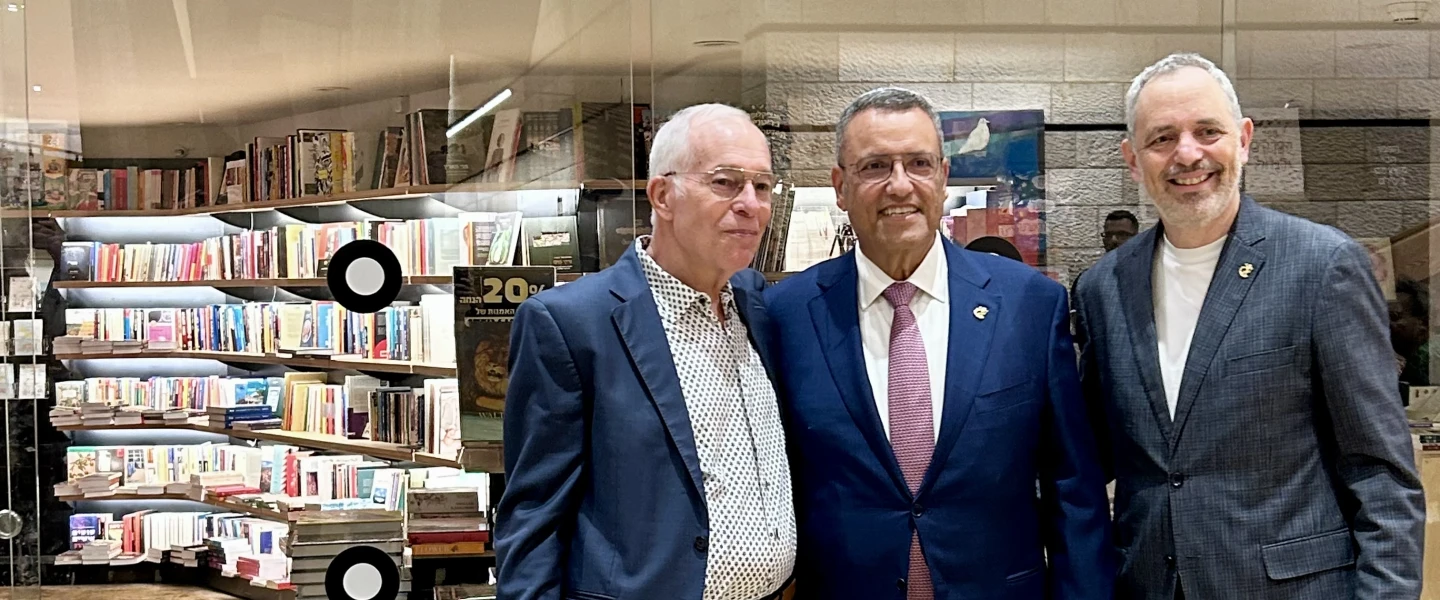
Relatives of Harry Levine, a key American Zionist figure of the 20th century, gathered on Wednesday evening at the Jerusalem Theater to inaugurate a gallery they hope will inspire visitors with his values.
Funded by Levine’s great-nephew, Marc Shmuel Levine, who goes by his Hebrew name, Shmuel, the Marc Shmuel Levine Gallery features “Soldier of Hope,” a bronze work by artist Ben Dror, alongside a large-scale painting of the Jerusalem landscape.
The project was coordinated by the Jerusalem Foundation, the Jerusalem Municipality and the Jerusalem Theater and includes a donation by Shmuel Levine to fund cultural programs for children, families and adults from every sector of the capital.
For Shmuel Levine, a Jerusalem resident who made aliyah in 2022, the project is more than a family memorial.
“Uncle Harry was my role model,” he told JNS, describing his uncle’s profound influence on his own Jewish identity and commitment.
Helping arm the Haganah
In the years leading up to Israel’s independence, Harry Levine used his business connections and considerable resources to help finance and equip the Haganah, the pre-state Jewish defense organization. His clandestine work included acquiring surplus World War II materials, arranging their shipment to Mandatory Palestine and helping secure the design and manufacturing equipment for a powerful automatic weapon.
Those efforts, including the smuggling of machinery into the Land of Israel, are chronicled in Leonard Slater’s The Pledge, an account of the covert American effort to help supply the Jewish struggle for statehood.
But Levine’s vision extended well beyond the battlefield.
A close friend of Chaim Weizmann, Israel’s first president, Levine helped establish the Weizmann Institute of Science in Rehovot, founded its American Committee and served as a lifelong governor of the institute. According to Shmuel Levine, Weizmann affectionately called his uncle “the boss.”
By the 1950s, Harry Levine was already working on desalination, recognizing the importance of water and technology for Israel’s future.
“He’s planning for the future. This is what he did,” Shmuel said.
As a boy, Shmuel recalled being astonished when his parents told him how much money his successful uncle gave away. As he grew older, astonishment turned to admiration for a man who understood what Jewish sovereignty meant after 2,000 years of exile, and who was prepared to risk his wealth and life to help make it possible.
“He was one of the biggest influencers I’ve ever been exposed to in my life when it comes to my Jewish commitment,” Shmuel told JNS.
Shmuel distilled that example into a rule for his own life: “If I can help people, I must. If I can, I must.”
‘A story of daring and dedication’
Harry Levine’s granddaughter Gayle Meyers, who lives in Jerusalem, said she had known from childhood that she belonged to “a story of daring and dedication in the founding of Israel.”

That story, she said, continues in the Weizmann Institute’s Applied Science Building, in generations of youngsters who attended Camp Young Judaea, which her grandfather helped found, and in Israeli high-tech companies realizing his belief that science could drive the country’s economy.
Jerusalem Mayor Moshe Lion called the gallery a fitting tribute to a man who understood the need for “a strong and secure Jewish state.” He praised Shmuel Levine for continuing that commitment by opening cultural and educational opportunities to Jerusalemites of all ages.
For Shmuel Levine, the obligation to carry that legacy forward has an intensely personal dimension. Born on May 1, 1945, hours after Adolf Hitler’s death, Levine said he came to understand that while he was taking his first breath, Jews in Europe were taking their last.
“This had an impact on me. ‘I have to do my part,’” he recalled telling himself.
Shmuel Levine wants visitors to look at the sculpture, learn what a businessman from a small Massachusetts town helped accomplish and ask what they themselves can do.
His message: “Stand up, speak out, take action.”