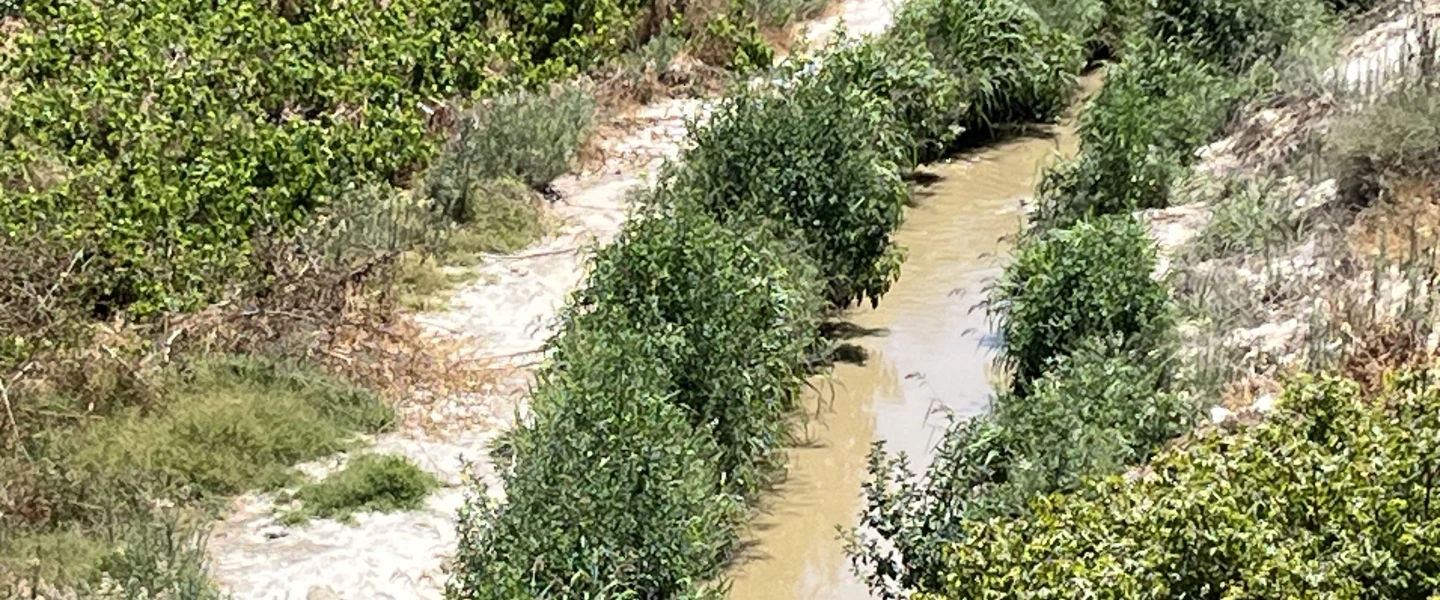
The 43-kilometer-long (26.7-mile) Hebron Stream, which begins near Hebron and flows south until joining the Beersheva Stream, is a seasonal waterway. It typically flows during the winter months following rainfall and dries up during the summer.
However, on Tuesday, a hot summer day, standing alongside the stream near the community of Otniel in the southern Hebron Hills, it was clear the waterway was still flowing strongly.
But the putrid smell in the air and the absence of wildlife revealed a troubling reality. The stream was not carrying clean water but rather a polluted mixture of sewage and “roba” stone slurry, allegedly dumped illegally into the waterway by wildcat stone factories in areas under the Palestinian Authority (P.A.).
These were among the findings observed by JNS during a tour for journalists organized by the Regavim Movement and the Green Now environmental protection organization.
Regavim and Green Now last month filed a petition against government ministers and enforcement bodies, demanding action to shut down the polluting factories, particularly those operating in Area C, which is under Israeli responsibility.
Green Now CEO Barak Werker explained that much of the pollution originates from the P.A.’s Hebron-area stone industry, which includes numerous stone-cutting factories and illegal quarries. The factories process locally quarried limestone into construction materials, producing large quantities of the roba byproduct.
Werker said many of these facilities lack the infrastructure needed to properly separate and dispose of the roba, leading some operators to discharge the stone waste mixed with wastewater into nearby streams. He added that enforcement and oversight have been insufficient.
In other parts of Israel, Werker explained, stone-cutting byproducts must be separated from wastewater before treatment because roba cannot be effectively processed by conventional sewage treatment facilities and can clog infrastructure.
Werker also pointed to the European Union-funded wastewater treatment plant in the Hebron-area town of Yatta, which was designed to treat conventional municipal sewage but, he said, cannot function properly with wastewater containing high concentrations of roba. As a result, he said, the facility has remained unused while pollution bypasses the treatment process and continues downstream.

Environmental costs
The contaminated Hebron Stream eventually reaches the Meitar Catchment Facility, northeast of Beersheva, where roba and heavy solids are removed. The wastewater is then transferred to the nearby Shoket Wastewater Treatment Plant, where it is combined with Israeli municipal wastewater and undergoes biological treatment.
Following treatment, the reclaimed water is incorporated into Israel’s treated wastewater system and is generally reused for agricultural purposes rather than continuing downstream as untreated sewage.
However, Werker warned that the environmental damage along the stream’s route before treatment at Meitar has been severe, with polluted flows contributing to widespread mosquito infestations, harming wildlife and vegetation, and degrading the surrounding ecosystem. He estimated that the cost of environmental rehabilitation could reach hundreds of millions of shekels.
Perhaps most importantly, he said the environmental impact extends beyond the stream itself.
“One of the biggest issues is the 68 million cubic meters of sewage a year going straight into the Mountain Aquifer,” he said, referring to the underground water system that serves as one of Israel’s most important natural freshwater sources.
Environmental experts have long raised concerns that pollution in the Hebron Stream watershed could threaten groundwater resources, as parts of the basin are located in areas where contaminated surface water can seep through the region’s porous limestone formations and reach underground aquifers.
Werker said this reality has forced Israel to stop pumping water from certain wells, reducing the availability of clean, usable water.
He stressed that environmental hazards do not recognize boundaries, whether between Areas A, B and C in Judea and Samaria or beyond. Whether air pollution, water pollution or other environmental hazards, he said, they affect the entire country.

Naomi Kahn, director of Regavim’s International Division, who guided the tour, said another catchment facility similar to the one in Meitar was needed much closer to Hebron, where the water-slurry mixture could be treated before reaching Yatta.
However, she said the underlying issue was the operation of the stone factories themselves, which she described as operating illegally without adequate oversight and failing to handle the stone byproduct properly.
“It’s a vicious cycle,” Kahn said. “The price of the final product is cheaper for consumers because these factories do not pay for environmental protection measures.”
She explained that Israeli consumers also benefit from the lower-cost materials, as market demand often favors cheaper products.
“This keeps the P.A.’s economy afloat and feeds into the Israeli economy through lower-cost materials—at the expense of the environment,” she said.
Calls for action
The group was led farther south along the stream into a valley near the P.A. village of Dahariya. There, Werker pointed to what he described as “massive abuse” of the environment, including large deposits of roba that had washed downstream and hardened into mounds stretching across the area.
He stressed that the untreated waste could “strangle Israel’s water purification systems” by clogging treatment infrastructure and making wastewater processing more difficult and costly.
Along the streambed, the group also observed piles of garbage and rotting animal carcasses. Werker pointed to bags containing animal parts, which he said came from a nearby slaughterhouse and had been dumped along the stream, creating a strong stench. The area also showed signs of what appeared to be widespread illegal garbage burning.
The group then traveled to Meitar to view the catchment facility firsthand. Werker said it has been effective in removing roba from the wastewater before it continues to the Shoket treatment plant. However, Kahn warned that “the facility is maxed out.”
Werker explained that during periods of heavy winter rainfall and flooding, when flows exceed the facility’s capacity, the wastewater-and-slurry mixture can bypass treatment and continue downstream, eventually reaching the Beersheva Stream.
He said a newly opened park in Beersheva was forced to close only months after opening because polluted flows carrying the material reached the stream running through the area.
The group then met with Ayala Bar-On, director of the international desk for the Har Hebron Regional Council. Bar-On, who lives in the South Hebron community of Teneh Omarim overlooking the Hebron Stream, urged officials to take meaningful steps rather than symbolic measures to address the environmental damage.
“You can’t deal with cancer with a band-aid,” she said.
Kahn argued that the Israeli government must act to address the environmental damage caused by the stone factories.
“When you have jurisdiction and you don’t take responsibility, you’re creating a black hole,” she said. “If you don’t govern, bad things fill the vacuum, and you end up with chaos—environmentally, politically and from a security perspective.”
Werker said one way to address the environmental crisis would be for Arab municipal officials to work directly with Israel, bypassing what he described as the P.A.’s bureaucracy and political considerations. He contended that the P.A. was “not a partner” on environmental issues but rather “part of the problem.”
At the same time, he acknowledged that local Arab officials could be putting themselves at risk by opening direct channels of communication with Israel.
“The biggest tragedy is that the Palestinians rely on the E.U. instead of working with Israel, which is the one that can truly help them on these issues,” he said.
Nevertheless, Werker said he remains optimistic, adding that he believes there is growing recognition of the problem at both the municipal level and among ordinary Palestinians.
“I think we are starting to see a blessed change,” he said.