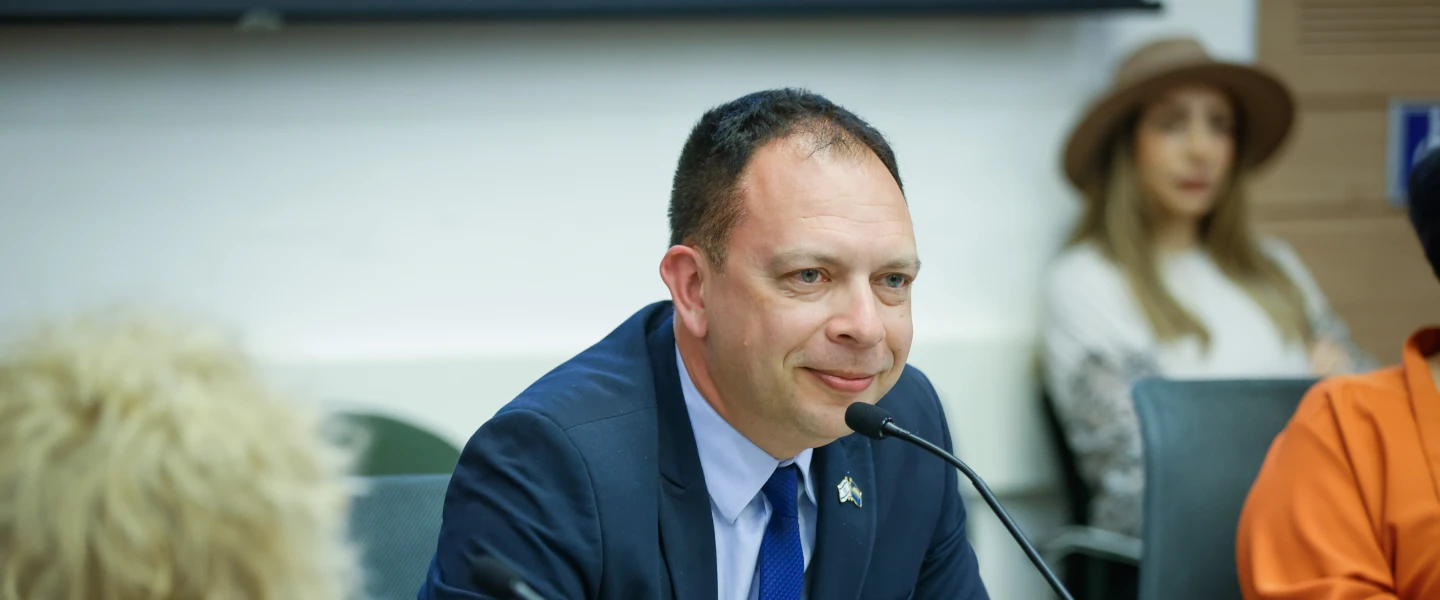
Arab parties and Haredi factions will not be part of Israel’s next government, Yesh Atid Knesset member Vladimir Beliak told JNS recently, saying only Zionist parties can be part of a coalition tasked with rehabilitating the country.
“Our mission is to form a broad national Zionist government and secure 63 to 64 mandates [in the 120-member legislature] with all our partners,” Beliak said.
He spoke as Israel’s political landscape continues to shift ahead of the Oct. 27 election. In April, former Prime Ministers Naftali Bennett and Yair Lapid announced they would run together on a joint electoral slate, Together (“Beyachad” in Hebrew). The alliance is projected to win 13 Knesset seats, according to a recent Kan News poll, down from earlier surveys.
Between 2019 and 2021, Bennett served as prime minister under a rotation agreement with Yesh Atid Party head Lapid, who succeeded him in the role before the coalition collapsed in late 2022. The government was notable for including Mansour Abbas’s Arab-majority Ra’am party as a coalition partner.
In the 24th Knesset that held office in 2021-22, during the Bennett-Lapid coalition, Beliak chaired the Knesset Caucus for Self-Employed Individuals and Small and Medium-Sized Businesses in Israel, as well as the Caucus for Immigrants from the Former Soviet Union and Their Descendants.
Netanyahu returned to power after the 2022 election, forming a right-wing government led by his Likud party.
An accountant and jurist by profession, Beliak immigrated to Israel from Kemerovo, Russia, in 1998 at the age of 25. He became involved in politics after Lapid founded Yesh Atid in 2012, joining the party a few months later.
Compensation for redeemed Gaza captives
In the current 25th Knesset, where he serves as an opposition lawmaker, Beliak said he is most proud of a law he passed together with MK Gilad Kariv of The Democrats and MK Yitzhak Kroizer of Otzma Yehudit to increase financial compensation for hostages who returned from captivity in Gaza after being held by Hamas and other terrorist organizations.
“In the first [hostage-release] deal, in November 2023, when the women and children were released, we realized that they were only receiving 1,300 shekels [about $425] per month. Obviously, that was not enough, so we worked throughout 2024 and passed a bill that increased the monthly payments for each hostage to 9,000 shekels [around $2,950] for life and made them eligible for a one-time grant of 60,000 shekels [some $19,700],” Beliak told JNS.
“The package also included eligibility for recognition as disabled and access to related benefits. It’s never enough, but at least we did what we could,” he said.
Beliak said that, as a member of the Knesset Finance Committee, he worked to increase wartime compensation for small businesses and local chains, helping to secure an increase in the budget from 4.5 billion shekels ($1,475 billion) to 17 billion shekels ($5,575 billion).
“There were businesses at the beginning of the war that had not even recovered from COVID-19 yet. The Finance Ministry benefits were temporary, but in the north, people still have not returned to working full-time between the rounds of fighting,” he said.
As a member of the Knesset Committee for Immigration, Absorption and Diaspora Affairs, Beliak said he worked to prevent cuts to programs for immigrant students. He also addressed telephone scams targeting the elderly and new immigrants.
The biggest issue Israel has faced since Oct. 7, Beliak said, is none of the security arenas has been definitively resolved.
“Hamas is still controlling some areas in Gaza. In the north, there is a ceasefire, but no one knows whether it will hold. Hezbollah is still not disarmed,” he said.
Regarding Iran, with countries such as Pakistan—which do not have diplomatic ties with Israel—serving as mediators, Beliak said Israel is only able to influence developments from the margins. He added that the nuclear issue remains unresolved and that Iran’s ballistic missile capabilities are not being addressed.
“The threats remain,” he said.
For Beliak, the upcoming Knesset election will focus on issues including whether to establish a state commission of inquiry into the Oct. 7 attacks, the cost of living, the education system and the rehabilitation of Israeli society.
He downplayed the relevance of the two-state solution, noting that a political breakthrough appears unlikely in the short term.
“I don’t think that after Oct. 7 there is a reason to talk about a Palestinian state, because it will not happen in the foreseeable future. We need to discuss security and regional alliances. There is a lot to do in that respect, potentially in relation to an agreement with Saudi Arabia and the expansion of the Abraham Accords,” he said.