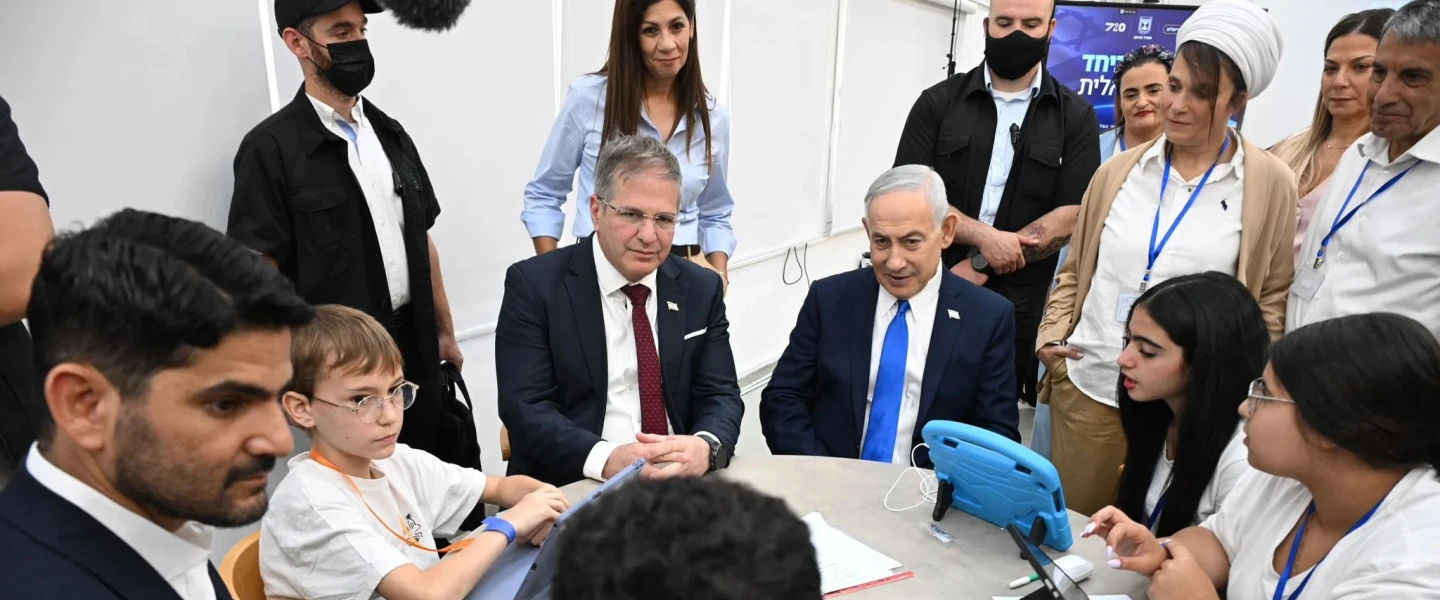
Israel’s Education Ministry is attempting to rebuild the classroom around personalized AI, launching an initiative called Project 720. According to information provided by the ministry, the guiding vision is to “leverage Artificial Intelligence to empower learner agency, academic excellence, and the resilience of both students and educators,” driving personal growth while “bolstering the nation’s social and economic resilience in an ever-changing era.”
The name refers to giving both students and teachers a complete, 360-degree view of learning (doubled to 720 to cover both sides of the classroom). What began as a 28-school pilot during the 2025-2026 year in 17 local authorities has this year already expanded to more than 180 schools, with some 300 more having applied to join.
“It’s not about the technology, it’s not about AI,” said Meirav Zerbib, deputy director-general and head of the ministry’s Innovation and Technology Administration, in an interview with JNS. “It’s about the relationship between students and teachers.”
The development comes on the backdrop of Israel’s public education system recently posting its worst results in a quarter-century of international testing. The country’s average score across reading, math and science dropped significantly in the published 2025 PISA results, representing the second-sharpest decline of any country and leaving Israel ranked 43rd globally, down from 38th in 2022.
A different kind of classroom
The classroom redesign sits inside a far larger strategy aligned with the government’s overall National AI Program. “Prime Minister Netanyahu said it clearly—personalization is one of his visions for education,” Zerbib said. “It’s not only the vision of the Ministry of Education; it’s the vision of the prime minister ... We’re the main pillar of the national strategic plan relating to human capital.”
Zerbib described a memory from a visit to one of the pilot schools about a year ago. She had asked a student what the program meant to her.
“She said, ‘My teacher asked me what my strengths were, and I told her that I didn’t think I had any,’” Zerbib recalled. As the story went, the teacher sent the student home to ask her family what they saw in her instead. “She came back and told the teacher: ‘I found out that everyone loves me’. I think this is the heart of 720.”
That anecdote matches how the ministry itself describes the program on paper. Materials shared by the ministry with JNS describe Project 720’s core logic as a shift “from ‘one-size-fits-all’ to a data-driven personal tutoring environment for every student,” built around a holistic map of each child’s growth.
In traditional classrooms, students will open the same book with the same text, and all be assigned the same homework. Under 720, Zerbib explained, “every student learns in a different subject, in a different content area, [at] a different pace.” She added that under the project, the teacher’s role shifts from “content delivery to mentoring and motivating students to work at their own pace.”
Homework, in her telling, may not survive the transition at all. “I don’t think the word homework will be part of education, because you work at your own pace, you have your own goal — you can work in class, outside of class, or whenever you want,” she added.
What the numbers say
Independent evidence on AI in education is genuinely mixed, and it turns largely on how the technology is designed. A Harvard randomized trial published in Scientific Reports found university students learned more, faster, with a purpose-built AI tutor than in an active-learning class, but the OECD’s 2026 Digital Education Outlook warns that unguided AI use boosts performance without real learning gains.
Project 720’s supervised design, with approved tools, teacher oversight, and parental consent, is closer to the guided model the research favors. Initially, Zerbib said the ministry’s evaluation found gains in motivation, agency, and academic achievement, particularly among weaker students.
JNS obtained the ministry’s external first-year evaluation, covering 716 students across 21 schools, 65 teachers, and 81 qualitative sources. It partly supports her claim: among the lowest-achieving students, agency scores did indeed rise in the program group, while falling in the comparison group, creating a statistically significant gap. There were also gains in self-regulation and emotional support.
But the effect isn’t program-wide; the combined agency score across all students “barely changed on average.” Moreover, academic achievement wasn’t measured at all this year. The evaluation says those outcomes were not yet available.
Researchers also found that where structured mentoring didn’t accompany the platform, struggling students were “the first to pay the price,” suggesting the technology alone isn’t driving the gains.
Zerbib was candid, noting that Israel doesn’t expect results to show up in international rankings until 2029.
The teacher question
Project 720 arrives as Israel’s education system is straining under a severe teacher shortage. Out of 19,000 English teachers in the system, around 40% haven’t been formally trained in teaching English, and the system currently has a shortage of 660 teachers, according to ministry figures presented to the Knesset Education Committee.
As reported by JNS, Education Minister Yoav Kisch acknowledged that hundreds of teaching positions were not filled when the school year commenced on Sept. 1. Some officials even indicated the shortage forced some schools to use unqualified teachers and assign teachers to multiple classes.
Zerbib argues the use of AI in the classroom can directly ease that strain. “It’s like a private tutor,” she said. “If there is a teacher [who] is not qualified enough in the content area, it’s a huge help to use AI.”
She pushed back firmly on the idea that the technology is a substitute for staff: “I don’t think it will replace teachers. I think the answer is the opposite.” She predicted that once AI reduces lesson preparation, grading, and administrative work, the result will mean “more people will want to be a teacher.”
From local experiment to national strategy
According to information provided by the ministry, Israel has built a five-tier “competency taxonomy” for AI education spanning its entire student population: roughly 2.3 million students are targeted to reach basic AI competency; 900,000 for AI integrated into general subject areas; another 900,000 for AI within STEM specifically; 30,000 training as developers in AI software engineering; and a specialized track of 1,500 students learning to become AI scientists.
It reflects a view of the future in which AI becomes increasingly ingrained in everyday life, and preparing students (and future employees) for that world has become a national mission. “I think we’re going to a world where AI will be like electricity,” Zerbib explained. “We should teach students not just how to use it, but also what it means to live in a world almost controlled by AI. AI is going to be everywhere.”
Guardrails for an AI classroom
There is a formal structure across several categories designed to assess and mitigate risks. The ministry itself acts as an “architect,” designing the space, setting standards, and approving every tool.
AI is then age-gated by grade, and teacher oversight is mandatory at every level, with real-time monitoring of student activity. Parental consent is required from Grade 4, and data privacy and security are maintained through a National Single Sign-On (National SSO), a centralized digital identity and authentication system managed by the government.
Its formal risk-management matrix for its Q2 education bot rates four categories: ‘technical and scale’ (latency); ‘pedagogical’ (hallucination or biased content); ‘security and privacy’ (data leaks and identity exposure); and ‘professional identity’ (teacher resistance). Each has been assigned a risk level of medium or high.
It’s an example of a government AI program formally documenting its own risks. But acknowledging that ‘security and privacy’ is considered high-risk raises questions about the program’s reliance on foreign cloud vendors against the country’s ambitions of technological independence.
Foreign technology, Israeli classrooms
For now, Project 720 is still relying heavily on American companies. Its underlying technology runs on Microsoft, Amazon Web Services, and Google—but the latter two companies are already central to Israel’s government cloud infrastructure through the $1.2 billion Project Nimbus contract, which requires that they establish local cloud sites that keep information within Israel’s borders under strict security guidelines.
Zerbib said 720’s data is stored the same way. “All the data is stored in Israeli clouds, and the Ministry of Education holds the data,” she said.
The “advanced toolbox” behind the program’s push for universal access includes Google’s Gemini and NotebookLM, alongside the ministry-built Q2 Educational Bot and Project 720 itself. But she was careful to note the program doesn’t solely rely on foreign vendors. Israeli firms such as Decart and Makat are also part of the mix, alongside content built in-house by the ministry. “We’re relying on more than seven platforms,” she said, “and we’re checking all seven for their effectiveness.”
The government has also launched a National AI sandbox alongside the Israel Innovation Authority for an initial NIS 10 million in government funding to allow AI startups to develop, test, and implement personalized AI-based learning solutions directly in public school classrooms.
Closing the rollout gaps
Not every community is part of the program yet. Israel’s ultra-Orthodox school system (a large and fast-growing share of the country’s student population) has not been officially included in Project 720’s rollout.
Asked when that might change, she confirmed the ministry is developing a closed, internet-disconnected version to best serve the community within the next year.
“This is something the ultra-Orthodox community wants,” she explained, highlighting a cultural preference to remain largely offline or integrate the technology within a stricter and more controlled environment. “It is less effective, but it still gives the feeling of how to use AI to make learning more effective.”
A request to visit one of the program’s schools in person, to see Project 720 in practice rather than in slide decks and interviews, could not be arranged before publication. Zerbib indicated a visit remains possible going forward.
For now, the clearest measure of Project 720 may be the one Zerbib offered herself when asked about its eventual scale: “Three years. Every school. Every student.”
The Education Ministry expects the effects of its broader education reforms to become visible in international assessments by 2029.