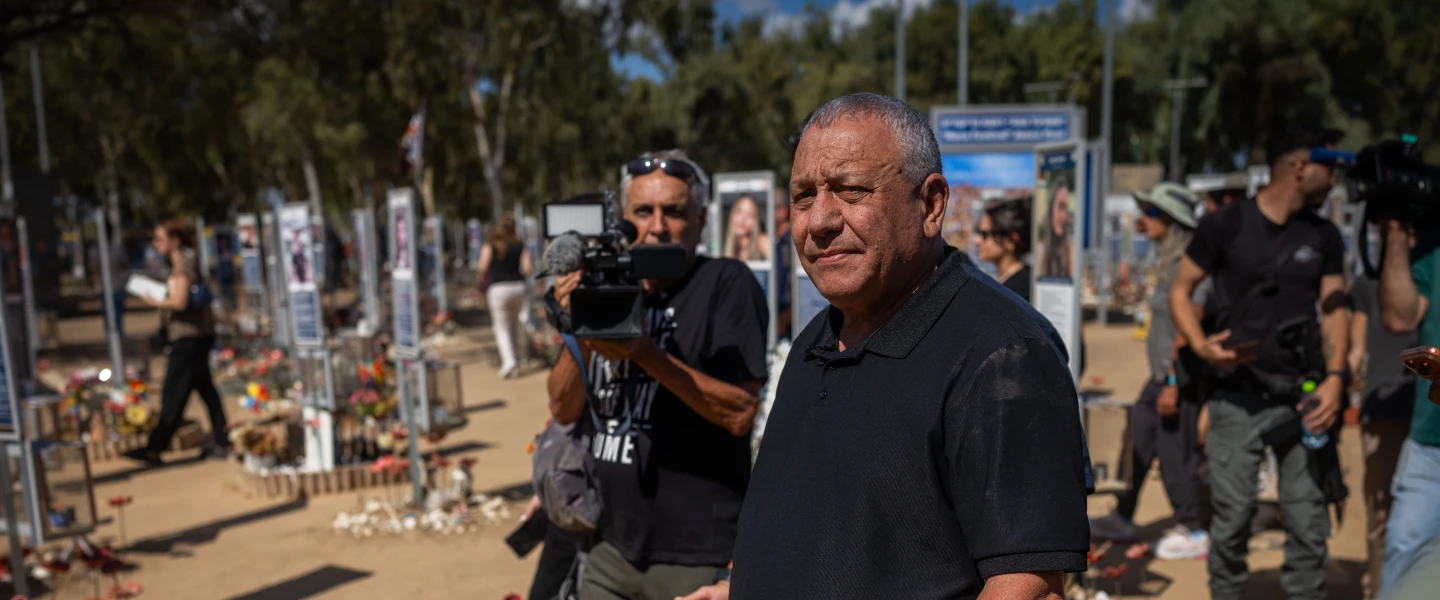
Just over a year after its founding, the Yashar party, led by former IDF Chief of Staff Gadi Eisenkot, approaches Israel’s Oct. 27 election as the leading challenger to Prime Minister Benjamin Netanyahu’s Likud.
Yashar presents itself as a vehicle for national reconstruction, combining security experience with commitments to professional government and shared civic obligations.
Understanding that appeal begins with Eisenkot’s path from military command to wartime government—and eventually to a party of his own.
The movement
Eisenkot spent 41 years in the IDF, rising through the Golani Brigade and commanding Northern Command before serving as Israel’s 21st chief of staff from 2015 to 2019. He entered the Knesset in 2022 with Benny Gantz’s National Unity alliance.
Following the Hamas-led massacre on Oct. 7, 2023, Eisenkot joined Netanyahu’s emergency government as a minister and served as an observer in the War Cabinet.
His son Master Sgt. (res.) Gal Eisenkot was killed fighting in Gaza that December; two nephews also died during the war.
In June 2024, Eisenkot left the government alongside Gantz, arguing that political considerations were influencing wartime decisions. The following year, he broke with Gantz and resigned from the Knesset.
On Sept. 16, 2025, he announced Yashar’s formation, saying, “The party will work toward repair, healing and hope for Israeli society.” The launch brought together figures from politics, business, security and civil society.
That mix is reflected in its electoral slate. Former Shin Bet director Yoram Cohen occupies second place on the Knesset candidates list, followed by former minister Orit Farkash-Hacohen. Social entrepreneur Adi Altschuler, the party’s proposed education minister, is fourth. Former ministers Matan Kahana and Chili Tropper and former Finance Ministry budget chief Shaul Meridor complete the first seven.
Together, they give Yashar a leadership drawn from the security establishment, elected office, public administration and education—the fields around which it has built its governing program.
The platform
Yashar’s program links national security to changes in how Israel is governed. It proposes a national security strategy emphasizing long-term planning, stronger armed forces, refortified borders, and expanded regional cooperation. Eisenkot identifies Iran as his foremost external concern and advocates strengthening relations with the United States and expanding Israel’s peace agreements. The party also promises a state commission of inquiry into Oct. 7 and the war’s management.
On the Palestinian question, Eisenkot has rejected the two-state formula. “The two-state solution is a grave mistake,” he told Israel Hayom in August. In the same interview, however, he opposed advancing construction in E1, located between Jerusalem and the developed area of Ma’ale Adumim in Judea, citing the international diplomatic cost. He also criticized “settler violence” and warned that government policies in Judea and Samaria were damaging Israel’s international legitimacy.
Domestically, compulsory service is central to Yashar’s program. Its proposal would require military or meaningful civilian-national service across population groups, including haredim and Arabs. The IDF would select recruits according to its needs, with others directed to civilian service. Up to 3% of the entire annual cohort could receive renewable, one-year Torah-study deferments, subject to eligibility requirements and basic training. Those evading service without an exemption would face criminal sanctions and loss of benefits.
Yashar further proposes a Basic Law to establish clearer rules governing the powers of the Knesset, government and courts. The party promises to preserve judicial independence while protecting parliament’s lawmaking authority, but its published program does not specify how judges would be appointed or when courts could overturn legislation. It also seeks broad agreement on a constitution, proposes limiting prime ministers to two terms and capping the number of government ministers.
Economically, Yashar combines measures to encourage competition with public investment. It proposes removing import barriers and Israel-specific regulation, expanding parallel imports and reducing market monopolies. Alongside these reforms, it pledges infrastructure investment and reconstruction in the north and south, while prioritizing IDF reservists for state assistance.
Education sees the same emphasis on centralized reform. Yashar proposes compulsory core studies (i.e. math, English and Hebrew), while simultaneously advocating for greater authority for schools and local government. Its platform further calls for stronger technological and traditional Jewish education.
Its domestic agenda also includes a national cabinet to combat organized crime and a program addressing violence in Arab society and the wider population.
The partners
Yashar’s principal prospective partners are Naftali Bennett and Yair Lapid’s B’Yachad list, Avigdor Liberman’s Yisrael Beiteinu and Yair Golan’s The Democrats. On Sept. 26, the five leaders signed an agreement to coordinate their campaigns, avoid attacking one another and establish working groups on voter turnout and prospective government policy. Their shared agenda includes haredi enlistment and a state commission of inquiry into Oct. 7.
That cooperation has not settled who would lead their government. Eisenkot’s position is that electoral strength should determine the bloc’s candidate: The head of the largest party is the candidate for prime minister, he said. He also rejects a rotation arrangement.
Bennett and Liberman have continued to seek the premiership, leaving the leadership question unresolved.
Beyond those partners, Eisenkot has set four conditions for joining his government: accepting Israel’s Jewish-democratic character, upholding the Declaration of Independence, compulsory service and recognition of Hamas as a terrorist organization that must be destroyed.
In a Sept. 26 interview with Channel 12, he said, “I currently see no Arab or haredi party that accepts these rules.” He explicitly ruled out including Mansour Abbas’s Ra’am party under its current positions.
Eisenkot’s critics argue that excluding Arab parties from the coalition leaves still room for dependence on their parliamentary support. In August, he himself left a minority government open as a last resort. Such a government could take office through Arab parties’ supporting votes or abstentions without giving them Cabinet seats. Liberman has rejected participating in such an arrangement, creating a potential obstacle within Eisenkot’s prospective bloc.
The polling illustrates the difficulty. A Zman Yisrael survey conducted Sept. 30–Oct. 1 gave the four cooperating lists 49 seats, against 53 for Netanyahu-aligned parties. With polling still placing his declared partners short of a majority, Eisenkot faces two tasks: securing leadership of the opposition camp and assembling sufficient parliamentary support for a government that accepts his conditions.