A five-course vegetarian dinner prepared and served on the rooftop of Jerusalem’s Clal Center on Monday celebrated the first six months of Agalala, a social coffee-cart cafe that employs young adults on the autism spectrum. The project’s name is a playful twist on the Hebrew word agalah (“cart”), reflecting both the coffee cart itself and its warm, community-oriented spirit.
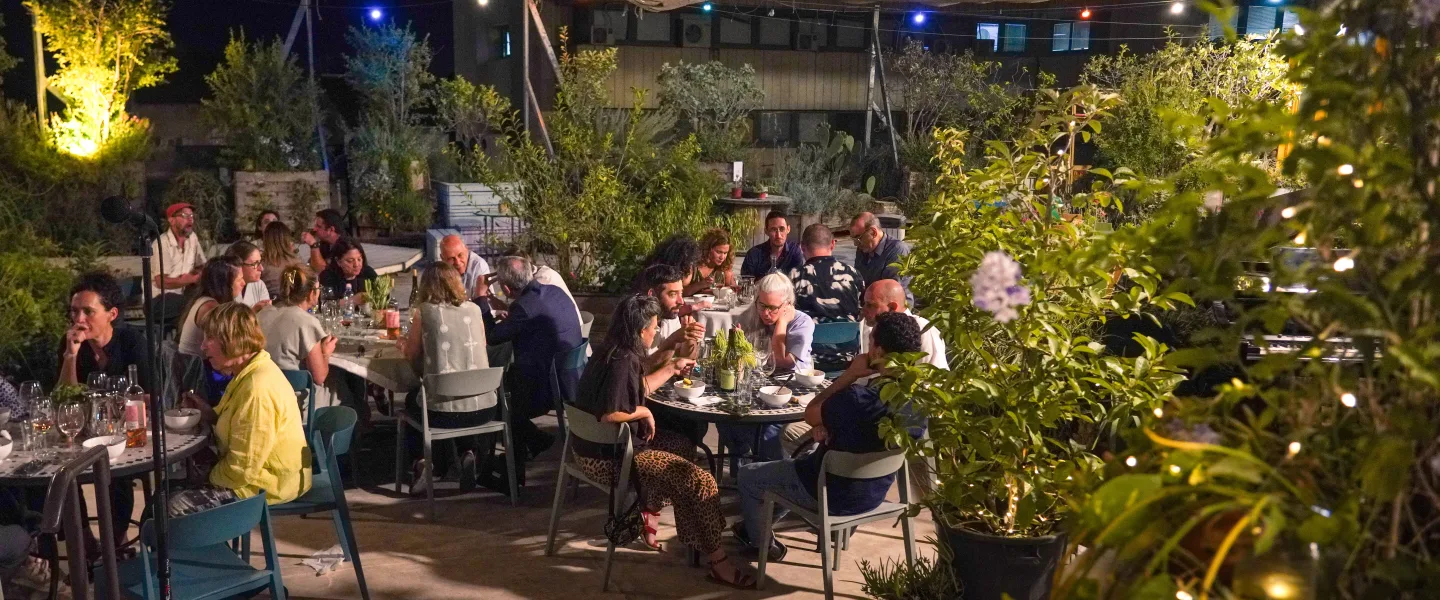
The “Agal-Gala” appreciation and fundraising event on a cool Jerusalem evening brought supporters, partners and community members to Muslala’s rooftop center on Jaffa Road for food, music, personal stories and a presentation of the project’s approach to inclusive employment.
The Agalala team prepared the evening’s kosher tasting menu under the direction of manager Udi Segal. Dishes included gazpacho, fresh-corn polenta, watermelon salad with fakous cucumber, sumac, honey, pistachios and jibneh cheese, and stuffed onion served on tzatziki.

Matan Israeli, co-founder and CEO of the Muslala nonprofit organization, said the coffee cart had completed a vision that the Jerusalem-based urban art and sustainability collective had spent more than a decade developing.
“We were given the privilege of reinventing the rooftop of a building that was once intended to be the heart of Jerusalem,” Israeli said.
Muslala has spent 12 years transforming the roof of the Clal Center into a cultural, ecological and community space, he said.
“Piece by piece, we have assembled a puzzle,” he said. “In a sense, everything created here was preparation for the day when the wonderful Agalala coffee cart would arrive.”
The project, he added, was “the missing piece of the puzzle,” enabling visitors to experience the rooftop through healthy food, warm hospitality and personal encounters.
A ‘third place’
Moran Bash Danon, CEO of Muslala, said the coffee cart brings together two groups with distinct but complementary missions.
Muslala focuses on art, culture and sustainability, while Gal College specializes in vocational training and employment resilience for people facing barriers to entering the workforce.
Drawing on American sociologist Ray Oldenburg’s concept of the “third place,” Bash Danon described the rooftop as a space that is neither home nor work, but a welcoming setting in which people meet and communities form.
“A third place can be a garden, a hair salon, a public library, a cafe or a rooftop,” she said.
“For me, Muslala’s rooftop is first and foremost such a place. It is a meeting place—open, inclusive, diverse, cultural, sustainable and social.”
The rooftop sits in the center of an increasingly dense urban environment where opportunities for spontaneous human interaction are becoming scarcer, she said.
“This space and this unique meeting point made possible the special partnership called Agalala,” Bash Danon said. “It connects Muslala and Gal College, culture and vocational resilience, professional training and human interaction, diverse employment and personal friendship.”

From training to employment
Ruti Tal, vice president for professional affairs at Gal College, said the 45-year-old nonprofit helps people acquire skills, enter the workforce, remain employed and develop professionally.
The organization operates programs at 12 locations across Israel and began working in Jerusalem about three years ago.
Tal said its activities in the capital began after a mother representing parents of young adults on the autism spectrum asked the college to create a program for participants completing national service who had no clear path into employment.
Gal College opened its Tal vocational program in Jerusalem in November 2023, just weeks after the Hamas massacre in southern Israel on Oct. 7, 2023.
The organization initially struggled to find an affordable location in the capital. A referral eventually led Tal to Israeli and Muslala.
“I immediately knew this was what I wanted for us: a connection to a community,” she said. “I sensed that there was something here much greater than simply a place to house our program.”
The program opened on Muslala’s terrace during heavy winter rains while other sections of the rooftop center were still being developed.
The idea for the coffee cart emerged when Israeli learned of a National Insurance Institute call for proposals and suggested that Muslala and Gal College apply together.
Muslala brought the concept and community setting, while Gal College provided the professional experience required to train and support the workers.
The two organizations secured the grant despite the complexities of building a joint project across separate nonprofit structures.
“This is not another machine in another sheltered workshop,” Tal said. “It is something larger—creative, innovative and rooted in the community.”
She said the project reflects a broader understanding of employment inclusion that emphasizes strengths, skills and what Gal College calls “ExtrAbility,” rather than defining people according to disability.
“It is this combination of ecology, art, society and extra abilities,” she said. “Together, they generate light every day.”
Tal praised Segal’s “gentle and humane” leadership and said Agalala allows graduates of Gal College’s programs to practice workplace skills while developing relationships with customers and colleagues.

A Jerusalem model
Arik Grebelsky, president of the Jerusalem Foundation, said Muslala represented a form of social entrepreneurship increasingly associated with the capital.
He said the rooftop could not be defined solely as an environmental, cultural, social or coexistence initiative.
“That is precisely its beauty and magic,” he said.
Grebelsky praised Israeli as a social mentor who had helped cultivate a new generation of Jerusalem activists and community leaders.
Jerusalem attracts young people with a strong interest in social innovation, communal life and connections between religious, secular, Arab and Haredi residents, he said.
He contrasted the city’s cultural and social initiatives with the perception among some overseas visitors that Jerusalem offers little beyond its religious and political institutions.
“Come with me for one day and see what a special city Jerusalem is,” he said.
Grebelsky cited Muslala and other independent cultural venues in the city center as evidence that Jerusalem is becoming a leading center for social entrepreneurship and cooperation between communities.
“We need many more leaders like you,” he told Israeli. “The Jerusalem Foundation intends to remain a partner for many years.”
He said that the foundation is also supporting a series of Friday events at Muslala featuring young Jerusalem artists in memory of Shai Doron, the beloved president of the Jerusalem Foundation, who died in 2024.

Partners in inclusion
Speakers thanked Gal College for its partnership in establishing Agalala and the National Insurance Institute, whose backing enabled the creation of the coffee cart. They also thanked the Jerusalem Foundation and Grebelsky for their long-standing support of Muslala, as well as Bank Hapoalim for backing Agalala’s activities.
Host Matan Israeli also acknowledged Eyal Bloch, chairman of Muslala’s board; the organization’s board members and professional advisers; Segal and the Agalala staff; and the Tal program team responsible for vocational training and continued employment support.
For Israeli, the evening demonstrated the potential of the project, which he hoped would be expanded and replicated in other locations.
“The ability to host people here and allow them to experience this place through the pleasure of meeting and eating together is a great privilege,” he concluded.