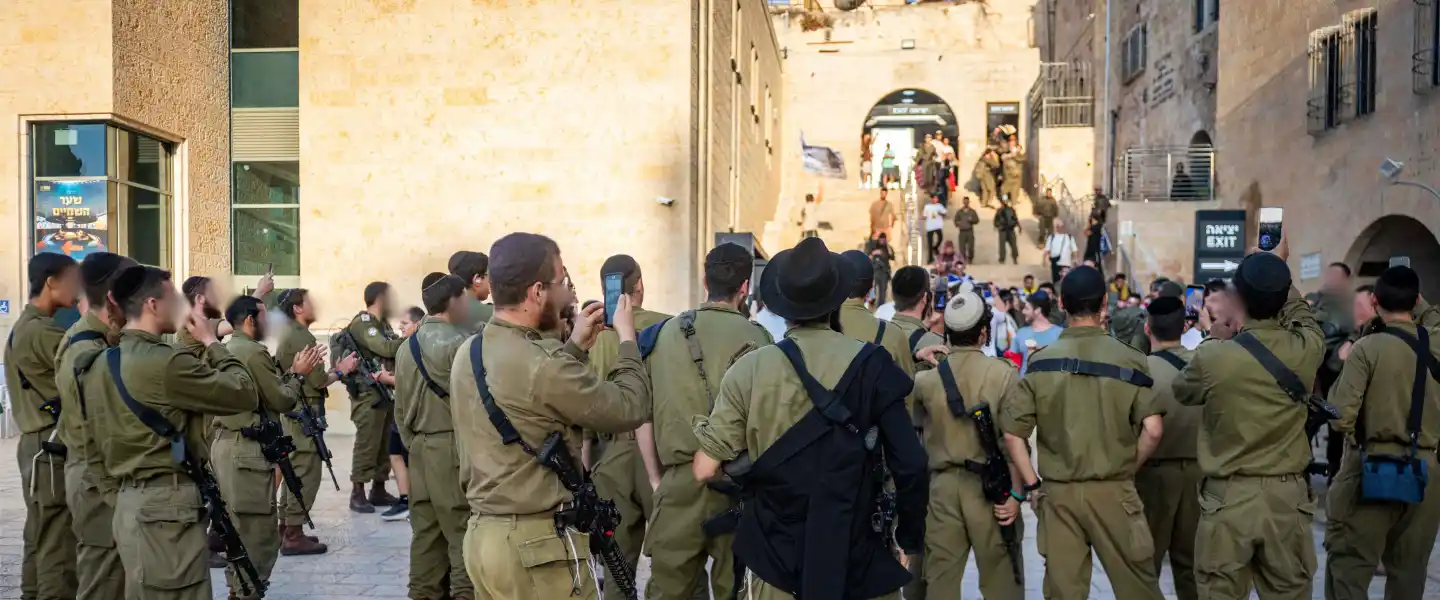
For decades, Israel’s Haredi draft debate unfolded mainly in courtrooms and coalition negotiations. After Oct. 7, the argument moved into homes, workplaces and army bases.
A State Comptroller report found that between October 2023 and July 2024, reservists served an average of 110 days, compared with annual averages of 10 to 13 days from 2020 through 2023. Families repeatedly reorganized themselves around absent parents, students left university, and workers returned to uniform for a fourth or fifth mobilization. As of the writing of this article, 968 soldiers have been killed and more than 6,000 wounded.
The longest war in Israeli history has driven the IDF to unprecedented manpower shortages and placed an immense burden on the fighting population. By May 2025, the IDF said it needed 12,000 additional compulsory-service soldiers for the war effort. The Haredi exemption was therefore no longer only an unequal civic arrangement; it formed part of a manpower shortage that increased the military’s reliance on those who already served.
Despite the circumstances, mainstream Haredi leaders continue to regard broad conscription not simply as a staffing policy but as an unacceptable threat to the Haredi world. In this sense, the post-Oct. 7 phase of the Haredi draft debate has forced a resolution of the question earlier compromises had avoided: whether full-time Torah study would remain an alternative national obligation available to virtually every qualifying Haredi student, or become a protected exception within a broader expectation of service.
Response to Oct. 7
The initial Haredi response to Oct. 7 showed a general understanding of shared national responsibility. Haredi volunteers cooked for soldiers, staffed medical units and joined Home Front Command.
“There was an enormous groundswell of volunteering and patriotism,” Gedalia Guttentag, deputy editor of Mishpacha magazine, told JNS. “I’ve never seen anything like it, an expression of identification with the Israeli majority which would never have happened in any other country.”
A Knesset Research and Information Center report counted approximately 4,000 Haredi men, most older than 26, who asked to enter a shortened military service between Oct. 7 and the end of February 2024.
Gilad Malach, a researcher at the Israel Democracy Institute (IDI), told JNS that these were largely older Haredim who had already entered the workforce, rather than the young conscripts the IDF required.
“The volunteering effort was very nice,” he said. “But it’s not changing the manpower needs of the army.”
Their participation demonstrated a willingness to contribute, but it did not resolve whether 18-year-old yeshivah students should leave full-time study for regular service. Emergency volunteers chose when, where and under whose authority they served.
In parallel, the IDF moved to expand accommodations for Haredi soldiers. In 2024, the IDF opened new units that provided enhanced kashrut, fixed prayer and study periods and gender-separated environments in designated settings, and were staffed by commanders trained for Haredi units. Knesset Foreign Affairs and Defense Committee chairman Yuli Edelstein described the objective as enabling a recruit “to enlist as a Haredi and be discharged as a Haredi.”
Such accommodations addressed how a Haredi soldier could serve, but not who would decide that he should leave yeshivah. Haredi leaders remained reluctant to cede that decision to the military, while military planners could not base wartime personnel policy on individual willingness. The wartime response therefore produced some solidarity without actual agreement.
The cultural rapprochement was largely overtaken by a legal rupture that predated the war. When the last statutory arrangement expired on June 30, 2023, Haredi men became subject to the ordinary Security Service Law. A government resolution nevertheless instructed the military not to pursue conscription proceedings against full-time yeshivah students through March 31, 2024, while replacement legislation was negotiated. The resolution delayed enforcement; it did not create another statutory exemption.
On June 25, 2024, the Supreme Court unanimously ruled that “the state must act to enforce the Law for Security Service on yeshiva students.” It required the state to begin applying the existing law and held that yeshivahs could no longer receive funding calculated for students without valid deferments.
Formal obligation did not produce mass enlistment. During the July 2024-June 2025 conscription year, the IDF issued approximately 24,000 initial orders. Of their recipients, 2,738 appeared at induction centers, 1,508 continued the process and 798 enlisted; another 432 received future enlistment dates.
As enlistment notices were increasingly ignored, the IDF began issuing arrest warrants against those who repeatedly failed to report, but these warrants initially went largely unenforced. The first Haredi yeshivah student arrested under the new policy was detained at Ben-Gurion Airport on Feb. 7, 2025, while attempting to leave the country; he was released several hours later.
In May 2025, military police began proactive operations at draft evaders’ homes. Only one Haredi man was reportedly among the 38 people arrested during that campaign. Arrests of Haredi draft evaders became more frequent and politically prominent during the summer of 2025.
As the issue heated up in late 2025, the court moved from pressuring the Knesset to supervising enforcement itself. On Nov. 19, 2025, it ordered the Knesset to pass an effective policy within 45 days, combining criminal proceedings with civil and economic consequences for all draft dodgers.
After the government failed to produce one, the court in April 2026 set deadlines for conditioning eligibility for housing and childcare benefits on draft compliance, required Knesset decisions on transportation and municipal-tax discounts, and directed police to assist military draft enforcement.
The legal exemption had therefore ended. The unresolved question was whether the pressure campaign, in combination with the genuine national need, could be converted into actual service.
The initial recruitment wave was notable but insufficient. The all-Haredi Hasmonean Brigade was established in 2024 to accommodate new Haredi recruits and can be seen as a measuring stick for Haredi recruitment. Its first intake in January 2025 comprised approximately 50 regular recruits and 100 older reservists.
On Dec. 2, 2025, around 70 soldiers completed its first squad commanders’ course, creating a leadership cadre. The brigade demonstrated that a functioning Haredi pipeline could be built, but remained far smaller than either the eligible population or the IDF’s manpower needs.
A new draft law
While the IDF tried to expand capacity, the Knesset pursued a postwar draft bill to relieve pressure from the judicial branch. Revived in June 2024 from a 2022 proposal, it emphasized gradual military integration, a lower exemption age and earlier employment options. The proposed bill met immediate resistance from military leaders, who argued that after Oct. 7, the IDF needed compulsory-service manpower immediately; slow social and economic integration no longer answered the military question.
The Knesset legal adviser counted 86 committee sessions on the draft bill in a process that dragged on for more than a year. They covered recruitment targets, personal and institutional sanctions, yeshivah funding and the definition of a Haredi recruit.
Military officials and the Finance Ministry argued that draft targets were too low and sanctions too delayed. Haredi parties considered personal penalties and external monitoring of yeshivah attendance to be threats to the institutional autonomy they were defending.
Yet that resistance was not uniform.
“Agudat Yisrael totally rejects the current version of the draft law,” Malach said. “They are totally against any compromise, targets and economic sanctions and things like that. Degel HaTorah and Shas are more moderate.”
The latter parties’ political leaders sought a compromise involving targets and limited economic sanctions, but could not bridge the gap between their rabbinic leadership, the military’s demands and the wider coalition.
Guttentag explained that the latest law failed to recognize the basic demands necessary for any palatable compromise from the Haredi perspective.
“There’s an absolute red line around the yeshivah and kollel worlds,” he said. “There will always be significant numbers, to the tune of tens and tens of thousands, who will be studying full time.”
Coalition arithmetic prevented either position from prevailing. Prime Minister Benjamin Netanyahu depended on Haredi parties but could not guarantee sufficient Likud support for a bill that failed to meet military needs. MK Yuli Edelstein, who chaired the committee responsible for the bill, pursued a stricter version before being removed from his position; his successor, MK Boaz Bismuth, offered a softer outline that also failed to gain the needed consensus.
After repeated suspensions and revivals, the bill had not reached its final readings when the Knesset dissolved on July 17, 2026.
In its final week, the Knesset instead passed a Basic Law declaring Torah study a foundational state value and a temporary law freezing enforcement against qualifying yeshivah students. The Supreme Court froze the enforcement law and, after a July 28 hearing, left that freeze in place pending judgment.
The compromise failed because any bill strong enough to answer the manpower crisis threatened Haredi participation in the coalition, while a bill acceptable to Haredi leaders could not command sufficient political, military or judicial support.
A country divided
The familiar legislative failure coincided with new cultural tensions unseen in the history of the Haredi draft debate. As repeated mobilizations disrupted families, careers and studies, the exemption came to feel like a refusal to relieve those already carrying the burden of the war.
One religious reservist described five combat rotations, three dead comrades and wounded soldiers in a company composed mostly of observant men.
“We are serving, and we are working, and we are fighting, and we are dying,” he said, “and they are not.”
An IDI survey found that support among non-Haredi Jews for some form of Haredi conscription rose from 67% in January 2024 to 84.5% that November, while support for the existing exemption fell to 9%. The shift was especially pronounced among national-religious Israelis and voters for Likud and Religious Zionism, constituencies whose inherent support for religious practice had long helped preserve Haredi immunity from the draft.
Haredi enlistment consequently became a defining promise of virtually every major opposition party. Naftali Bennett, Yair Lapid, Gadi Eisenkot, Avigdor Liberman and Yair Golan differed over exemptions and penalties, but all made service the norm rather than a voluntary Haredi choice.
Lapid voiced the severity of the general frustration in a recent speech, saying, “When choosing between the soldiers and the draft dodgers, Netanyahu chose the draft dodgers and betrayed the soldiers.”
Enforcement produced an opposite reaction inside Haredi society. The number of proactive arrests remained small, but each detention became a communal event. Guttentag described the prevailing attitude succinctly.
“The sense on the street is: ‘We will not negotiate while our young men are subject to arrest.… Take the heat off, and we can talk.’”
From the summer of 2025, rabbis visited military prisons, Haredi newspapers organized prayer gatherings and protesters repeatedly blocked roads. A mass Jerusalem rally that October drew tens of thousands.
The prisoners were not presented as lawbreakers but as defenders of Torah. Shas and United Torah Judaism leaders visited them, distributed religious books and promised to secure their release. One freed evader returned home in a limousine accompanied by singing and dancing. Hardline organizers created an alert system to mobilize supporters whenever an evader was detained.
“The Torah itself, God forbid, is in prison,” Rabbi Dov Lando said at a celebration for two released prisoners.
Haredi leaders also disputed the premise that conscripting their community would solve the army’s manpower problems. Yitzhak Goldknopf argued that the IDF neither wanted nor needed Haredi recruits and claimed that the push for enlistment was a ploy to assimilate Haredi youth and undermine the communal structure.
“We know that there are available non-Haredi populations that are not being drafted while everyone is pushing for yeshiva students to go into the army,” Eli Paley, publisher of Mishpacha magazine and chairman of the Institute for Strategy and Haredi Policy, told JNS.
“There is a lot of suspicion when it comes to the draft question, and it is not clear that when Haredi youths are being ordered into the army that this is only because there are not enough soldiers,” he added.
Malach explained that this suspicion was why some Haredi leaders opposed the draft even for youths not actively engaged in Torah study.
“They believe that not just Torah learners should study Torah, but any Haredi should stay and not enlist in the army,” he said.
The two publics, therefore, reached opposite understandings of the same confrontation. The serving public saw a state protecting evasion while demanding further sacrifice from the rest of the population; Haredi leaders saw a state criminalizing loyalty to Torah. Courts could establish service as the legal default, but enforcement could not make it the accepted communal default.
The war made choosing between those perspectives unavoidable—and made compromise between them harder.
This is the fourth in a JNS series on the Haredim in Israel.