


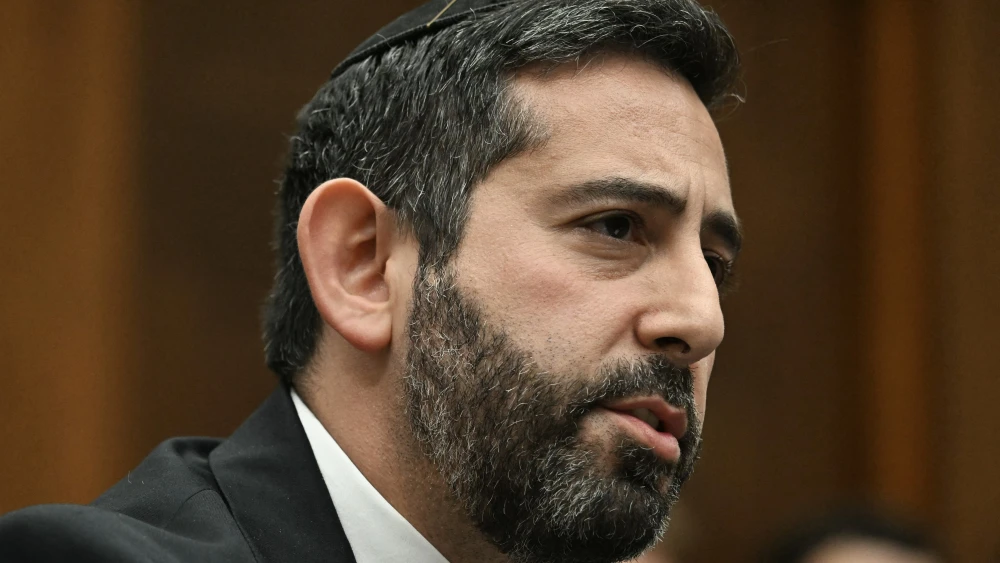

Rabbi Dr. Mark Goldfeder and the National Jewish Advocacy Center (NJAC) delivered a decisive, precedent-setting legal victory this week that cuts to the core of how antisemitism is litigated and understood in America.
Thanks to Goldfeder and NJAC, a federal court has ruled that attacking a Jew for wearing an Israeli flag is direct evidence of racial discrimination. The “it’s just anti-Zionism, not antisemitism” defense was raised, fully briefed and rejected.
The case of Sumrall v. Ali was brought after pro-Israel activist Kimmara Sumrall was assaulted at a demonstration in Washington, D.C., while she was wearing an Israeli flag tied around her neck as a cape. The defendant approached from behind, yanked the flag hard enough to choke her and was later sued. Representing Sumrall, NJAC pressed claims under the Reconstruction-era civil rights statute known as Section 1981.
U.S. District Judge Trevor N. McFadden denied a motion to dismiss. The court found that “the Star of David—emblazoned upon the Israeli flag—symbolizes the Jewish race” and that “battery, particularly involving a racial symbol, is strong evidence of racial discrimination.”
The judge called it “quite a stretch” to treat yanking a flag from a Jewish person’s neck as mere objection to Israeli policies, adding that battery is not a legitimate form of protest and the defendant had no reason to believe Sumrall was an Israeli government official. As such, the incident was an intentional attack on a Jewish person displaying a symbol of her heritage.
This was not mere abstract legal theory. It was a concrete rejection of the most common contemporary evasion used to justify violence and discrimination against Jews: that such things are merely anti-Zionist, not antisemitic. Every future defendant who reaches for that excuse will now confront McFadden’s opinion.
The ruling also clarified that Section 1981’s protections against private racial violence apply to attacks on Jews wearing Jewish symbols, expanding the legal toolbox available to Jewish victims. It is the kind of precedent that changes things.
NJAC, of which Goldfeder is CEO and director, was essential to this precedent-setting victory.
NJAC has grown rapidly since its founding—particularly after the Hamas-led terrorist attacks in southern Israel on Oct. 7, 2023—into a high-impact strategic litigation and advocacy organization. Its docket has included Antiterrorism Act cases against entities accused of facilitating or benefiting from Hamas-related activity, FACE Act actions against those who blocked synagogue access; discrimination suits against universities and employers; challenges to bans on Jewish or Zionist participants in professional and recreational settings; and coordinated amicus and legislative work.
Settlements, denials of motions to dismiss, religious-accommodation victories and deterrence effects have followed.
NJAC also runs the nation’s first Antisemitism Law Clinic at Touro University and, through the Touro Antisemitism Institute, sponsors a teaching fellowship that equips professors across disciplines to develop and teach rigorous courses on antisemitism on their own campuses.
Goldfeder holds two rabbinic and two judicial ordinations. As an Orthodox Jew, he draws on classical sources, including medieval responsa, when crafting modern legal arguments and preparing testimony. He has testified before House committees on campus antisemitism and the U.S. Commission on Civil Rights.
During one such appearance, when a witness described Zionism as merely an abstract idea that could not be a basis for discrimination, Goldfeder responded by pulling out a rock from Mount Zion. He explained that Jews are called Jews because they are from Judea and Zionists are called Zionists because they are from Zion, the place where King David established his capital thousands of years ago.
The right to Jewish self-determination in the ancestral Jewish homeland, Goldfeder argued, flows from a concrete historical reality. Treating it as mere politics or an optional belief is inaccurate and a form of discrimination forbidden under civil rights law.
The same man who studies Talmud and Jewish law applies their disciplined creativity to federal courtrooms and hearing rooms. He also builds educational pipelines for future lawyers and professors and seeks out systemic tools to protect Jewish civil rights. This results in both isolated wins and an expanding architecture of protection.
That expanding architecture is the mark of a genuine powerhouse. At a time when many sense a shortage of bold and effective Jewish leadership, Goldfeder and NJAC have gotten results through methods that are rigorously legal, deeply rooted in Jewish sources and unapologetically public. That is rare. It is also exactly what our moment demands.
The Jewish flag ruling is the latest and clearest demonstration of this. It shows what happens when such methods confront real-world violence and how fashionable excuses for antisemitic violence can be overcome with far-reaching consequences.


