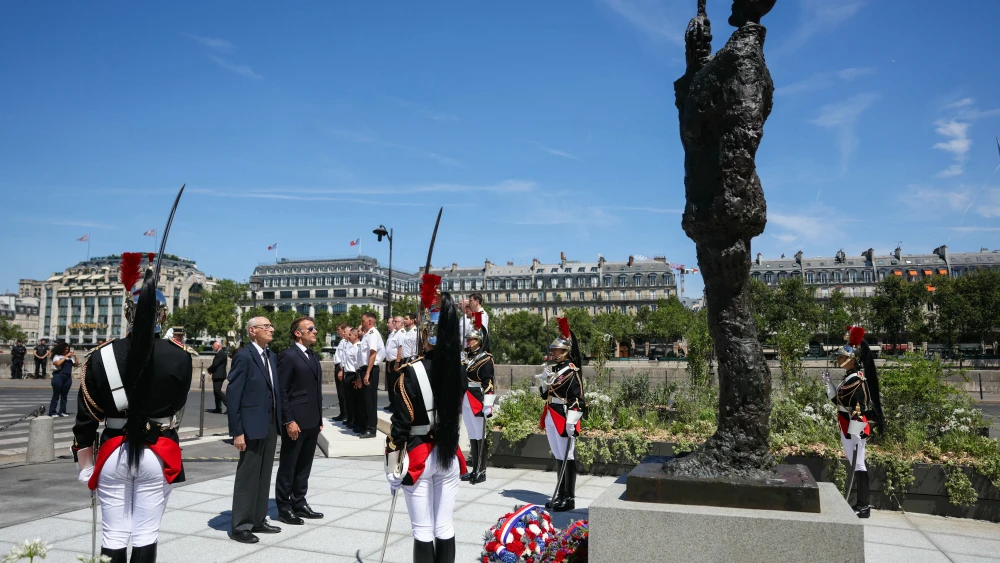
French President Emmanuel Macron marked on Sunday the first national day commemorating the recognition of Alfred Dreyfus’s innocence, saying in French that “Dreyfusism reminds us that antisemitism—whatever its roots or supposed explanations—is the enemy of the Republic.”
Dreyfus was a Jewish officer wrongly accused of being a German spy. His conviction in 1894 led to a social outcry, followed by new evidence that eventually paved the way for his exoneration.
In the ceremony in Paris on Sunday, 120 years to the day after France’s highest court of appeals cleared his name, Macron described the ruling proclaiming Dreyfus’s innocence as “a triumph of justice after years of struggle and the slow unveiling of the truth,” according to a translation by French newspaper Le Monde.
“Today, for the first time, we are gathered for a national day of commemoration, which I wished to establish on our calendar from now on,” Macron continued, referring to a resolution advanced unanimously at the French National Assembly in the summer of 2025.
Macron said that the antisemitic affair was a “particular form of contradiction and confrontation unique” to the French people, but which ultimately ended with the “victory of the republican spirit over reactionary forces.”
He further listed the French figures, the “Dreyfusards,” who stood by the Jewish officer and fought to clear his name, among them head of France’s counter-espionage, Lt. Col. Picquart, French authors Emile Zola, Anatole France and Marcel Proust, statesman Georges Clemenceau and others.
“We know that the old demons of antisemitism have never completely disappeared from our country. We know this because antisemitic acts, far from fading away, have continued to target people simply because of what they are,” the French president continued.
However, “while a nation may be torn apart over the fate of a mere captain, it can also, thanks to the vigilance, perseverance and courage of a few fighters, restore its honor,” he continued. “From now on, every July 12, we will remember this: That justice and truth overcame hatred and lies, and that they must be defended again every single day. Long live General Dreyfus, long live the Republic, and long live France!”
Le 12 juillet 1906, la plus haute juridiction de notre pays proclamait l'innocence du capitaine Alfred Dreyfus. Triomphe de la justice après des années de combat et le lent dévoilement de la vérité.
— Emmanuel Macron (@EmmanuelMacron) July 12, 2026
Mais ce que Dreyfus et les dreyfusards ont légué à la France… pic.twitter.com/BdUs4lCAaJ
Souring in French-Israeli relations
Relations between Israel and France have been strained since the Hamas-led Oct. 7, 2023, attacks on the northwestern Negev in Israel.
Macron’s government has been increasingly critical of Jerusalem’s conduct since the war began, culminating in its official recognition of a Palestinian state at the United Nations General Assembly in September 2025.
As early as Oct. 27, 2023, the first day of Israel’s ground incursion into Gaza, France voted in favor of a “humanitarian truce” in the U.N. General Assembly.
In a letter delivered to Israeli Prime Minister Benjamin Netanyahu in August 2025, Macron wrote, “I solemnly appeal to you to end the desperate race of a murderous and illegal permanent war in Gaza, causing indignity for your country and placing your people in a deadlock.”
In an earlier letter sent to the Élysée Palace on Aug. 19, Netanyahu chastised Macron for inciting a wave of antisemitism across France via his calls to recognize a Palestinian state.
In a phone call between the two leaders in September 2024, Macron reportedly blamed Israel for the escalation of violence in Lebanon, calling for a diplomatic solution regarding Iran’s proxy terrorist group Hezbollah.
“Instead of putting the pressure on us, it’s about time you pressured Hezbollah. We will bring our residents back home [in the north]. This is the decision we made this week, and we will act on it,” Netanyahu replied at the time, according to Israel’s Channel 12.
The spike in anti-Israel policy in France has coincided with a significant increase in antisemitic attacks.
In 2024, France recorded over 1,500 antisemitic incidents, making up more than 60% of all religion-based hate crimes in the country. In the first half of 2025, another 646 incidents were reported.
Cases include the assaults on rabbis, vandalism of synagogues and the Holocaust Memorial (the Mémorial de la Shoah museum in Paris’s Marais neighborhood), graffiti on El Al’s office in the city reading “genocide airline,” and “Free Palestine” spray-painted on Jewish tourists’ cars in the Alps. An outdoor adventure park manager was also detained for refusing entry to a group of Israeli children.
The Dreyfus affair
The Dreyfus affair is widely seen as a symbol of antisemitism in Europe and a major catalyst for modern Zionism.
It exposed deep-seated antisemitism in French society and caused a public storm that led to a long legal battle to clear his name.
Born in 1859, the captain of artillery was convicted in a secret court martial for allegedly selling French military secrets to the Germans, with a handwritten message falsely attributed to him. He was publicly stripped of his army rank and sentenced to life imprisonment on Devil’s Island in French Guiana in South America.
During the public ceremony stripping him of his ranks and breaking his sword, Dreyfus declared, “I swear that I am innocent. I remain worthy of serving in the Army. Long live France! Long live the Army!”
In 1899, Dreyfus was given a second trial, but was again found guilty of treason.
President Émile Loubet pardoned Dreyfus shortly afterward, but he technically remained a traitor. During this period, he lived under a form of restricted residence, initially with his sister. This was not a formal house arrest but rather a restriction on his movement due to his legal status.
It was only in 1906 that he was exonerated by a military commission. He was subsequently rehabilitated and reinstated in the French Army, although at a lower rank than his seniority would have warranted.
Dreyfus served during World War I, first as a major of artillery, and then as a lieutenant colonel.
He died exactly 29 years after his exoneration, aged 75, on July 12, 1935.