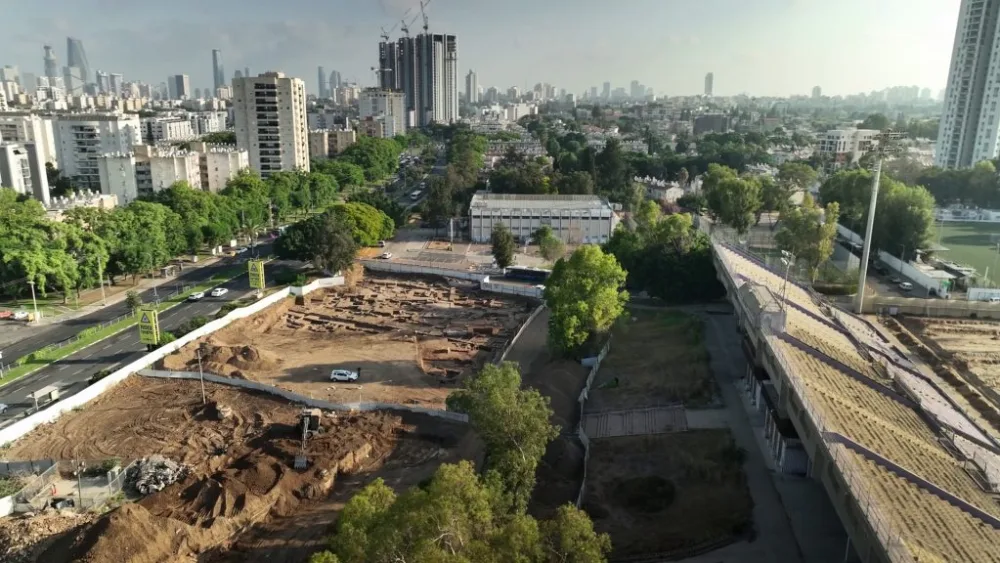
A 1,300-year-old industrial and commercial complex featuring planned streets, pottery kilns, shops and warehouses has been uncovered in Ramat Gan, the Israel Antiquities Authority announced Sunday.
The excavations were carried out in recent months ahead of the construction of a large bus terminal.
“Although buildings and artifacts from ancient periods have been discovered in the area in the past, the results of the current excavation exceeded all expectations,” said Yoav Arbel and Lior Rauchberger, the excavation directors on behalf of the IAA.
The excavation revealed a carefully organized complex with straight, intersecting streets. Rooms lining the streets apparently served as shops or warehouses, while other structures included plastered industrial installations and pottery kilns.
“Clearly, its main phase was planned in advance in detail by engineers and was built with the knowledge of the regional authorities — and perhaps even on their initiative and with their funding,” the archaeologists said.
The location may have been chosen for both commercial and agricultural reasons, the archaeologists added. The site was apparently near a major road connecting Jaffa, Ramla, then the regional administrative capital, and Jerusalem, while the surrounding area offered fertile farmland and accessible water sources. Ramat Gan is east of Tel Aviv.
The complex was built during the 7th or 8th century C.E., during the Umayyad and Abbasid periods, and remained in use for about 150 years. Researchers believe it may have functioned as a large trade and industrial station or formed part of a nearby settlement that has yet to be discovered.
The complex was abandoned under circumstances that remain unknown. According to the IAA, the site was resettled in the 10th century C.E., during the Fatimid period, when residential buildings and production facilities were constructed and numerous tabuns, or clay ovens, were installed.
The site was abandoned again in the late 11th century C.E., shortly before the Crusader conquest, and was never resettled.
Archaeologists uncovered dozens of pottery vessels and intact oil lamps, as well as bronze tableware and cosmetic implements, iron pickaxe heads, a sickle, numerous nails and dozens of coins. Large quantities of locally produced and imported pottery and glass fragments were also found.
The excavation yielded no finds that clearly establish the ethnic or religious identity of the people who lived and worked at the site. Archaeologists noted that the wider Yarkon region was likely home to a significant Samaritan population at the time, while nearby Ramla had a Muslim community.