The Israel Defense Forces has implemented major changes to the way it protects Israeli communities and residents in the Gaza border region, seeking to ensure that the lessons of the Oct. 7, 2023, Hamas massacre are learned and that such an attack never happens again.
On Sept. 10, a senior IDF Southern Command official gave JNS an exclusive briefing highlighting some of the major steps that have been taken.
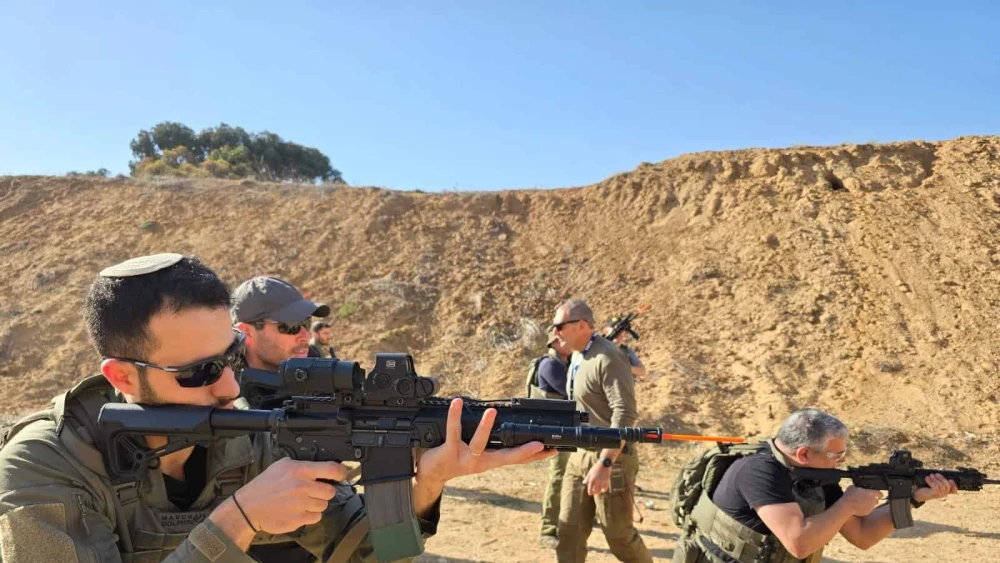
At the forefront of community security is “Hagmar,” the Hebrew acronym for haganah merhavit (“regional defense”), the IDF’s local-defense framework. It relies on IDF reservists who live in the communities and serve as part of their local defense, in uniform, working hand in hand with the kitat konenut, or civilian first-response team, and the “ravshatz,” a Hebrew acronym for rakaz bitachon shotef tzahali, a civilian who coordinates directly with the IDF.
This system mirrors the local defense system that has protected communities in Judea and Samaria for more than two decades.
The kitat konenut, comprising local resident volunteers, is tasked with providing the community’s immediate response during the first minutes of a security incident. The composition of each community’s kitat konenut is determined by its size and needs. Sderot, for example, has a larger defense formation than the smaller community of Kfar Aza.
According to the official, following Oct. 7, the IDF took numerous steps to strengthen the Hagmar system in the Gaza border region. Communities were classified according to factors including their proximity to the border, with frontline communities—those that would be the first to encounter an incursion—receiving more significant defensive components.
“The goal is to build the capability so that every community can provide an immediate response and defend itself,” the official said.
Strengthening the communities
The IDF reviewed and strengthened the communities’ fences, security roads, lighting and ravshatz vehicles, while adding technological capabilities such as cameras and regional council command centers.
Staffed around the clock, the regional command centers are connected to security cameras throughout the communities and maintain communication channels to help coordinate a response.
Following Oct. 7, the centers were initially staffed by IDF reservists. The IDF and Israeli Defense Ministry are now funding local authorities to employ civilians to operate them, ensuring that each center can monitor camera feeds 24/7, mobilize the necessary responders and provide additional information during an incident.
The official acknowledged that cameras were breached during the Oct. 7 attack, but said the IDF has since strengthened the systems, including through information-security assessments, password changes and other measures designed to prevent another breach.
“We are constantly aware that the systems and capabilities in the communities’ possession ... cannot be breached either,” she said.
Another new initiative is Magen 48, an IDF Gaza Division project named for the 48 members of local security squads who were killed during the Oct. 7 attack. The program trains and prepares the squads throughout the region.
Before Oct. 7, the squads trained twice a year. Magen 48 increased that to eight, using advanced simulations of attacks and incidents inside communities, culminating in an eighth session designed to expose squads to extreme scenarios.
In addition to these measures, the IDF has been working to ensure that the civilian first-response teams are fully staffed and equipped according to the needs of each community. The squads have received additional weapons, protective gear and, in particular, drones—a capability that did not exist before Oct. 7. Trained and certified squad members can now deploy drones during an incident to provide an aerial picture of what is happening inside and around the community in real time.
“We are constantly equipping the forces according to the standards,” the official said, adding that the goal is for the squad to be able to “operate independently and have a complete response.”
New reserve units
The IDF also established the Avshalom, Oz and Yael reserve units to reinforce community defense. The units provide an additional military presence in the communities and help fill the gap when members of the civilian teams are unavailable.
The three units were given names with personal and historical significance: Avshalom honors pre-state Irgun fighter Avshalom Haviv; Oz refers to the Gaza border communities of Nahal Oz and Nir Oz; and Yael is named for three fallen soldiers from the 55th Paratroopers Brigade.
The official explained that a resident of Be’eri, for example, may be a member of the community’s security squad but commute to work in Tel Aviv during the day. To ensure that a military force remains in the community, the IDF has stationed reservists from Avshalom, Oz and Yael in the communities, and provides them with residential accommodations.
In addition, each brigade commander approves a detailed defense plan for every community under his command. Like a military base, each community has a defense file outlining the threats it faces, the required responses and communications procedures, as well as information on its population and other relevant details.
The IDF conducts ongoing inspections at the command, division and brigade levels, working with the communities to identify and correct deficiencies and ensure they have the capabilities needed to respond to an incident.
Real-time response
Finally, the IDF has developed the Netz app, a system designed to provide real-time situational awareness and command-and-control capabilities during an incident.
The app can also be used for exercises and, during an actual incident, functions similarly to the IDF Home Front Command app by issuing alerts. When the ravshatz or a member of the kitat konenut identifies an emergency, the app can alert other members of the squad, who can then communicate with one another, share information and photos, and interface with other systems.
The official said the Netz app is one of several systems the IDF uses to build a real-time picture during an incident, calling it a “very, very major capability.”
The official said that while the Hagmar defense system existed before Oct. 7, it “simply wasn’t at the level it is today,” with far greater emphasis now placed on training, equipment, preparedness and reinforcement. The civilian defense teams are “much stronger” and “better trained,” giving communities greater confidence in their ability to respond to threats, she said.
She also pointed to the reservists who have spent the past three years strengthening the Hagmar system and providing security to the communities, saying it was “very important to mention the people who have been working truly hard for three years now.”
The effort, she said, has helped communities such as Nir Oz, Kfar Aza and Be’eri begin the process of returning, knowing that soldiers are alongside them and that they now have defensive capabilities they did not have on the eve of Oct. 7.