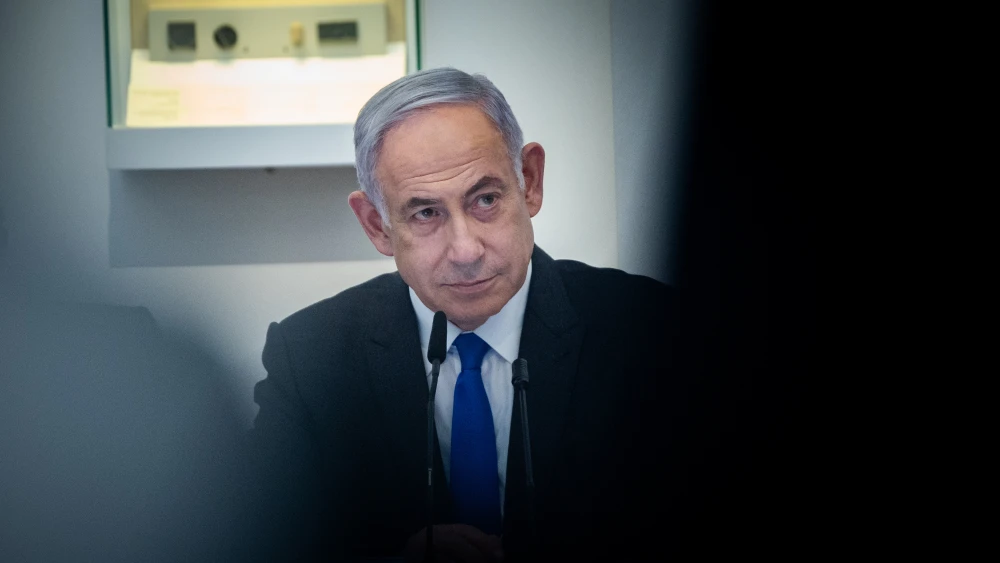
Israeli Prime Minister Benjamin Netanyahu in an interview aired on Monday expressed skepticism regarding Hamas’s willingness to lay down its weapons as required by the Board of Peace’s 15-point Roadmap for peace in Gaza, and called on the international community to accept Palestinian immigrants.
“I don’t think Hamas is going to turn into a kitten—this predator,” Netanyahu said during an appearance on Israeli historian and media personality Gadi Taub’s podcast.
The 15 points were published last week, followed by concerns in Israel that they stipulate the withdrawal of the Israel Defense Forces from the Gaza Strip before the terrorist group fully disarms.
When asked if Israel had missed the opportunity to eradicate Hamas in Gaza, the prime minister replied, “It’s not missed—it’s not completed. There’s still work to do ... Hamas must be disarmed and Gaza demilitarized, and only then [Gaza] can start reconstruction, including rehabilitating its fanaticism.”
Netanyahu added, “Certain people in the West, maybe the entire West, have a problem understanding what fanaticism is. [For example,] when you are willing to sacrifice any human norm, when you are willing to slaughter people—like we saw in Syria; they tore out someone’s heart and ate it while the victim was conscious for the last few seconds.”
Israel’s longest-serving prime minister went on to say that allowing Gazans to voluntarily relocate to other countries is a policy that must be advanced, adding that the only other place on earth from which citizens are not permitted to emigrate is North Korea.
The majority of Gazans, between 50% to 80%, wish to leave the Strip, Netanyahu said.
“For God’s sake, open the door, let them leave! The countries [say], ‘No, no, we will not accept them so as not to help Israel.’ What about helping the Gazans? Why don’t they have the right granted to billions of people around the world, to move from place to place?” he continued.
The underlying motivation behind opposition to Palestinian relocation is “to destroy the State of Israel,” he added. “If you let people leave and if you really eliminate Hamas and those who remain [in Gaza] can live a normal life and not under these human monsters, then it’s obvious that the conflict would end.”
Netanyahu reiterated Israel’s accomplishments in the multi-front war sparked by Hamas and other Gaza terrorist organizations invading the northwestern Negev on Oct. 7, 2023, highlighting the decapitation of the enemy’s leadership in Gaza, Lebanon and Iran, and the fall of the Bashar Assad regime in Syria, which he linked to the degrading of Hezbollah’s military capabilities.
However, “time and again” he said, he encountered resistance from the country’s defense establishment against his plans to preemptively strike Iran and its nuclear project in the years leading up to the war.
“In my opinion it was vital [to act], but for many years—I’m speaking frankly—I could not summon a majority, not only in the defense establishment, but I could not summon a majority in the political establishment [to back this war],” the premier said.
In the aftermath of the Oct. 7, 2023, massacre, public opinion domestically and internationally changed significantly, said Netanyahu.
When asked if an Israeli prime minister can advance policies that the defense establishment unanimously opposes, Netanyahu said, “It is very difficult.”
The establishment does not formally refuse to carry out instruction, but uses methods such as leaking plans to the press, he added.