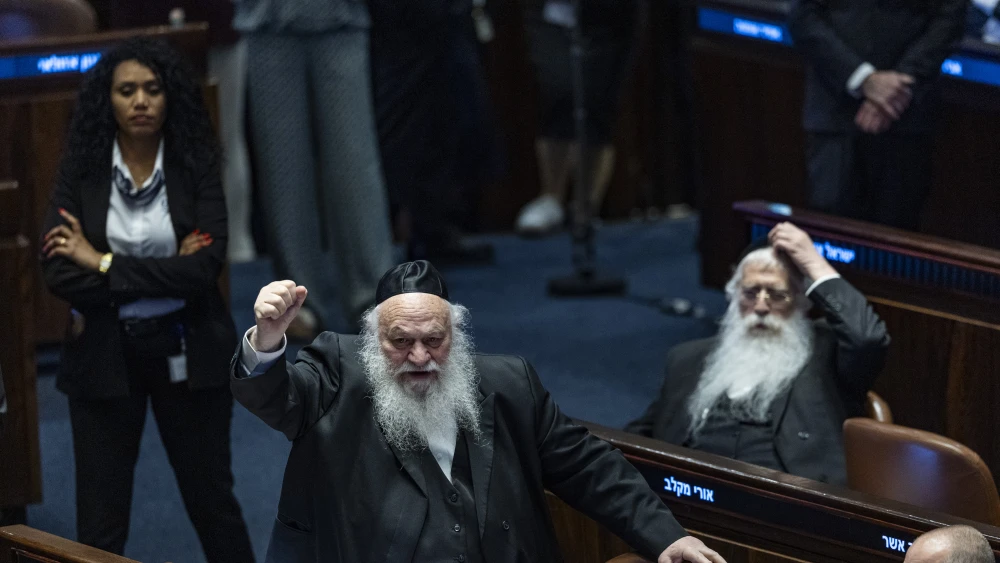
Israel’s High Court of Justice extended a temporary injunction on Tuesday, freezing a law that shields Haredi yeshivah students from arrest for evading mandatory military service, leaving the measure on hold pending a final ruling the court said it would issue “soon.”
The nine-judge panel heard arguments from the Knesset’s legal adviser and the Attorney General’s Office, both of which urged the court to strike down the law.
Representing the Knesset legal adviser, attorney Yitzhak Bart argued that the legislation was passed in violation of parliamentary procedure.
“The law, the way it was legislated, does not align with the rules of procedure of the Knesset,” Bart told the court.
Anar Helman, representing the Attorney General’s Office, argued on ethical grounds that to pass such a law during a time of war was immoral.
Attorney Nathan Rosenblatt, representing the Haredi advocacy group Emet LeYa’akov B’Yisrael, countered that military enlistment remains religiously prohibited absent approval from leading rabbinic authorities.
“So long as there is no directive from the Torah leaders of Israel to enlist, it’s forbidden to enlist,” he told the justices.
The Netanyahu government boycotted the hearing in protest of what it called judicial interference in the legislative process.
‘Direct blow to spiritual and existential security’
Separately, the Council of Torah Sages, which is the senior rabbinic body that sets policy for the coalition Haredi party Shas, issued a letter rejecting the High Court’s authority to rule on the issue.
The council said that, under halachah (Jewish law), it is forbidden to conscript “children of Torah whose Torah is their faith.” Harming Torah scholars, it argued, “is not only a blow to the world of Torah, but also a direct blow to the spiritual and existential security of the State of Israel.”
The letter compared full-time Torah scholars to the biblical Tribe of Levi, whose members were assigned religious duties and exempted from the obligations borne by the other tribes.
“The Tribe of Levi has a role to play, to instruct the people of Israel on the divine path, to explain halachah, to delve into the depths of the Torah,” the letter states. “Therefore, the Holy One, blessed be He, commanded that they be given donations and tithes to support them so that they would fulfill their role and mission in the world, to spread Torah and to instruct in halachah.”
The Knesset had passed the legislation blocking Haredi student arrests by a vote of 58-54 on July 14.
The law would have stopped the detention of Haredi yeshivah students until Nov. 30, barring all criminal proceedings or arrests against those who failed to report for military-related fitness tests or for duty. The law defined a yeshivah student as someone who studies Torah regularly for 45 hours per week and not less than 40 hours.
The court issued its first order freezing the law on July 15. The judges argued that the law contradicted the High Court’s rulings. In June 2024, the court declared that ultra-Orthodox men must be conscripted, effectively ending a decades-long system of exemptions.
Ultra-Orthodox, or Haredi, Jews have received near-blanket exemptions from military service in what started as a release for about 400 Torah scholars at the state’s establishment. The community views military service as a distraction from study and fears that those who are drafted will turn away from religion.
The issue has become increasingly contentious since the Hamas-led terrorist attacks on Oct. 7, 2023, and the ensuing war, as reservists have faced repeated call-ups and public pressure has mounted for the ultra-Orthodox community to share more of the military burden.
Arrests of Haredi yeshivah students who ignored draft orders have repeatedly triggered large-scale protests in ultra-Orthodox communities.