Since Monday, Aug. 10, the Arab village of Qusra in Area B of Samaria, under Israeli security control and Palestinian Authority municipal control, has emerged as a flashpoint after Israeli civilians established themselves in a makeshift encampment near Palestinian homes on the outskirts of the village.
The Israel Defense Forces spokesperson told JNS that the civilians had returned to an area where the military had previously evacuated an unauthorized outpost known as Tel Talpiot several times. The latest escalation occurred after the Israelis expanded the site and moved closer to Palestinian homes, prompting residents to contact security forces.
Arab residents and the Israeli civilians involved have offered competing accounts of what occurred, including allegations that residents were prevented from leaving their homes or otherwise harassed.
The confrontation has also drawn unusual attention from the U.S. State Department, adding a diplomatic dimension to the dispute. The house at the center of the confrontation is believed to belong to a Palestinian-American who lives in the United States.
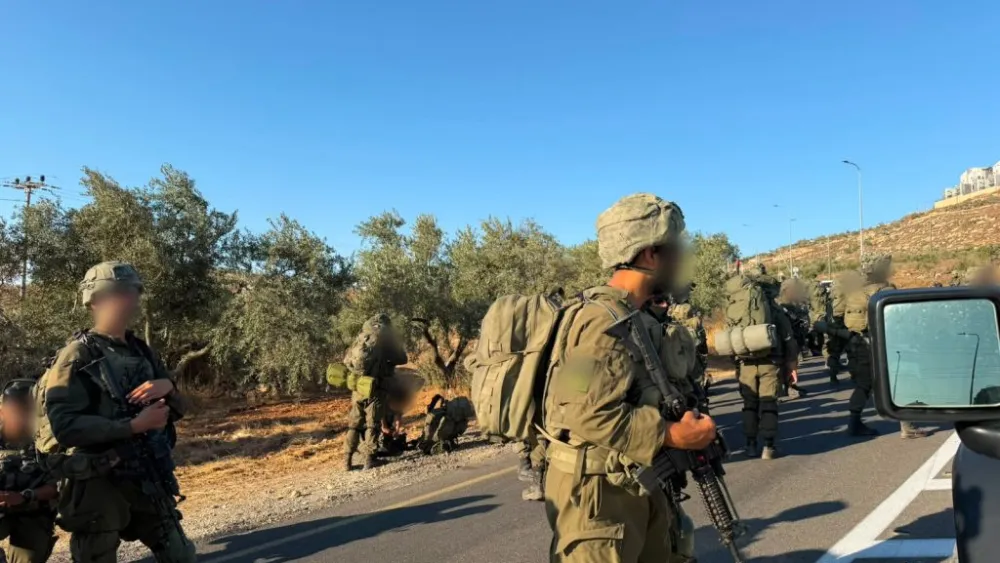
According to the IDF spokesperson, Palestinian residents asked security forces to evacuate the Israelis. Soldiers did so, but the civilians repeatedly returned after the troops left, creating what the spokesperson described as a “game of cat and mouse.”
The military has since expanded its presence in the area and taken measures to prevent further confrontation, including evacuating the Israelis, establishing a closed military zone for Israelis and placing barriers on paths leading toward the village to prevent people from circumventing the main roads and entering the area.
The spokesperson told JNS that the military was not aware of any direct violence against IDF troops or Palestinian residents. Rather, the spokesperson said, the issue involved civilians blocking roads and interfering with efforts by the authorities to enforce the law.
The IDF said it has maintained a battalion in the Qusra area to avert further escalation. The initial force was from the Golani Brigade, which was scheduled to be replaced by a Kfir battalion on Sunday.
On Wednesday morning, Aug. 12, IDF Central Command chief Maj. Gen. Avi Bluth and the commander of the Judea and Samaria Border Police District toured Qusra and nearby outposts and spoke with the Palestinian family living in the house at the center of the dispute.
According to information provided to JNS by the IDF spokesperson, Bluth determined that the Israeli civilians were harassing the family and ordered that they be evacuated. The IDF said the commanders expressed “grave concern” over the civilians’ actions toward the family.
IDF Chief of Staff Lt. Gen. Eyal Zamir subsequently assessed the Qusra situation with Bluth and other senior officers. He ordered the reinforcement of the sector, including the deployment of an additional infantry battalion.
Overnight Wednesday, Aug. 12, security forces once again dismantled two illegal Jewish structures on the outskirts of Qusra and confiscated equipment from the sites. One Israeli was detained.
The spokesperson told JNS that more than 120 illegal outposts had been evacuated by soldiers since the beginning of 2026, describing the Qusra operation as part of a broader military effort to prevent unauthorized Israeli outposts and confrontations in Judea and Samaria.
Responding to the situation, U.S. Ambassador to Israel Mike Huckabee said on Thursday that the U.S. Embassy had been “VERY involved” in efforts to remove the Israelis from the area around the Palestinian homes in Qusra.
In a post addressing a claim that the White House had intervened over the situation, Huckabee wrote on X:
“This is another lie. @usembassyjlm has been VERY involved & the IDF & Israel Police have gone at our request to remove the Israeli terrorists doing this. The actions of those doing this to this family’s home is criminal. The WH hasn’t ‘intervened’ because we have kept DC apprised of the situation already. Actions by those who carried out this horrific act of terror meant to intimidate and harass this family are disgusting. No excuse for such thuggish behavior.”
In a subsequent post, Huckabee sought to distinguish the individuals involved in Qusra from the broader settlement movement. “‘Settlers’ are not the problem in Judea/Samaria. ‘Unsettlers’ are. Very small minority who do great damage to Palestinian families & to Israel. Real settlers like Yisrael Ganz, Governor of Judea/Samaria condemn the actions of the few. Let’s hope the media gives attention to this & balances their stories.”
Ganz told JNS that while some were exploiting the events as part of a campaign against Jewish communities, that should not obscure what he called the “simple truth” that what happened in Qusra “was wrong and is unacceptable to us.”
He also called on the Israeli government to “cancel the Oslo Accords and enable legitimate, regulated Jewish communities throughout the open areas.”
A U.S. State Department spokesperson told JNS that the United States is in “regular dialogue with partners” about improving stability and security in Judea and Samaria, condemns criminal violence in the area “by any party” and that “a stable West Bank keeps Israel secure and is in line with this administration’s goal to achieve peace in the region.”
Israeli Prime Minister Benjamin Netanyahu’s international spokesperson, Doron Spielman, told JNS that Israel shares the concerns of the U.S. government regarding the situation in Qusra, but insisted that U.S. pressure was not what prompted Israel to act on the matter.
“Israel has an excellent relationship with the ambassador of the United States and on this issue, we are both on the same page,” he said.
Spielman emphasized, however, that Israel has been independently working to address the issue, as well as violence by Israelis more broadly in Judea and Samaria.
Netanyahu had made clear in recent weeks that Israel was actively working to prevent such violence, he said, noting that more than 30 arrests had been made and 20 indictments handed down against those engaging in violence.
“We’re aware of this matter. It’s very damaging to the State of Israel. The prime minister has been incredibly vocal on the need to crack down on this. Israel is taking this very seriously. It’s not surprising that Ambassador Huckabee is taking this seriously,” he said.
Elisha Yered, who works with the “Hilltops Front Directorate,” an organization that brings together and supports farms and settlement outposts in Judea and Samaria, told JNS that reports that Jewish activists prevented Palestinian residents from leaving their homes are unequivocally false. He also said that contrary to media reports there was no violence directed at Palestinian residents or IDF soldiers.
Yered said that, on the contrary, soldiers had been seen having coffee and praying alongside the Jewish activists at the site, and that the activists had maintained cooperation and good relations with soldiers in the area.
In a lengthy post on X, Yered argued that the Palestinian home at the center of the controversy is part of a broader effort by the P.A. to establish a presence and gain control of a strategically located mountain outside the village itself.
Yered said that about eight months ago, a group of families and young men established the Tel Talpiot site at the top of the mountain. He specifically accused Qusai Abu Ridi, who lives in the home at the center of the controversy, of involvement in attacks against Jews. Yered shared videos that he said show masked Palestinians throwing rocks from the vicinity of Abu Ridi’s home at Jewish hikers and shepherds.
Yered also alleged that Abu Ridi had been involved in a violent attack on a shepherd, during which Abu Ridi and others restrained the man while another person attempted to strike him with a hoe. Yered said Abu Ridi was arrested and later released. He further alleged that Palestinians had planted explosive devices in the area and that gunfire had been directed toward Tel Talpiot from the vicinity of the home several weeks ago.
According to Yered, the immediate dispute began after Jewish shepherds, during a period of extreme heat, erected a structure on the slopes of the hill for shade about two weeks ago. Yered said that despite the allegations against the Palestinian residents, “no one acted violently” toward the family, no one prevented them from leaving or returning to their home, and no one assaulted security forces.
He said that when security forces later moved to dismantle structures and confiscate equipment from the site, several dozen Jewish teenagers attempted to block a road to prevent the confiscation of a Ranger vehicle, but that “none of them raised a hand or acted violently.”
Daniella Weiss, director of the Nachala Settlement Movement, told JNS that the confrontation in Qusra is part of a broader conflict over control of state land in Judea and Samaria.
Weiss argued that the division of the territory into Areas A, B and C under the Oslo Accords has not been respected by the Palestinians, pointing to what she described as thousands of Palestinian homes built in Area C, and efforts promoted by former P.A. Prime Minister Salam Fayyad to expand Palestinian construction and agricultural activity there.
Following the Oct. 7, 2023, Hamas attack, Weiss said, many Israelis concluded that there was no possibility of achieving peace with the Palestinians. She said the growth of new Jewish communities over the past two years had created an “irreversible map” in Judea and Samaria and “literally put an end to the Oslo accords.”
“The spread of new farms in area B creates conflicts with the Arabs and also with the IDF,” said Weiss.
She added that the current emphasis among the settlement movement is shifting beyond Judea and Samaria, saying, “Now the emphasis is on establishing Jewish communities in Gaza.”
A spokesperson for the Binyamin Regional Council, speaking on behalf of Ganz, declined to directly address Weiss’s comments but doubled down on the council’s opposition to violence while reiterating its support for legal farms in Judea and Samaria established in coordination with the IDF.
The council considers legal farms an important component of the region’s security, the spokesman said, arguing that they strengthen Israel’s ability to defend the area.
“We believe that the farms are a huge support of the security defense of the area and the army agrees with it 100%,” the spokesperson said. “We are proud to support the farms, a very important part of the security of the area and secure all of Israel. We have farms that without them, Ben-Gurion Airport would be in danger.”
The spokesperson also once again called for the government to end the Oslo framework and eliminate the distinctions between Areas A, B and C, arguing that a new approach would benefit residents of all communities and religions in the region.
“We believe that for the good of all residents and all religions we have to give a new future for the area,” the spokesperson said.
The IDF spokesperson emphasized that civilians cannot take the law into their own hands, regardless of their views regarding ownership of the territory.
“To take the law into your own hands and try to prevent [them from leaving] because you feel that they’re not obligated or they’re not allowed to leave where they live, it’s not your job,” the spokesperson said. “Even if I truly believe that it’s mine, there’s a law.”