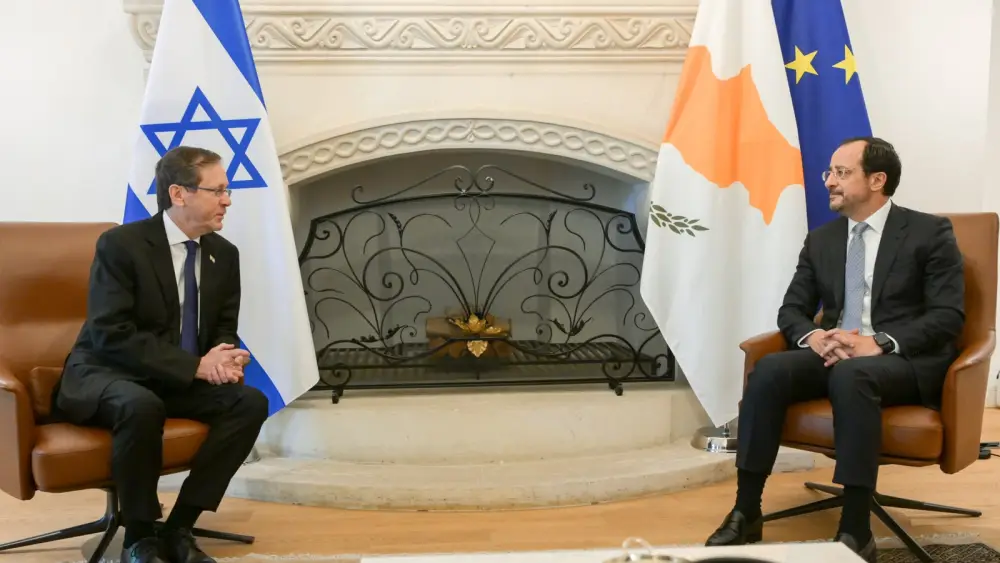
Israeli President Isaac Herzog met with Cypriot President Nikos Christodoulides at the Presidential Palace in Nicosia on Thursday, voicing hope for expanded Mediterranean diplomacy that could eventually encompass Beirut.
During their private consultations and expanded bilateral meetings, the two heads of state discussed methods to bolster strategic ties across security, trade, energy and tourism.
“My dream is for the president of Israel and the president of Cyprus to meet together with the president of Lebanon here,” Herzog said. “I believe that we should move toward peace in our region while making sure that terror is shunned and removed, and that life thrives between nations and peoples for the well-being of the entire region and the world.”
Christodoulides welcomed Herzog as a close partner, emphasizing shared regional interests.
“I am looking forward to our discussion on how to enhance our strategic partnership at all levels,” the Cypriot leader said, pointing to defense and economic cooperation to foster stability across the Eastern Mediterranean.
Following the meeting, Christodoulides said that Nicosia sees “great value in re-energizing our trilateral and 3+1 formats, including with the United States,” with an eye toward regional connectivity frameworks such as the India-Middle East-Europe Economic Corridor (IMEC).
He added that bilateral cooperation encompasses “economy, health, trade and energy to infrastructure, education, defence, cybersecurity and maritime security.”
Oren Anolik, Israel’s ambassador to Cyprus, told JNS on Thursday that Herzog’s visit is a manifestation of the very close relationship between the countries.
“I think this is President Herzog’s third visit while I have been ambassador. You can see from the way he was welcomed by President Christodoulides how much he is liked and appreciated,” Anolik said.
The conversation between the leaders was “very warm, very friendly and very open,” he continued.
“We discussed things that can be done further to bring the countries and both peoples closer together. This is a very wonderful way to close the Jewish year and begin a new one, taking more steps to climb this ladder of relations,” the ambassador said. “I can say, after witnessing the discussions, that I am very optimistic about the future of these ties.”
Cyprus and Israel have made strides in our bilateral relations, building a truly strategic partnership.
— NikosChristodoulides (@Christodulides) September 10, 2026
Our relationship is anchored in a broad agenda – from economy, health, trade and energy to infrastructure, education, defence, cybersecurity and maritime security. We are… pic.twitter.com/tOAHBdMgSG
Israel, Cyprus advance emergency-response cooperation
Israel and Cyprus are advancing cooperation on emergency preparedness and response, including a joint work plan for 2026-27, Israel’s Defense Ministry said on Wednesday following a two-day visit by National Emergency Management Authority chief Brig. Gen. (res.) Itzik Bar.
Bar met with senior Cypriot defense, interior and civil-defense officials, with talks focusing on professional coordination, exchanges of operational experience and additional mechanisms for responding to major emergencies.
The visit also included the Cyprus Regional Aerial Firefighting Station at the Paphos Airbase. The Defense Ministry said the stop was part of preparations for Israel to join a regional coordination framework for responding to large-scale wildfires.
ישראל וקפריסין מחזקות את שיתוף הפעולה בתחום ההיערכות והמענה לחירום
— משרד הביטחון (@MoDIsrael) September 9, 2026
להמשך קריאה:https://t.co/1IhCDqRQq5 pic.twitter.com/pfoLjHW9c7