Newsletter
Newsletter Support JNS

Israel launches Greek award honoring World War II legacy

The initiative comes amid burgeoning ties among the eastern Mediterranean allies who have united to push back against contemporary regional threats.

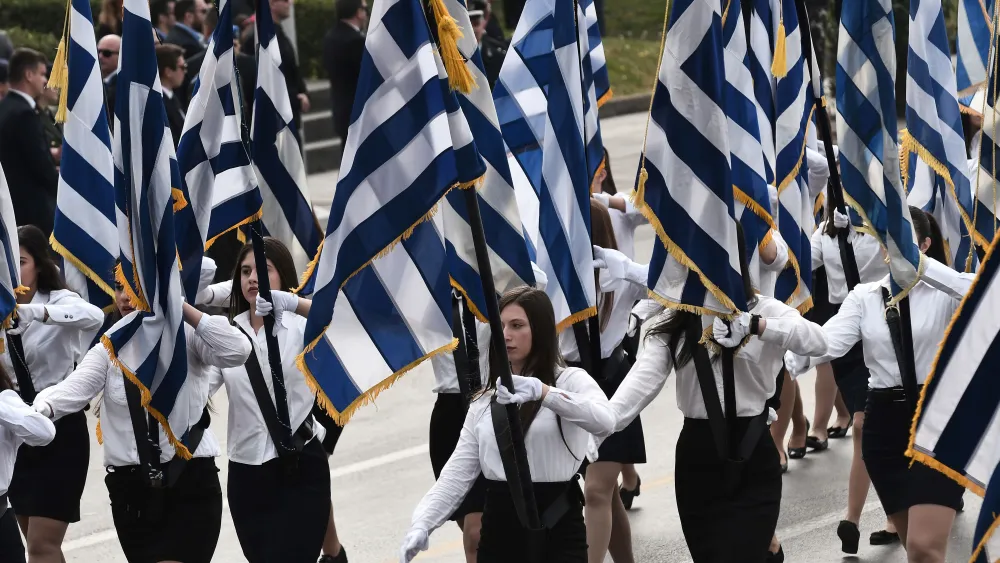
Students holding Greek flags take part in a military parade in Thessaloniki on Oct. 28, 2018, during the celebrations marking Greece's National "Oxi" (No) Day, commemorating Greece's refusal to accept the ultimatum advanced by fascist Italy in 1940 during World War II. Photo by Sakis Mitrolidis/AFP via Getty Images.
Students holding Greek flags take part in a military parade in Thessaloniki on Oct. 28, 2018, during the celebrations marking Greece’s National “Oxi” (No) Day, commemorating Greece’s refusal to accept the ultimatum advanced by fascist Italy in 1940 during World War II. Photo by Sakis Mitrolidis/AFP via Getty Images.
SAKIS MITROLIDIS/AFP via Getty Images

Israel on Wednesday launched an annual Hellenic Education & Community Award marking the anniversary of Greece’s refusal to allow Italian troops to enter the country during World War II.

The award, announced by the Israeli Embassy in Greece and titled ‘No — Honoring courage, inspiring the future generations’, will honor a Greek educational institution, community or social initiative that embodies the country’s shared values.

This year, Israel will provide modern educational technology and equipment to the Model Ecclesiastical High School of Xanti, a city in northeastern Greece in the region of East Macedonia and Thrace that suffered profoundly during World War II.

The honors mark Greece’s historic refusal of an ultimatum from Italian dictator Benito Mussolini on Oct. 28, 1940, demanding that Italian troops be allowed to enter and occupy strategic sites across Greek territory.

Then Greek Prime Minister Ioannis Metaxas famously rejected the demand, replying in French: “Alors, c’est la guerre” (“Then, it is war”), which the Greek public and press soon popularized into the single, defiant word “Oxi” (No).

Italian forces invaded Greece from Albania shortly after the response, triggering the Greco-Italian War. Greek forces mounted a fierce defense and pushed the Italian army back into Albania, scoring the first major Allied land victory of World War II. Nazi Germany invaded Greece on April 6, 1941, to bail out its failing ally.

Greeks worldwide mark this historic act of resistance on Oct. 28 as Oxi Day.

“A historic NO” becomes a resounding “YES” to the future of Greece’s children,” the Israeli Embassy in Greece posted on X.

The initiative comes just weeks after an Israeli parliamentary group was launched in the Greek parliament, deepening the historic partnership among eastern Mediterranean allies.

Etgar Lefkovits, an award-winning international journalist, is an Israel correspondent and a feature news writer for JNS. A native of Chicago, he has two decades of experience in journalism, having served as Jerusalem correspondent in one of the world’s most demanding positions. He is currently based in Tel Aviv.
“I’m scared of what’s going to happen now,” Miri Bar-Halpern, a Jewish psychology lecturer at Harvard Medical School, told JNS. “I can already predict the backlash.”
The country’s next government will depend on whether its political leaders can reconcile their competing commitments, or whether voters will again be asked to resolve a deadlock that negotiations could not.
“They will push legislation very hard to end the Iran war, and it’s not inconceivable that they could get a fair amount of Republican support for that,” William Galston of Brookings told JNS.
Belgrade police killed the minor, who was armed with two knives and was tied to the Islamic State, the Serbian Interior Ministry said.