


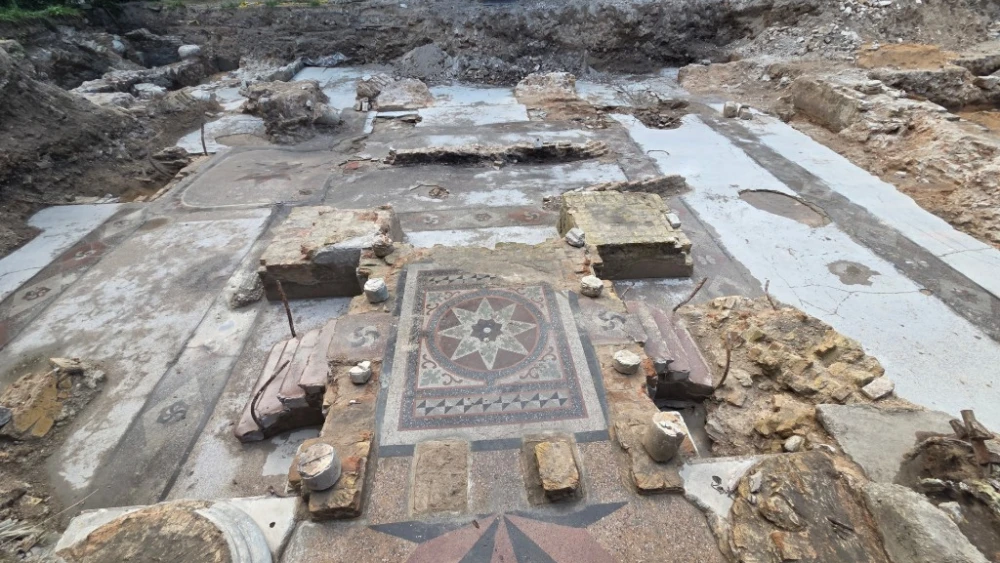
Israeli archaeologists have fully uncovered the large central bimah—the raised platform used for Torah readings—at the site of the Great Synagogue of Vilna in Vilnius, Lithuania, one of Europe’s most important Jewish religious centers, following a month of excavation work, the Israel Antiquities Authority announced on Tuesday.
The excavation also uncovered sections of the main prayer hall and women’s gallery, colorful terrazzo floors, seating plaques bearing worshippers’ names, and a metal plaque engraved with the Ten Commandments.
The synagogue, closely associated with Rabbi Eliyahu Kramer, better known as the Vilna Gaon (“Genius of Vilna”), the renowned 18th-century rabbinic scholar, was destroyed by Nazi Germany during World War II and later demolished by Soviet authorities, according to the excavation organizers.
Research and excavation at the synagogue and the surrounding communal compound, known as the Shulhoyf (Yiddish for “synagogue courtyard”), has continued since 2011. This is the sixth excavation season, conducted jointly by the Israel Antiquities Authority and Lithuania’s Cultural Heritage Preservation Forces.
Excavation directors Dr. Jon Seligman of the Israel Antiquities Authority and Justinas Račas of the Lithuanian heritage agency said removing the former school building that had stood over the historic synagogue made the latest discoveries possible.
“The removal of the old school building that covered the historic synagogue enabled us, for the first time, to expose additional extensive and continuous sections at the heart of the building,” Seligman and Račas said in a joint statement.
Among the discoveries were seating plaques marking reserved seats for individual worshippers. Some named women who prayed in the synagogue’s women’s gallery, while others bore men’s names or identified seats belonging to members of a charitable society that helped administer Vilna’s Jewish community.
One plaque marked a seat donated by Gitel Klachek, identified as the wife of the late Yechezkel, the city’s shamash—a synagogue official responsible for announcements, administration and other communal affairs. According to the excavation organizers, the Klachek family owned several businesses on streets surrounding the synagogue.
The archaeologists said the discoveries provide fresh insight into centuries of Jewish religious and communal life that flourished at the site before the destruction of Vilna’s Jewish community in the Holocaust.
The excavation is funded by the Good Will Foundation and carried out in cooperation with the Lithuanian Jewish (Litvak) community.


