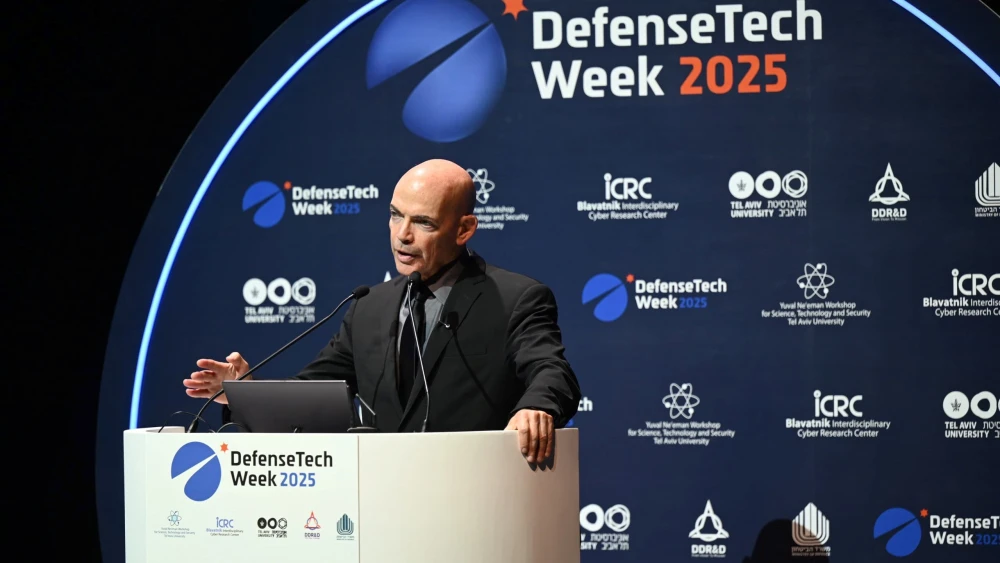
The next phase of weapons development in Israel is expected to involve greater cooperation with the United States on production, Brig. Gen. (res.) Daniel Gold told Globes in an interview published on Saturday, as he marks his 10th year as head of the Israeli Ministry of Defense’s Directorate of Defense Research and Development, also known as Maf’at.
“We are operating according to [Defense Ministry] Director General [Maj. Gen. (res.)] Amir Baram’s strategy, which has been published and will be updated further regarding full independence throughout the supply chain,” Gold was quoted as saying in reference to Israel’s objective to become more independent in arms manufacture.
The Memorandum of Understanding signed in 2016 by Prime Minister Benjamin Netanyahu and then-U.S. President Barack Obama, securing a $3.8 billion annual American aid package for defense purposes, entered into effect in 2018 and expires in 2028.
Jerusalem and Washington are working on the next 10-year MoU, which is projected to diminish or even remove U.S. financing, and instead focus on joint development projects.
“There is going to be a lot of joint production, although even now there is [air defense systems] David’s Sling, Arrow and Iron Dome, which was developed with Israeli funding and is produced jointly,” Gold told Globes.
In addition to production in Israel, Iron Dome interceptors are also manufactured at a plant in Arkansas. Gold said that 50% of production of the Israeli-developed Iron Beam, a laser defense system, is also being manufactured in the U.S., as part of a financing deal.
“The issue [of the MoU] is currently under discussion, and we will see what comes of it. In Israel, we are accelerating things massively so that we can become independent. In basic research and development of fundamental knowledge, we are doing amazing things; in production, we were independent, but it depends on what you are talking about. Israel is investing billions in manufacturing infrastructure,” the Israeli official continued.
“There is global competition for resources; countries are driving up prices threefold and prioritizing themselves. It is a serious struggle,” he added.
“R&D, technology and game-changing capabilities must grow significantly, by a factor comparable to the rest of the world, which is increasing its R&D budgets wildly. Not only our enemies, but our competitors as well. Major development and R&D programs depend on this.”
The Iranians ‘are trying to learn or guess what we are doing’
Gold, the mastermind behind the Iron Dome missile air defense system—considered one of Israel’s most efficient interceptors of short-range aerial threats—received four Israeli Air Force Commander’s Awards and the Israel Defense Prize before deciding to leave the Israel Defense Forces in 2014. He also lit a torch at Israel’s main state Independence Day ceremony in Jerusalem in 2015, before returning the following year to state duty as the head of Ma’fat.
Israel met Iran’s challenge successfully, achieving air superiority above the Islamic Republic in the most recent round of fighting, and downing a number of UAVs unprecedented in the Middle East over the last three years, Gold went on to say.
He stressed, however, that Israel and Iran are engaged in a learning race, with Tehran studying Israel’s capabilities, manufacturing more ballistic missiles and changing its methods.
“They are trying to learn or guess what we are doing and get around it. They are not hitting us very effectively, but they are trying to fine-tune their attacks,” the Ma’fat chief said.
Gold said that Israel’s interception rate for ballistic missiles and UAVs in “Operation Rising Lion” in June 2025 stood at 86% and in the 40-day “Operation Roaring Lion” that started on Feb. 28 at 92%.
The hypersonic threat
Israel is already a significant space power, and is looking to improve in this area, Gold told Globes.
“We have high-quality radar and imaging satellites, and we have also launched a communications satellite,” he said. “Everything I can do, I do from space, which means very high-quality satellites as well as constellations of satellites carrying out missions in intelligence and defense,” he added.
One of the most challenging threats Ma’fat faces in the future battlefield are hypersonic missiles, which combine capabilities associated with ballistic and cruise missiles, the official continued.
Although they do not reach the altitudes of ballistic missiles, they can fly at roughly 19 to 44 miles above the ground, while traveling at extremely high speeds of about 34,000 to 45,000 mph, according to Gold. Their highly maneuverable flight paths, likened to a pebble skipping across the surface of water, make them significantly more difficult to intercept.
“The whole world is working on the hypersonic threat: the United States, Russia and China—it is a real race. China and Russia already have operational capabilities; the United States does not yet, but it will. Our active defense systems, and not only defensive systems, need to be prepared for the threat,” Gold said.