Newsletter
Newsletter Support JNS

MK Sharren Haskel backs formation of unity government

The Israel First leader and former deputy foreign minister told JNS that Israel must bridge its political divisions after three years of war.

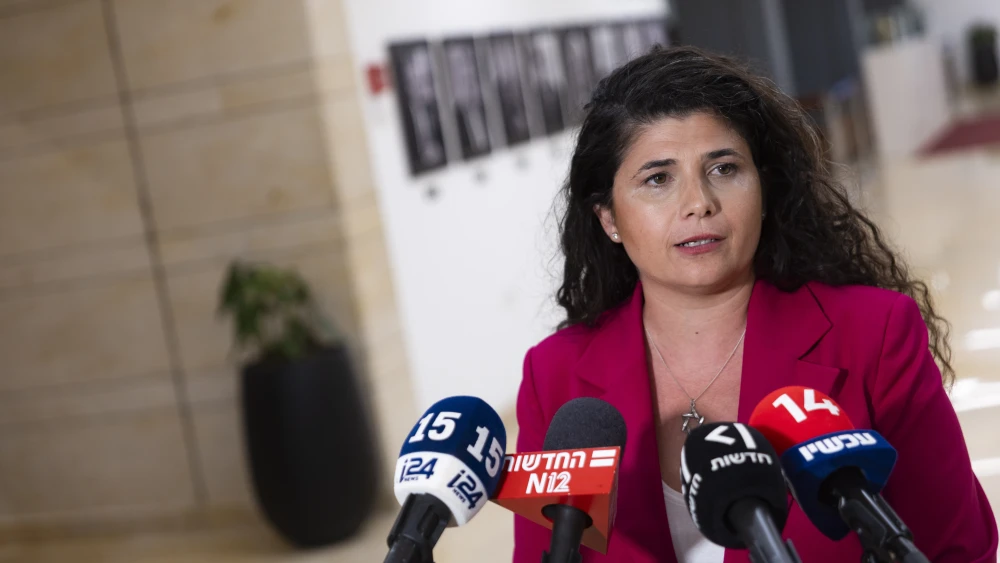
Knesset member Sharren Haskel, speaking in Jerusalem, announces her resignation as deputy foreign minister, July 14, 2026. Photo by Chaim Goldberg/Flash90.
Sharren Haskel, speaking in Jerusalem, announces her resignation as deputy foreign minister, July 14, 2026. Photo by Chaim Goldberg/Flash90.

Former Israeli Deputy Foreign Minister Sharren Haskel, leader of the Israel First party, supports the formation of a broad national unity government post-elections on Oct. 27.

In an interview with JNS ahead of Tuesday’s vote, Haskel said Israeli politics are divided into two camps centered on Israeli Prime Minister Benjamin Netanyahu, leaving little room for parties unwilling to align themselves with either side.

“What we have today in politics is two camps: the Bibi camp, where everything he says is completely holy, and the anti-Bibi camp, where everything he says is a crime,” Haskel said.

Haskel argued that Israel First could break that political deadlock by denying either bloc the ability to form a government without it.

“If we pass the threshold, we are the only party that will be able to force both of these camps to sit together,” she said. “Unless we find a way to put that hatred aside and force them to sit together, we’re all losing.”

Haskel, who resigned as deputy foreign minister on July 14 and subsequently launched Israel First, said the party would support a government that does not depend on sectoral parties she accused of putting their own interests ahead of the country’s.

“We need a strong government. We need a united government,” Haskel said. “And we need a government that doesn’t look at sectoral interests, but at the good of Israel—that puts Israel first.”

Watch the full interview here.
Steve Linde, the JNS features editor, is a former editor-in-chief of The Jerusalem Post and The Jerusalem Report and a former head of Kol Yisrael English News. Born in Harare, Zimbabwe, he grew up in Durban, South Africa, and has degrees in sociology and journalism. He made aliyah in 1988, served in IDF Artillery and lives in Jerusalem.
“I’m scared of what’s going to happen now,” Miri Bar-Halpern, a Jewish psychology lecturer at Harvard Medical School, told JNS. “I can already predict the backlash.”
The country’s next government will depend on whether its political leaders can reconcile their competing commitments, or whether voters will again be asked to resolve a deadlock that negotiations could not.
“They will push legislation very hard to end the Iran war, and it’s not inconceivable that they could get a fair amount of Republican support for that,” William Galston of Brookings told JNS.
Belgrade police killed the minor, who was armed with two knives and was tied to the Islamic State, the Serbian Interior Ministry said.