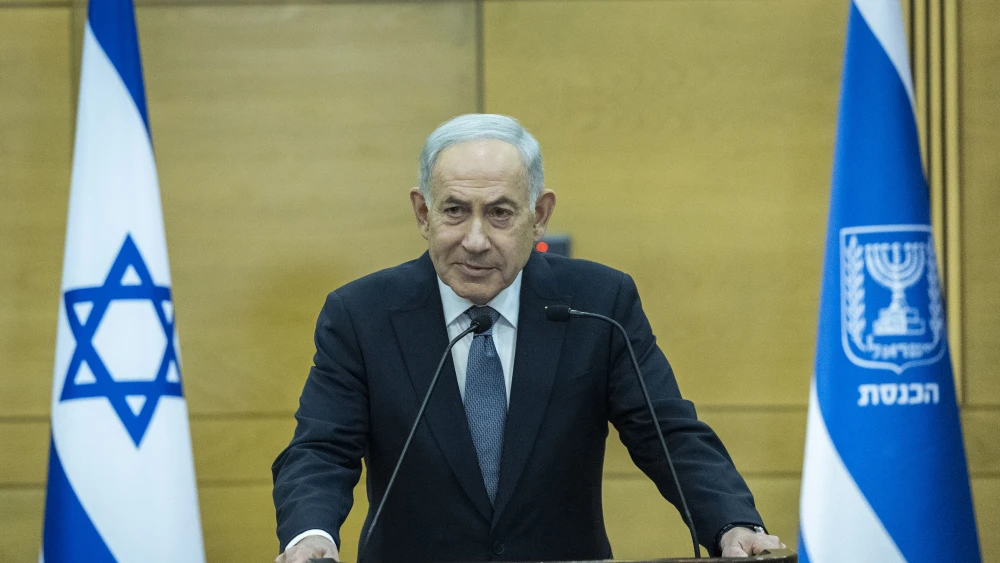
Israeli Prime Minister Benjamin Netanyahu reacted on Wednesday to the recommendation of judges in his corruption trial to drop some of the charges against him, saying that he is extending a hand “on this very day” in reconciliation.
“I said 10 years ago: there will be nothing, because there was nothing. But it took 10 years for this truth to be revealed for all to see,” Netanyahu said, in a televised address from the Knesset.
He called to end the trial, effective immediately, adding that the personal boycotts against him must cease.
He further lamented the years of “inflated articles, false leaks, tendentious testimonies. I wanted to say ‘every evening,’ but it isn’t every evening. It’s morning, noon, evening and night.”
The premier described the prolonged process of the trial as “terrible suffering for me, for my wife, for my sons—of absurd investigations, of character assassination, of severe incitement that wounds the soul. Who will give us back these years?”
He also noted that his associates endured a series of humiliations in interrogation rooms, in an attempt to get them to give false testimony against him. For many, “their lives were ruined,” he continued.
Netanyahu said that the trial was geared at demonizing him and his family, framing him not as the prime minister of Israel but as “the defendant.” The billions of shekels spent on repeated election campaigns and investigations could have gone to Israel Defense Forces reservists, residents of the north and the south, and all Israeli citizens, he said.
He then addressed a bill being advanced by the opposition that seeks to bar anyone who has been indicted from running for prime minister.
“On this very day, when we finally saw a ray of truth and justice, on this very day, something astonishing is happening in the Knesset,” Netanyahu said. He claimed his political rivals are seeking to push through the legislation because of what he sees as the collapse of the cases against him.
“This is a tool for political elimination. Do you know where this is done? In Iran ... in North Korea, in dictatorships,” he said.
Netanyahu ended his statement by calling for unity, saying that the “immense and immediate” dangers Israel is facing require coming together.
היום נפל דבר. היום נפל המשפט. אמרתי לפני עשור 'לא יהיה כלום כי לא היה כלום', אבל לקח עשור כדי שהאמת הזו תיחשף לעיני כל.
— Benjamin Netanyahu - בנימין נתניהו (@netanyahu) November 25, 2026
צפו >> pic.twitter.com/tTWe1Odwcr
Judges propose dropping main charge, resolving others
Earlier on Wednesday, the judges in Netanyahu’s trial said in a hearing attended by Attorney General Gali Baharav-Miara that the chances of conviction in two of the cases against the premier are low, proposing to drop the first case and hear arguments from the parties regarding the second.
As for the third case, Justice Rivka Friedman-Feldman told Baharav-Miara that an agreement could be reached and that the parties should “strive to conclude the trial.”
Last week, the judges ordered Baharav-Miara to appear in court, despite the latter’s objection. They were expected to demand a response from the attorney general, who has yet to make a decision regarding their recommendation to withdraw some of the charges.
Friedman-Feldman on Wednesday clarified that her remarks were not a judicial ruling, but were based on the judges’ “impression” and “insights” thus far.
“We propose considering dropping the first charge,” she said in summary. “Regarding the second charge, we propose hearing arguments from the parties. And regarding the third charge, we propose reaching a conclusion and verdict.”
Shaul Sharf, senior lecturer in constitutional law at the Peres Academic Center in Rehovot, told JNS that “Case 2000 has shattered into 2,000 pieces. Case 4000 has shattered into 4,000 pieces. I expect Case 1000 to eventually shatter into at least 1,000 pieces.” This, he said, was no coincidence. “All three cases emerged from the same institutional breeding ground, whose serious professional and legal deficiencies have been exposed by the defense. The very flaws that, in my view, have undermined the first two cases are likely to determine the fate of the third,” he continued.
However, he warned that the judge’s statement on Wednesday was not sufficient, and that “judicial courage” was now required.
“Yesterday’s judicial intervention should not be mistaken for the beginning of the end,” he told JNS. “The prosecution faces an institutional trap: acknowledging its failures would expose it to public accountability and potentially legal consequences. It therefore has little incentive to admit its mistakes,” he said.
After a decade of investigations and six and a half years of trial, “Judicial skepticism is no longer enough. What is required now is judicial courage. Unless the judges translate their concerns into meaningful judicial action, yesterday’s intervention may prove to be little more than a footnote in a prolonged legal saga,” he concluded.