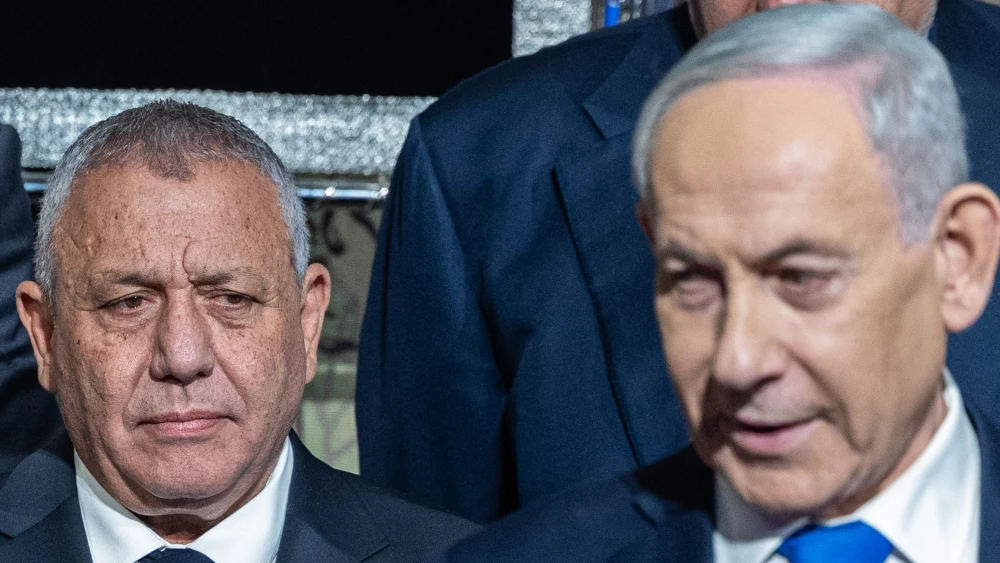
Israeli Prime Minister Benjamin Netanyahu and Yashar party chairman Gadi Eisenkot held a two-hour security briefing in Jerusalem on Thursday, following a public dispute over intelligence updates and reports of disagreements over possible military action against Iran.
The meeting at the Prime Minister’s Office was attended by Netanyahu’s military secretary.
“The security briefing held by Prime Minister Benjamin Netanyahu and his Military Secretary Maj. Gen. Guy Markizeno for Yashar Chairman Gadi Eisenkot has now concluded,” according to a joint statement issued by Netanyahu and Eisenkot.
“Eisenkot was briefed on the security and diplomatic challenges presently faced by the State of Israel. The parties agreed to proceed with mutual updates as the need arises.”
The meeting came four days after Israeli President Isaac Herzog tasked Eisenkot, a former IDF chief of staff, with forming Israel’s next government following the Oct. 27 election.
Eisenkot received the mandate after parties with 67 members of the newly elected Knesset recommended him for prime minister, compared with 46 who backed Netanyahu. Neither political bloc, however, commands a majority in the 120-seat legislature.
Dispute over security briefings
The meeting followed two letters sent by Eisenkot on Wednesday, one to Netanyahu warning against unnecessary military action during the political transition and another to Attorney General Gali Baharav-Miara seeking her intervention to secure regular intelligence and security briefings.
In his appeal to the attorney general, Eisenkot accused Netanyahu’s office of failing to respond to repeated requests for updates on Israel’s security situation.
He argued that, as the lawmaker tasked with forming a government, he should receive regular, structured and comprehensive briefings, particularly in the absence of an official opposition leader.
Eisenkot also urged Baharav-Miara to ensure that military operations were properly discussed and approved by the regular Cabinet and Security Cabinet, as required by law.
Netanyahu’s office rejected Eisenkot’s accusations, saying that all security decisions had been made on professional grounds and in proper coordination.
“All decisions made by the government led by Prime Minister Netanyahu were made solely based on security considerations and in full coordination with the security establishment,” the Prime Minister’s Office said.
“Eisenkot’s letter is an irresponsible move to discuss sensitive security issues in public. This is a transparent attempt to introduce politicization into Israel’s national security issues,” it added.
The Prime Minister’s Office urged Eisenkot to join a Netanyahu-led government.
Netanyahu maintained that arrangements for a security briefing had already been initiated before Eisenkot approached the attorney general.
The briefing was initially expected to be conducted by Markizeno alone, before Netanyahu joined the meeting.
The two political rivals later issued a joint announcement confirming that the prime minister would attend in person.
Iran tensions
The dispute unfolded against the backdrop of reports of disagreements between Netanyahu and IDF Chief of Staff Lt. Gen. Eyal Zamir over the possibility of renewed military action against Iran.
Netanyahu was reportedly considering military action despite reservations among senior defense officials about the risks of escalation. The reports of disagreements have not been independently confirmed.
In his letter to Netanyahu on Wednesday, Eisenkot urged the caretaker government to exercise restraint and avoid military operations that were not urgently required to address an immediate threat.
He warned that deploying security forces without an immediate threat that could not be postponed could have serious consequences for Israeli democracy and public confidence in state institutions.
Eisenkot called on Netanyahu to act responsibly and avoid military action that could be delayed until a new government was sworn in.
Netanyahu rejected Eisenkot’s criticism as irresponsible, urging him to refrain from spreading fear and division.
Defense Minister Israel Katz also defended the government’s authority to make security decisions during the political transition.
“We do not need approval from the opposition or any legal authority to instruct the IDF,” Katz wrote on X on Thursday.
He stressed that Israel’s security could not be placed on hold while political negotiations continued.
Later Thursday, following a security assessment with Zamir and senior defense officials, Katz rejected suggestions of a rift over Iran and insisted that the political and military leadership were making decisions on Iran responsibly and in coordination.
“The prime minister, the chief of staff and I see eye to eye on the Iranian issue in all its aspects, and we will continue to act together and do whatever is required to ensure the security of the State of Israel and protect its citizens,” he said.
Political transition
The briefing marked a significant encounter between Netanyahu and Eisenkot as the Yashar leader seeks to assemble a governing coalition.
Although Herzog entrusted Eisenkot with forming the next government, Netanyahu remains prime minister, and his caretaker government retains responsibility for Israel’s security and foreign policy.
Both Netanyahu and Eisenkot have called for a national unity government, while coalition negotiations continue among the parties elected to the 26th Knesset.
Thursday’s joint statement did not disclose whether Iran was specifically discussed or whether the two leaders reached any understandings beyond their agreement to continue exchanging security and diplomatic updates as necessary.