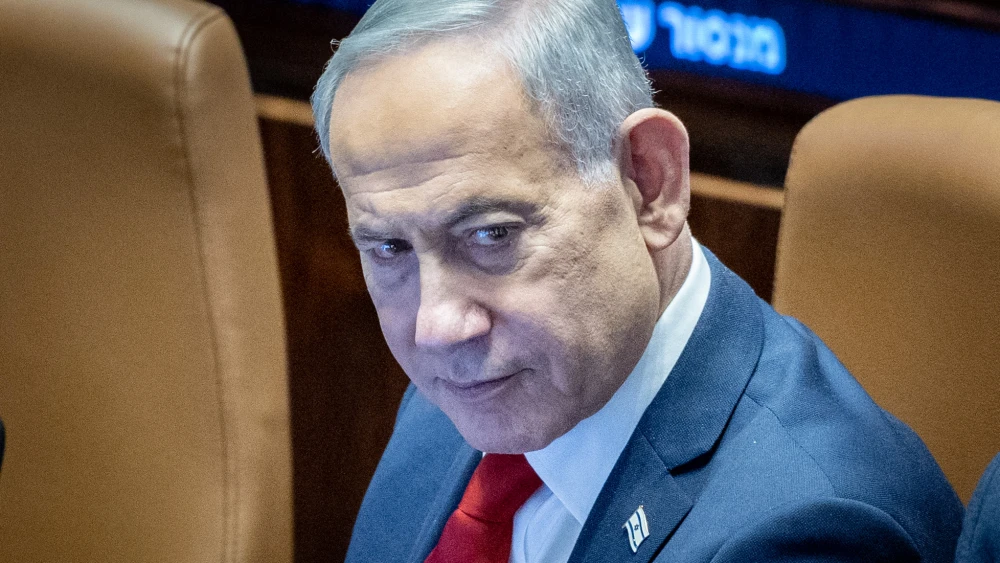
Tehran is “once again working to revive its nuclear program,” Israeli Prime Minister Benjamin Netanyahu said on Saturday night, calling on his political rival Gadi Eisenkot to establish a national unity government that will deal with the Iranian threat together.
Netanyahu called on the former military chief to accept coalition negotiations “without preconditions” and accept agreements “for the sake of Israel’s security and future.”
The Iranian regime that murdered thousands of its own people “will not hesitate to use nuclear weapons against us,” Netanyahu warned in a recorded message delivered to the press. “We must remove this existential threat hanging over our heads once and for all,” he continued.
Netanyahu said that a narrow government reliant on the 19 Knesset seats of the Arab parties, or on some of their lawmakers, whom he branded “supporters of terrorism,” will not be able to accomplish this task.
But a national unity government, he stressed, “can achieve it in time, thereby ensuring Israel’s security for many years to come.”
Netanyahu moreover said that a unity government composed of all the parties that support Israel as the nation-state of the Jewish people “will answer the yearning” of many citizens.
He said that the issue of military conscription—one of the main issues around which the Oct. 27 election revolved—can be resolved in a unity government together with the ultra-Orthodox parties.
The appropriate response to those who “deliberately walked out” during the singing of “Hatikvah,” Israel’s national anthem, during the swearing-in ceremony of the new Knesset on Tuesday, is to establish the Government of Hope, the premier said.
Eisenkot reiterates call to Netanyahu to ‘break with the extremists’
Shortly afterward, Eisenkot released a Hebrew-language statement labeling Netanyahu’s plea for a unity government “another political spin.”
The chairman of Yashar party said that there is no need to call for a negotiation meeting since one has already been scheduled for Sunday.
He said that Netanyahu is fully aware of his conditions for joining a national emergency government under his leadership, which include “a break with the extremists,” apparently referring to the factions of ministers Bezalel Smotrich and Itamar Ben-Gvir, the heads of the Religious Zionist and Otzma Yehudit parties, respectively.
Eisenkot went on to say that Netanyahu knows that he “lost the election,” with “an absolute majority of Israeli citizens and the Knesset” opposing him.
He charged the incumbent prime minister with placing obstacles in the way of forming a new government and thwarting the replacement of the Knesset speaker.
Eisenkot said that the plan to appoint Yashar party lawmaker Matan Kahana to the role of the Knesset speaker on Tuesday will be the “next test” for Netanyahu’s Likud and his allied Religious Zionist party, “to prove how serious they are” about a national unity government.
ביום חמישי קיימתי שיחה חשובה עם גדי איזנקוט. גדי ואני מכירים אחד את השני שנים רבות, מאז כהונתו כרמטכ”ל ועוד לפני כן.
— Benjamin Netanyahu - בנימין נתניהו (@netanyahu) November 14, 2026
פגישה זו רק חיזקה אצלי את ההבנה כמה הכרחי להקים בעת הזאת ממשלת אחדות לאומית - ממשלה שתכלול את כל המפלגות שתומכות בקיומה של מדינת ישראל כמדינתו של העם היהודי,… pic.twitter.com/S9mEEa6D9t
Netanyahu, Eisenkot meet for security briefing
On Thursday, Netanyahu and Eisenkot held a two-hour security briefing in Jerusalem, following a public dispute over intelligence updates and reports of disagreements over possible military action against Iran.
“The security briefing held by Prime Minister Benjamin Netanyahu and his Military Secretary Maj. Gen. Guy Markizeno for Yashar Chairman Gadi Eisenkot has now concluded,” according to a joint statement issued by Netanyahu and Eisenkot.
“Eisenkot was briefed on the security and diplomatic challenges presently faced by the State of Israel. The parties agreed to proceed with mutual updates as the need arises.”
The meeting came four days after Israeli President Isaac Herzog tasked Eisenkot with forming Israel’s next government.
Eisenkot received the mandate after parties with 67 members of the newly elected Knesset recommended him for prime minister, compared with 46 who backed Netanyahu. Neither political bloc, however, commands a majority in the 120-seat legislature.