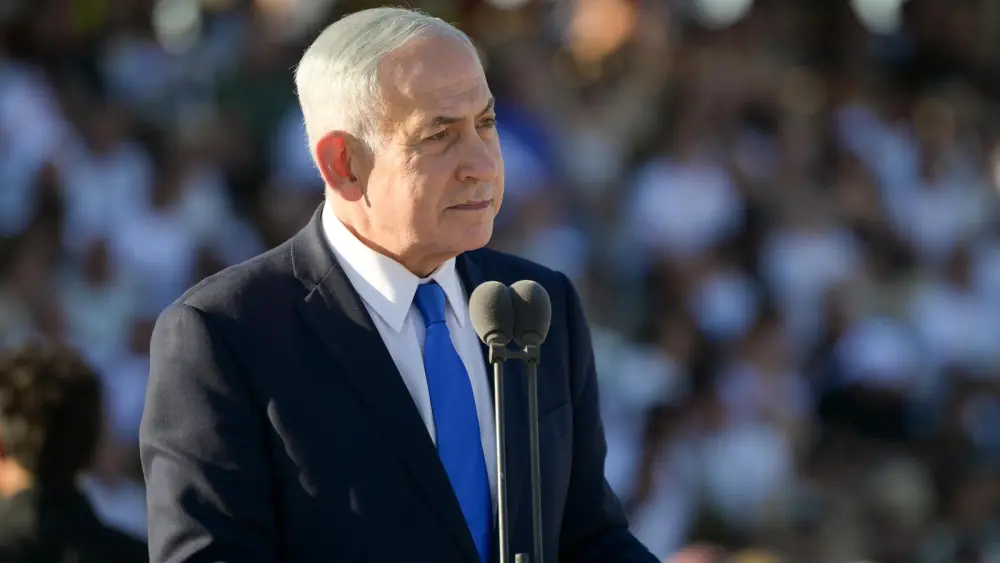
Israeli Prime Minister Benjamin Netanyahu delivered a message to Iran’s leaders on Tuesday, warning that should they decide to attack Israel, the Jewish state’s response will be greater than the last round.
“Don’t count on it to be quiet if you attack us. Don’t count on a rerun. It will be a different broadcast—far more powerful,” the prime minister said while addressing the Negev Conference in Dimona, a regional forum focused on the economic development of Israel’s south.
“We are prepared for any scenario,” he said. “Gone are the days when someone hits us, and we don’t even strike them with a single blow.”
Israel and Iran last exchanged strikes on June 7, when Iran launched ballistic missiles at Israel in retaliation for an Israeli attack against its proxy Hezbollah in Lebanon.
Israel hit Iran’s Mahshahr petrochemical complex in return.
Since then, the Islamic Republic has so far refrained from hitting Israel, even as U.S. and Iranian forces intensify their exchange of volleys.
Iran’s Islamic Revolutionary Guard Corps instead attacked Bahrain, Jordan and three tankers transiting the Strait of Hormuz in response to the latest U.S. strikes.
Two of the vessels, the Mombasa and Al Bahiyah, which were linked to the United Arab Emirates, briefly caught fire, the Associated Press reported. The Emirati Defense Ministry said the attacks killed one mariner and wounded eight others.
Bahrain’s Defense Force said its air defenses intercepted “a number of treacherous Iranian aerial attacks,” adding that “the deliberate use of missiles and drones to target civilians and private property constitutes a flagrant violation of international humanitarian law.”
A Jordanian military source told the state-run Petra News Agency that the army “successfully intercepted and shot down four missiles that breached Jordanian airspace from Iranian territory early Tuesday.”
U.S. President Donald Trump ordered more strikes against Iranian regime targets on Monday in response to the Islamic Republic’s attacks on commercial ships in the Strait of Hormuz.
Also on Monday, Trump told Fox News that the United States will be “taking over” the Strait of Hormuz.
In a subsequent Truth Social post, Trump declared the Strait open and that, from “this point forward,” the United States will be known as “the guardian of the Hormuz Strait.”
He said that America is reimposing the Iranian blockade, “so named because it is only stopping Iran’s ships or customers from entering or leaving. All other countries will have fair and open use of the Strait.”
However, Washington said it will charge 20% on all cargo shipped, plus “costs necessary to do the job of providing safety and security to this very volatile section of the World,” Trump added.
CENTCOM said the blockade on all “maritime traffic entering and exiting Iranian ports” would go into effect at 4 p.m. Eastern Time on Tuesday.