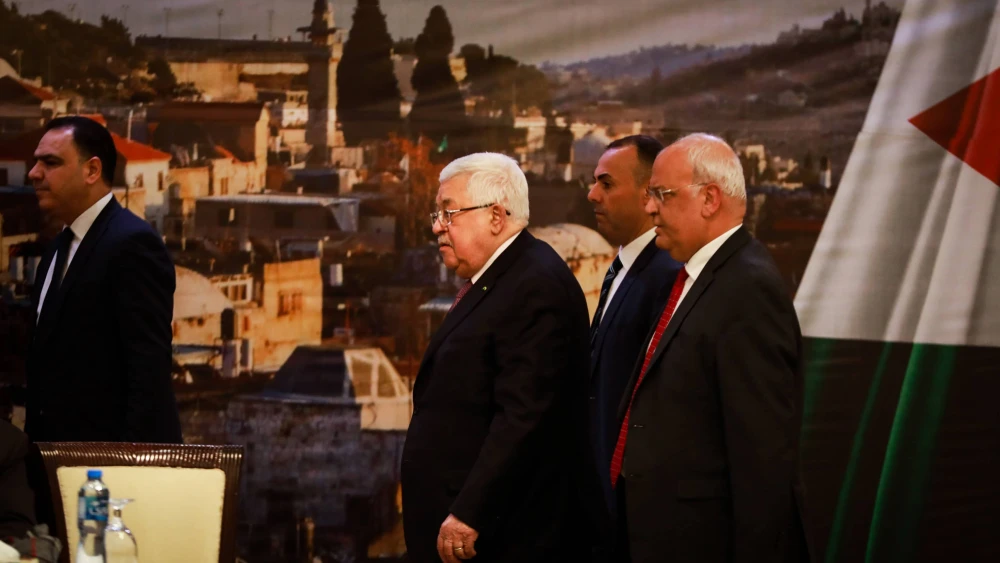
Palestinian Authority chief Mahmoud Abbas and other P.A. officials were involved in the process that led to the unification of three Arab-Israeli political parties into a technical bloc ahead of the Oct. 27 national election, in an effort to prevent Prime Minister Benjamin Netanyahu from forming the next government, Israel’s Channel 12 reported on Saturday.
The P.A. exerted “heavy pressure” on the parties, the report stated.
The concern in the P.A. was that running separately might lead to the failure of the parties to pass the 3.25% threshold of total votes to enter the Knesset. The three parties in question are the Communist and supposedly secular Hadash Party (with a minority Jewish presence), and the Arab nationalist parties Balad and Ta’al.
The Arab parties announced on Aug. 19 their unification into the Joint List, but without Ra’am, also known as the United Arab List, led by lawmaker Mansour Abbas, which is expected to run on its own.
The four parties have run together in the past as the Joint List, garnering 13 Knesset seats in 2015 following the raising of the threshold the previous year from 2% to 3.25%. It was the third-largest faction in the Knesset at the time, but has since dissolved.
“The decision to establish the Joint List was made for the benefit of the Arab public and at its request, and we say that we will do everything to bring down Netanyahu, regardless of pressure from any other element,” sources in the Joint List said in response to a Channel 12 request for comment.
Most P.A. efforts to finalize a joint bloc focused on Ta’al chairman Ahmad Tibi, according to Channel 12. Contacts were made with Tibi in an attempt to persuade him to agree to the compromise formula proposed for allocating seats on a united bloc candidates list, after previous talks had reached an impasse.
“We must not repeat the mistakes of the previous election and allow Netanyahu to return to power. You are missing a historic opportunity for our people because of internal disputes,” a senior P.A. official was quoted in the report as saying.
Following the unification announcement, Balad chairman Sami Abu Shehadeh told Channel 12 that the three parties would not serve as a “tool” for any candidate for the premiership, neither Netanyahu nor main opposition candidate (according to polls) Gadi Eisenkot, who heads the Yashar Party.
A technical bloc can be disbanded after the election, with each party maintaining its respective number of seats gained separately according to the bloc’s agreed candidates list.
Culture and Sports Minister and Likud Party member Miki Zohar reacted to the report on X on Saturday, writing in Hebrew, “Israel’s enemies are saying explicitly they are working to make us lose the election. What more is left to convince Israel’s citizens to vote only for Netanyahu and the right?”