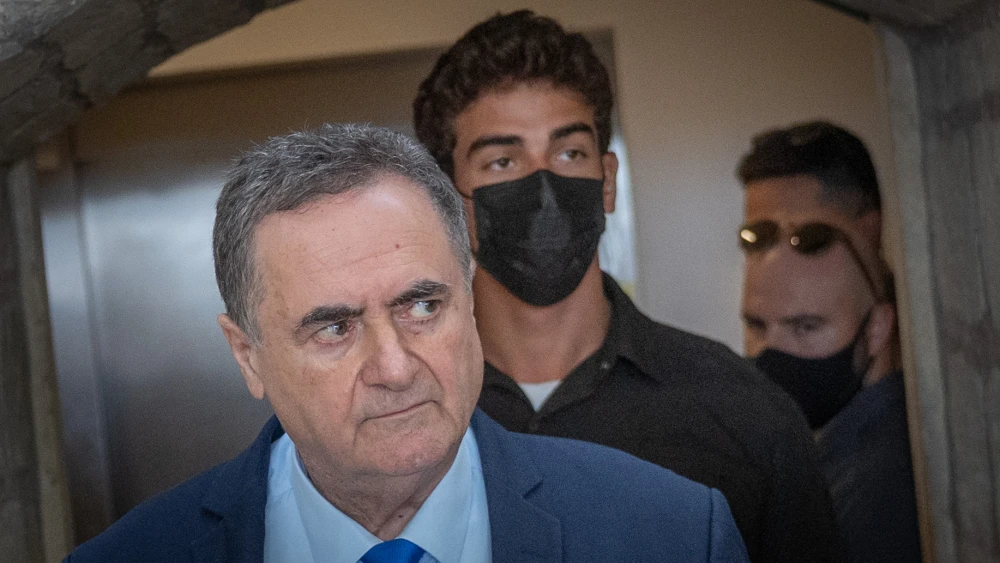
Defense Minister Israel Katz on Monday called reports of disagreements between Jerusalem’s political leadership and the Israel Defense Forces over Iran “entirely baseless and false,” rejecting claims of a rift over possible military action against Tehran.
Katz said coordination between Prime Minister Benjamin Netanyahu, himself and the IDF has been complete. He also stated unequivocally that Israel had no intention of initiating an attack on Iran before Tuesday’s Knesset election, but warned that Israel would respond with great force if Iran attacked.
The statement followed a Channel 12 report alleging disagreements between Netanyahu and IDF Chief of Staff Lt. Gen. Eyal Zamir over a proposed military action that could trigger a wider confrontation with Iran.
Katz accused opposition figures of exploiting the reports to question the government’s judgment.
הפרסומים על פערים בין הדרג המדיני לצה"ל בנושא איראן הם מופרכים ושקריים לחלוטין.
— ישראל כ”ץ Israel Katz (@Israel_katz) October 26, 2026
מאז כניסתי לתפקיד שר הביטחון התיאום בין רה"מ וביני לבין צה"ל בנושא איראן הוא מלא - עם הישגים היסטוריים חסרי תקדים לטובת ביטחון מדינת ישראל.
זהו השיקול היחיד - וכך יהיה גם בעתיד.
אני קובע באופן חד…
The IDF also responded on Monday to media reports that it said “attributed various statements to the chief of staff or to senior IDF officials.”
The IDF said it “is focused on its missions and is on high alert in every arena, in light of various warnings and the sensitivity of the period.”
“The IDF’s operational activity and the considerations it weighs are purely security-related, professional, substantive and nonpartisan, and any other discourse is misleading and irrelevant,” it added.
On Oct. 19, Netanyahu warned Israel’s enemies not to test the Jewish state, speaking during a visit to an Israeli Air Force base.
“I spoke with the base commander and I was impressed by the readiness, the determination and the capability to strike our enemies the moment it is required,” Netanyahu said, speaking in Hebrew.
“I say to our enemies: Don’t test us,” the premier added. “You will suffer harsher blows than you have suffered up to now.”
Netanyahu’s remarks came on the backdrop of a statement made by Katz that Israel has identified attempts by Iran and its proxies to carry out terrorist attacks aimed at influencing the results of the Oct. 27 Knesset election.
“We must stand united and make clear that political disagreements will not undermine our collective resolve against our enemies,” Katz said at a ceremony inaugurating the Irgun Museum and Altalena cannon in Binyamina on Oct. 13.
At a Security Cabinet meeting the same week, Netanyahu warned that “Precisely because Hamas is so weak, it will try to challenge us with the remainder of its forces ahead of the election. We are ready for this. First of all, we will thwart such attempts. And, in any case, we will respond to them with tremendous force if they make this mistake. I say to all our enemies: ‘Look at what we did to you on seven fronts in the War of Revival. Don’t tangle with us.”
Tensions in the Middle East have risen in recent weeks, with the fighting between Saudi Arabia and the Iranian-backed Houthis in Yemen intensifying.
CNN reported on Friday that the U.S. has rushed to reduce its staff in Saudi Arabia, Jordan, Bahrain, Kuwait, Qatar, the United Arab Emirates and Lebanon.
A State Department official told the U.S. network that these countries “will see temporary changes to staffing levels under restricted operations.”
U.S. officials are concerned that the Iranian-backed Houthis in Yemen could expand their attacks beyond Saudi Arabia to other states in the region, Axios reported.
An NBC News report said that that the U.S. military has been quietly scaling back its troops’ presence throughout the Middle East, citing two U.S. officials and two individuals with knowledge of the matter.
Similar reductions in the Middle East took place before the start of “Operation Epic Fury” against Iran on Feb. 28.
Memo: Tehran plotting to assassinate US personnel
Meanwhile, the Iranian regime has increased efforts to target U.S. officials in the Middle East and elsewhere, Director of National Intelligence Jay Clayton said in an unclassified memo sent to Secretary of State Marco Rubio on Friday and obtained by Axios.
The underlying intelligence concerning Tehran’s plotting has already been shared with senior U.S. State Department officials, according to the memo.
As the director of national intelligence, Clayton oversees 18 member agencies of the U.S. Intelligence Community and serves as the primary intelligence adviser to the president.