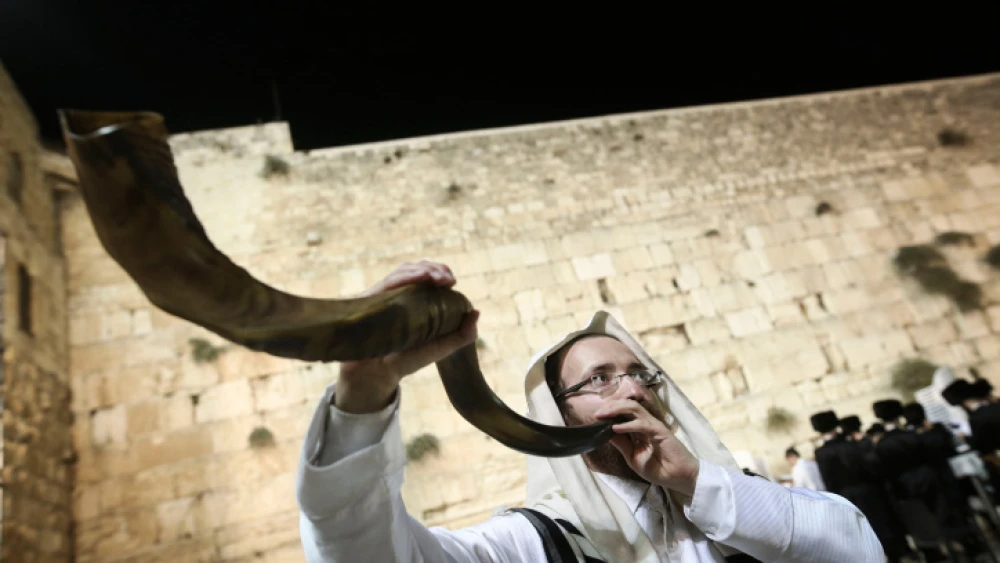
A group of Temple Mount activists has condemned the government’s refusal to open Judaism’s holiest site to Jewish worshippers on the first day of Rosh Hashanah, the Jewish New Year, and allow the sounding of the shofar there.
Following more than a month of appeals to Prime Minister Benjamin Netanyahu and National Security Minister Itamar Ben-Gvir, the Shofar B’Tzion NGO, along with the Committee for Opening the Temple Mount on Shabbat, filed a petition with Israel’s Supreme Court, sitting as the High Court of Justice, challenging the restrictions ahead of Rosh Hashanah.
Shofar B’Tzion chairman Yosef Rabin explained to JNS that while the court did not dismiss the petition outright, the absence of a defined timetable for a hearing has left the petitioners without an effective avenue for obtaining judicial relief before the holiday.
Rabin said the dispute is particularly significant this year because the first day of Rosh Hashanah falls on Shabbat. While the shofar is not normally sounded when Rosh Hashanah and Shabbat coincide, the Temple Mount is an exception, where, according to Jewish law, the shofar is to be sounded.
He explained that since the Second Intifada in the early 2000s, the government has generally banned Jewish access to the site on Shabbatot throughout the year. Rabin expressed hope that the government would make a “one-off” exception this year.
Rabin said that after 2,000 years, the Jewish people had returned to the Temple Mount and that it was absurd that Jews now have to argue with the State of Israel over the issue.
“The Jewish people have an intrinsic right to pray at our holiest place,” he said.
Rabin also compared the government’s policy to restrictions imposed under the British Mandate.
“Under the British Mandate, Jews were forbidden to sound the shofar at the Western Wall, and young Jews were arrested for defying the ban. Nearly 80 years after the establishment of the State of Israel, Netanyahu and Ben-Gvir have chosen to continue that policy in a new form—this time on the Temple Mount.”
Political support for campaign
The campaign has drawn support from MK Simcha Rothman, chairman of the Knesset Constitution, Law and Justice Committee, who last month penned a letter to Netanyahu and Ben-Gvir calling for the sounding of the shofar on the Temple Mount on Rosh Hashanah and for opening the holy site for the Mussaf prayer on the first day of the holiday.
Rothman wrote, “Blowing the shofar on Rosh Hashanah is one of the central commandments of the holiday. Significantly restricting the public’s ability to fulfill this mitzvah at the holy site constitutes a serious infringement.”
Asaf Fried, chairman of the Committee for Opening the Temple Mount on Shabbat, told JNS that the government’s refusal to open the site on the first day of Rosh Hashanah represented “a disregard for the rights of Jews to pray at the holiest site of the Jewish people.”
He said he has yet to receive a satisfactory answer as to why Jews are generally not permitted to ascend the Temple Mount for prayer on Shabbatot and why this is considered a security risk.
He explained that with the outbreak of the Second Intifada in 2000, the Mount was completely closed to Jews for three years. When Jews were allowed to return in 2003, there was no explanation for why they were no longer permitted to ascend on Shabbat.
“There is no reason for it. It doesn’t bother anyone. There are no Muslims up there that day,” he said.
Fried remains hopeful that if the site is not opened on the first day of Rosh Hashanah, the court will allow Jewish visits during Sukkot and the other Jewish holidays in the month of Tishrei, some of which also fall on Shabbat this year.
A broader push for Jewish prayer
Rabin said that this past April, he and other Temple Mount activists led a campaign to allow Jewish worship on the Temple Mount on Jerusalem Day, which coincided with a Friday—another day on which Jewish worshippers are generally prohibited from ascending the site.
At the same time, more than 20 government ministers and MKs called on the heads of the Israel Police and the police’s Jerusalem District to allow worship on that day.
In response, Rabin received a letter from an adviser to Ben-Gvir indicating that “the fundamental decision regarding opening the Temple Mount on holidays or closing the Mount on certain occasions, such as Fridays, falls under the exclusive authority of the prime minister. It is not within the authority of the police commissioner or the district commander, whose role is to implement the minister’s policy.”
The adviser also highlighted Ben-Gvir’s support for Jewish prayer on the Temple Mount, saying that the minister had spearheaded “a historic change in the status quo after approximately 1,000 years during which Jewish prayer was prohibited. Today, Jewish worship on the Mount is permitted, including prostration, singing and the use of prayer sheets (pages of prayer text).”
Rabin clarified that, based on the letter, the prime minister has exclusive authority over opening the site on certain occasions, while broader issues concerning Jewish prayer at the site are addressed by the prime minister, Ben-Gvir, the courts, police and other authorities. He said this is why he approached the relevant authorities as part of the current campaign.
Rabin said he was grateful that the Temple Mount would be opened for a limited time this year for Jewish worship on the second day of Rosh Hashanah, on Sunday, although without the sounding of the shofar or the presence of a Torah scroll.
He said every small step toward unrestricted Jewish prayer on the Temple Mount was welcome.
“The Jewish state is fighting on the international stage against delegitimization in Europe, and it is creeping into the United States as well,” said Rabin. “If the Jewish state won’t stand its ground and say that Jews have the right to pray there without restriction, we shouldn’t be surprised when the rest of the world delegitimizes us.”