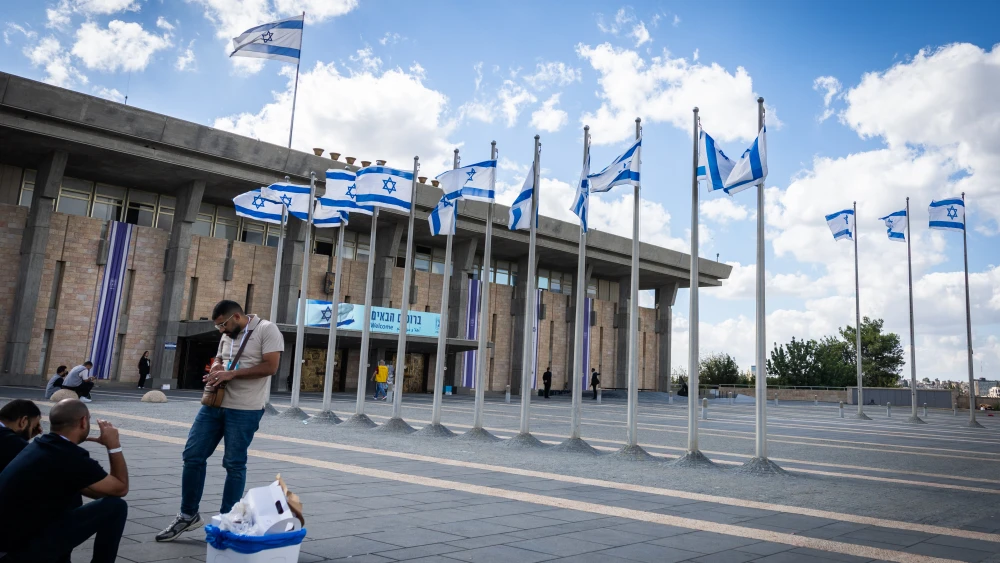
The opening session of the 26th Knesset is scheduled to be held on Nov. 10, the 14th day after the election, when the newly elected MKs make their declarations of allegiance and are sworn in.
Meanwhile, Vote Smart website, a self-described “neutral startup,” has published a breakdown by various criteria of the figures who will make up Israel’s new parliament.
More than half of the members of the 25th Knesset have been re-elected, with 39% of new lawmakers taking up their seats for the first time, and the remaining 10% consisting of returnees, the figures show.
Out of the 120 MKs, 73% have served in the Israel Defense Forces.
Twenty-eight percent of the legislators are women, with Gadi Eisenkot’s Yashar party’s faction composed of 52% women, followed by The Democrats and B’Yachad each at 50%, according to the report.
Prime Minister Benjamin Netanyahu is the Knesset’s longest-running member, having served a total of 32 years, followed by Defense Minister Israel Katz and United Torah Judaism’s MK Meir Porush at 28 years each, and Yisrael Beiteinu leader Avigdor Liberman, the Joint List’s MK Ahmad Tibi and Likud’s MK Haim Katz at 27 years each, according to the website.
Haim Katz, 78, the outgoing health minister, is also the oldest member of the Knesset, and Yonatan Shalev, 24, of B’Yachad will be the youngest member of Knesset, three years over the minimum age of 21.
There will be lawmakers in their 20s (one), their 30s (11), their 40s (32), their 50s (36), their 60s (30), and their 70s (seven). The age information of three MKs was not known.
The places of residence of the Knesset’s members were divided by central Israel (21%), Tel Aviv (20%), Jerusalem (15%), north, south and Judea and Samaria (each 13%) and Haifa (4%).
Forty-seven percent of the incoming lawmakers have a master’s degree, 23% a bachelor’s degree, nine percent a Ph.D., 8% secondary education and 8% Torah education (the schooling of 4% was categorized as “unknown”).
Categorization by sector showed secular (40%), religious (23%), Arab (14%), traditional and ultra-Orthodox (each 11%) and Druze (2%).
According to the Central Elections Committee, 5,716,665 ballots were cast, for a turnout of 77.9%, the highest since 1999. Of those, 5,690,778 were valid and 25,887 invalid.
Likud emerged as the largest party with 27 seats, followed by Yashar with 21 and B’Yachad with 12. The Joint List won 11 seats, The Democrats and Ra’am eight each, Yisrael Beiteinu, United Torah Judaism and Otzma Yehudit seven each, and Shas and the Religious Zionist Party six each.
The electoral threshold of 3.25% required 184,947 valid votes. All other parties failed to cross it.
The two Arab parties, Joint List alliance and Ra’am, together won 19 seats, leaving neither of the Zionist blocs with a majority and setting the stage for tough coalition negotiations.