


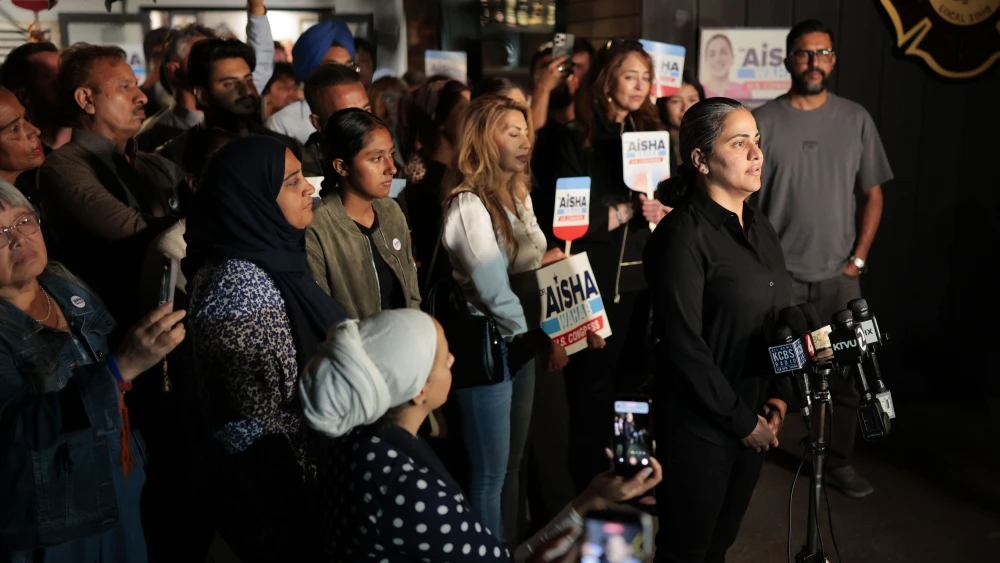
Aisha Wahab, an anti-Israel state senator, defeated Melissa Hernandez, a former mayor of Dublin, Calif., whom AIPAC has supported, in the special election to replace former Democratic congressman Eric Swalwell.
With 95% of votes counted in California’s 14th Congressional District, Wahab had 51,610 votes (53.1%) to 45,598 votes (46.9%) for Hernandez.
Wahab has accused Israel of “genocide.” Hernandez has said that “Israel had the right to defend itself” after Oct. 7 but that “the destruction in Gaza has gone too far.” Super PACS tied to AIPAC spent more than $4.4 million in the race opposing Wahab and supporting Hernandez, according to federal data.
Jared Sclar, a Democratic consultant in San Diego who consulted on Hernandez’s 2020 campaign for Alameda County Board of Supervisors, told JNS that “the headline is that AIPAC spent millions and lost.”
“The more useful story is that the money moved this race about 20 points and still came up short,” Sclar said.
“Wahab won the June special primary by 26. She is winning this runoff by about six,” he said. “An independent expenditure program that closes 20 points in six weeks is not a failure. It is one of the more effective independent expenditure efforts you will see this cycle.”
“It just started too far behind to finish the job,” he said.
Sclar said that the two candidates will run against each other again in November for the full term.
“The November electorate will be two to three times the size of a sleepy August special,” he said. “Hernandez now has proof of concept, a donor network and 20 points of momentum.”
“Wahab has a narrow win in a low-turnout special and a scar,” he said. “That is a genuinely competitive rematch, which nobody would have said in June, though the incumbency advantage for Wahab now isn’t nothing.”
Sclar thinks that Wahab’s “closing argument” against AIPAC spending, which included “publishing a list of AIPAC-linked donors to her opponent,” won’t work in the general election.
“Turning individual donors into targets invites exactly the response AIPAC gave, that it stigmatizes Jewish donors, and it puts a candidate in the position of defending a tactic rather than making a case,” he told JNS. “In a larger November electorate, that is a harder argument to sustain.”
Dan Schnur, a political science lecturer at Pepperdine University, the University of Southern California and the University of California, Berkeley, told JNS that “winning is always better than losing, but AIPAC deserves credit for turning what would have been a landslide into a real nail-biter.”
“Make no mistake. They came up short, but they sent a strong message to other anti-Israel candidates and their supporters that even in an era of Mamdani, AOC and DSA,” he told JNS, of the Democratic Socialists of America.
“Candidates like Wahab are still going to be in for a fight,” he said.
Tali Klima, spokeswoman for Bay Area Jewish Coalition-Action, told JNS that “we are concerned by Wahab’s election and the trend toward far-left or DSA-affiliated candidates who use antisemitic tropes to get elected.
“In this case, Wahab’s campaign increasingly singled out AIPAC to increase voter turnout by stoking fears of Jewish government control,” Klima said. “This has become a popular dog whistle that endangers Jewish constituents and cements hatred against us.”
She added that “we’re afraid that anti-Jewish conspiracies will be used by opportunistic politicians, interest groups and powerful PACs to promote Wahab’s campaign from now through November, fueling additional antisemitic incidents in the area.”
“We call on Wahab to reject any attempts to leverage her campaign to stoke anti-Jewish sentiment in the Bay Area and divide her constituency,” Klima said.


