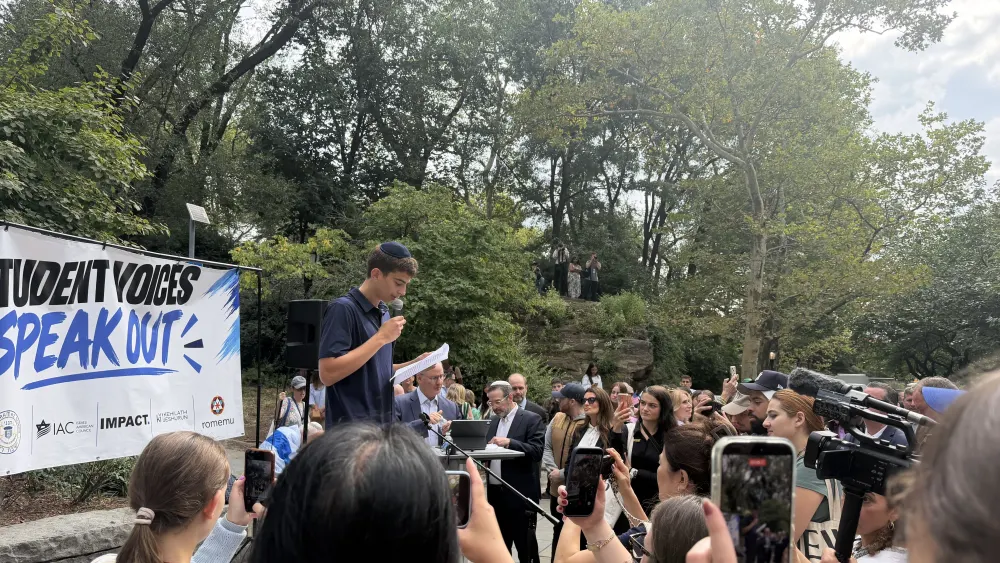
New York City Mayor Zohran Mamdani was nowhere to be seen among a crowd of about 400 Jewish day school students outside Gracie Mansion, the mayoral residence, for what organizers called a “prayer vigil” on Friday morning.
“The mayor has said he’s got a schedule,” Rabbi Binyamin Krauss, principal of SAR Academy, one of three institutions represented at the gathering on Manhattan’s Upper East Side, told JNS.
“I suggested he work from home, and then he could have been here,” the rabbi said. “But he’s got a busy schedule, and he chose not to be here, so I respect that.”
Krauss told JNS ahead of the gathering that the intended message was that “we’re here. We’re Jewish. We want to be safe and express our Zionism.”
SAR students and faculty joined participants from Ramaz and Park East Synagogue, two other Modern Orthodox institutions in the city, for student-led morning prayers that began around 9:30 a.m. There was a minyan, or quorum of 10 or more men above the age of bar mitzvah, and some male students and many faculty members donned tefillin, or phylacteries, and tallitot, or prayer shawls.
At 10 a.m., when the group’s sound permit took effect, students, faculty and event organizers took turns addressing the crowd and leading songs and prayers.

“I think he’ll get the message anyway, I hope,” Krauss told JNS on Friday, of the mayor. “The message was we’d love for him to reach out and to connect with us and to show his concern for us. We’d appreciate that.”
“Stay away from stuff that he doesn’t need to be talking about if he can’t say things that make us feel safe,” Krauss said.
On Wednesday, Mamdani told reporters that the schools could “have a vigil, or I’ve heard some describe it even as a ‘protest.’”
“Whatever it is intended to be, they have the room and space to do so outside of Gracie Mansion,” Mamdani said. “I think that at the time that they are there, I will probably be somewhere else across the city.”
Inna Vernikov, a Jewish member of the New York City Council, told JNS outside Gracie Mansion that “nobody expected Mamdani to be here, but quite frankly, we don’t want him here.”
“It’s great that we showed up here outside his house, considering his rhetoric, his actions, his associations,” Vernikov said. “But none of that matters, because today all the students came together. We’re very proud of them.”
Vernikov, who joined students singing “Acheinu” (“Our brothers”) and the Israeli national anthem, told JNS that she was “very proud” of the students “for speaking up, standing up, showing up, being loud and proud about their Jewish identity and showing the mayor and the entire city that we are not going anywhere.”
Between speeches, students danced in circles and prayed arm-in-arm for the safety of the Israel Defense Forces and U.S. elected officials.

Ari Fogelson, a sophomore at one of the schools, told JNS that he and many other students came voluntarily. (Some critics of the gathering have circulated a petition saying that the event took advantage of the students.)
Asked what message he wanted to send the mayor, Fogelson said, “Get out of office and stop interfering with our stuff. Stop being so cruel to Jews.” Fogelson told JNS that Mamdani is “mean to Jews.”
“He doesn’t like us,” he said. “He constantly puts out things that hurt us. He’s trying to almost commit genocide, like mental genocide.”
The students’ presence outside the mayoral residence was particularly significant, according to Fogelson.
“Even though we’re kids, we still matter and you can’t shut us out,” he told JNS. “You might be able to shut the adults out, but you can’t shut the kids out.”

Rabbi Haskel Lookstein, 94, principal emeritus at Ramaz and rabbi emeritus at Congregation Kehilath Jeshurun, told JNS that what brought him to Gracie Mansion on Friday was “my whole life.”
“I was here 30 years ago, 40 years ago, for Soviet Jewry,” the principal of the Ramaz School from 1966 to 2015 said. “We fought, and we won the fight. And 2 million Soviet Jews got out because of, among other things, our efforts.”
Lookstein told JNS that Jews are “under attack as loyal Americans.”
“We love our country,” he said. “Unlike a lot of our enemies, we believe in America. That’s why we’re here. But we are also loyal Jews, and we believe in Judaism and for 4,000 years, we’ve been doing nothing but bringing good to the world.”
“Let our enemies know this, and know that as long as we have to come out publicly, we will come out publicly,” he said. “We don’t seek to make trouble for anybody. We seek to survive and do good in the world. That’s why we’re here.”
Lookstein stressed that he viewed the gathering not as a protest but as a prayer vigil.
“Only once in my life did I participate and lead a prayer like this one, and it was in Auschwitz on Tisha B’Av, when we davened mincha,” the afternoon prayer, “alongside the ruins of the last crematorium in Auschwitz that’s standing with a whole group of the congregation,” he told JNS.
“I’ll never forget that davening, which was an affirmation that we are still here,” the rabbi said. “And I’m never going to forget this davening, two days or three days before Yom Kippur, where we’re again saying, ‘We’re here.’”

The gathering was also intended to send a message to the students, he said.
“We closed part of the school and brought them,” Lookstein told JNS. “The trick will be if we do it on a Sunday and they have to come voluntarily. And, by golly, we did it with Soviet Jewry. We used to march with 100,000 down Fifth Avenue and shouting out our loyalty.”
“If we have to do it again, we’ll do it again,” he said,
Lookstein’s son, Joshua Lookstein, associate head of school at Ramaz, addressed the crowd.
“My family has built institutions in this city and inspired others to build countless more,” he said. “New York City proudly courses through my veins.”
“I am here today—we are here today, because over the last several years, others have been communicating to us that we have to choose one or the other, especially as it relates to Zionism,” he told students.
“That is part and parcel of my Jewishness, and that pressure has been weighing on me,” he said.
The younger Lookstein thanked the New York City Police Department, who “risk their lives day and night to protect us and all New Yorkers.”
“I am grateful to the proud and action-oriented co-sponsors of this prayer vigil,” he said. “I am grateful to the students here and back at their schools, who energize us and inspire us every day.”

Aaron Herman, CEO and co-founder of IMPACT, one of the organizations that hosted the gathering, told JNS that the event brought students and community members together “right before Yom Kippur to show our resilience through prayer, through community and education.”
The students “showed up resilient,” according to Herman.
“These youngsters are going to be able to vote one day,” he said. “There are certain moments that you’ll remember, like you were at this vigil and this incredible resilience event. That’s a building block.”
Mamdani “has to listen up,” Herman said. “He has to listen to the community. Young people will show up and show that they’re proud to be Jewish and that they’re concerned about the rise of antisemitism.”
“The Jewish community is concerned but we’re resilient, and we will stand up for our Jewish values,” he told JNS.
David Rosenberg, an elderly man who attended the event to “show support,” told JNS that the presence of students was “very encouraging.”
“We need more young people, because I go to a lot of these demonstrations and a lot of the people there are people who are retired, like me,” he said. “We need more young people to show up to these things.”
Several members of Neturei Karta, a fringe anti-Zionist, Chassidic Jewish group, protested behind police lines at the gathering.


Michael Rapaport, a Jewish actor and comedian, told JNS that he “couldn’t believe” they were there.
“I didn’t realize it was going to be as many kids as there are, and I’m very moved and honored, and I’m glad that I made the decision to come here,” Rapaport told JNS, as he stood near the Neturei Karta protesters.
“I’m from the Upper East Side, so it’s a very, very nice event—beautiful event,” he said. “I love to see so many young Jewish kids, especially in New York City, with all the crap that we’re dealing with.”
Rapaport said that seeing so many young Jews was particularly meaningful.
“The younger people are of the utmost importance,” he told JNS. “To be informed, educated, proud. It’s really good to see it.”
He, too, rejected describing the gathering as a “protest.”
“I don’t think this is a political statement,” he told JNS. “It’s a beautiful Shabbat—I don’t know what they called it, but this is beautiful.”
The gathering concluded with more singing before students boarded school buses and headed back to school.