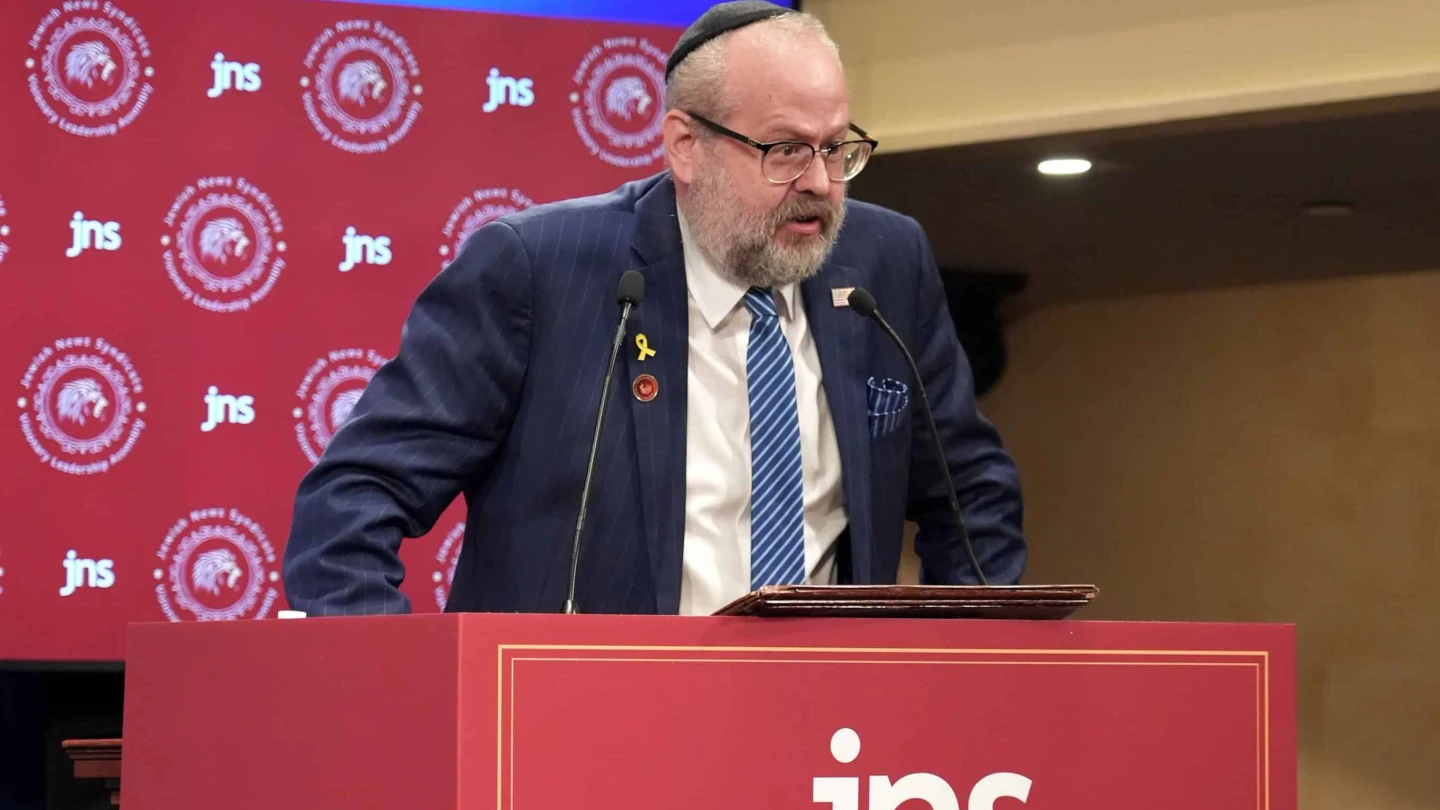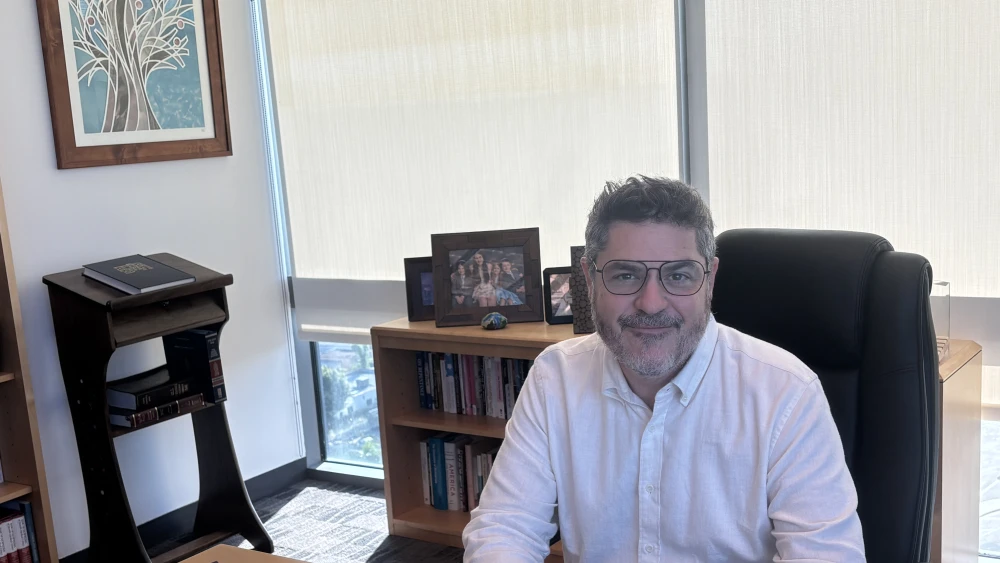
In January, Rabbi Noah Farkas will mark five years as president and CEO of Jewish Federation Los Angeles, where he has overseen Jewish communal responses to Russia’s invasion of Ukraine, the Oct. 7 attacks, rising Jew-hatred and two devastating wildfires in Los Angeles.
“It feels like both five minutes and 500 years,” he told JNS last month in a Federation conference room. “The work is so fast-paced, the volume is just incredible and the Jewish community has gone through probably its most trying time since World War II.”
When Russia attacked Ukraine, the Federation raised nearly $7 million in emergency relief and helped “move tens of thousands of Ukrainian refugees out of harm’s way,” some to Israel and others to Poland, according to Farkas.
“I remember very clearly in a hotel in Warsaw that was processing people for aliyah,” the rabbi told JNS. “That was my first taste of the international network that makes up the uniqueness of Jewish life, and that was just a few months in.”
“I thought, ‘OK. Maybe it will calm down,’” he said.
But the Oct. 7 attacks came just after the Federation finished its emergency campaign for Ukraine.
“It wasn’t just that my life changed. I think all of us in the Jewish community say our life has changed inextricably, forever,” Farkas told JNS. “Thank God all the living hostages were able to come home, and the ones who died were able to be brought home to be buried.”
“But Israel is still at war. There are still reservists serving hundreds of days. There are still people who are just getting back to their homes,” he said. “There are still two kibbutzim, which are basically still closed, and we raised $40 million for that.”
Farkas believes that Jewish identity has undergone a “radical transformation.”
Internal communal conversations once centered on who is Jewish and on issues that divided denominations, like intermarriage.
“You can afford to have the conversations about Jewish culture when your culture isn’t really under threat,” Farkas told JNS. “Now it’s actively under threat.”
“Those who believed that our place in America was firmly secure, and this was a place where there was no question about whether you should show up being Jewish or not—the window on that has radically changed,” he said.

‘Have been punched’
The Plano, Texas, native, who grew up in a “very Jewish-ly warehouse in a very non-Jewish area,” had an uncomfortable experience there as a young Jew.
“I don’t know how many people have been called a ‘k***’ or a ‘Jewboy’ or have been punched,” he told JNS. “I have been through all of those.”
When he was 15, he had his family found in the middle of the night that vandals “had blown up our mailbox” and burned a Nazi swastika into its lawn. He told JNS that the vandals were never caught, and the incident didn’t make the news.
“I had to go to school the next day,” Farkas said. “That was my greatest lesson my dad ever gave me—was that if I don’t go to school, then they win.”
“So I went to school. No idea if any of the people I was sitting in school with were the same people who were at the house the night before,” he told JNS.
After experiencing Jew-hatred, Farkas wanted to visit Israel. His father, who had been saving Israeli bonds so that he could go to Israel, cashed them in so his son could go instead. A local Federation pitched in the remaining $500.
In Israel, Farkas told JNS that he found God.
“I wasn’t really that religious beforehand,” he said. “It was the first time where I felt part of something much greater than myself, part of a history. I felt grounded. It was the first time where being Jewish wasn’t an exclusionary thing or made me feel unique or isolated.”
He decided to become a rabbi and dedicate his life to the “prosperity of the Jewish people.” (He was ordained at Jewish Theological Seminary, which is part the Conservative movement.)
His work at the Federation has combined his background in Jewish leadership with his experience outside the rabbinate, including his prior role as a commission chair for the Los Angeles Homelessness Services Authority.
“I actually am using more parts of my brain now than I ever have,” he told JNS.

‘We fight for Jewish life’
The Federation at one point directed its staff that “we’re not in the business of fighting antisemitism,” according to Farkas.
“Very shortly after I came, I began changing that, and we wrote a whole white paper on how we’re going to fight antisemitism,” he told JNS. “By the way, we don’t fight antisemitism. We fight for Jewish life.”
One of his first acts at the Federation was to convene what became an “antisemitism roundtable.”
“I took the Jewish defense organizations, namely American Jewish Committee and Anti-Defamation League, that have never worked well together and never worked well with the Federation until then,” Farkas said.
“We locked ourselves in a room and we said, ‘We’re going to work this out,’” he told JNS. “Over three, four hours, we mapped all of the work that we did in Los Angeles, saw what was redundant, decided who was better at it and deconflicted.”
The roundtable, which formed in November 2022, includes other organizations, like Simon Wiesenthal Center, StandWithUs and Holocaust Museum Los Angeles.
“We’re willing to do things that we’ve never done before. We hosted a walk right after Oct. 7 with Simon Wiesenthal Center down Wilshire Boulevard,” Farkas told JNS. “We sponsored the Israel march in Washington, D.C., where we flew hundreds and hundreds of Jews to D.C. so they could march in Washington.”
“We have stood up a very robust community engagement department that does government affairs on a regular basis,” he said.
The Federation has also expanded its “security apparatus” to include Southern California areas, including Santa Barbara and the Conejo Valley, according to the rabbi.
Farkas has sought to hold public figures accountable. He said in August that Rob Bonta, the California attorney general, had a “mixed” record, after Bonta told anti-Israel actor Mark Ruffalo that “Mark, I hear you,” of Ruffalo’s criticism of the Paramount-Warner Bros. merger.
The actor had said that the merger was related to the Israeli military and accused the Jewish state of “genocide” and “apartheid.”
Ruffalo’s “unhinged rant” drew on “recognizable antisemitic tropes with a long and dangerous history,” Farkas said.
He told JNS that Bonta has been “a consistent and vocal ally” in “speaking out forcefully against antisemitism, documenting the rise in anti-Jewish hate crimes in his office’s reporting and standing behind California’s new law protecting Jewish students in the classroom.”
But “many” Jewish parents and community leaders have been “deeply frustrated by his approach to K-12 issues, including years of legal fights over school parental-notification policies that, in my view, competed for attention with the more urgent work of getting antisemitism out of California classrooms,” Farkas said.
“No public official gets everything right, so we will continue to engage his office and hold him accountable to our expectations,” Farkas told JNS.
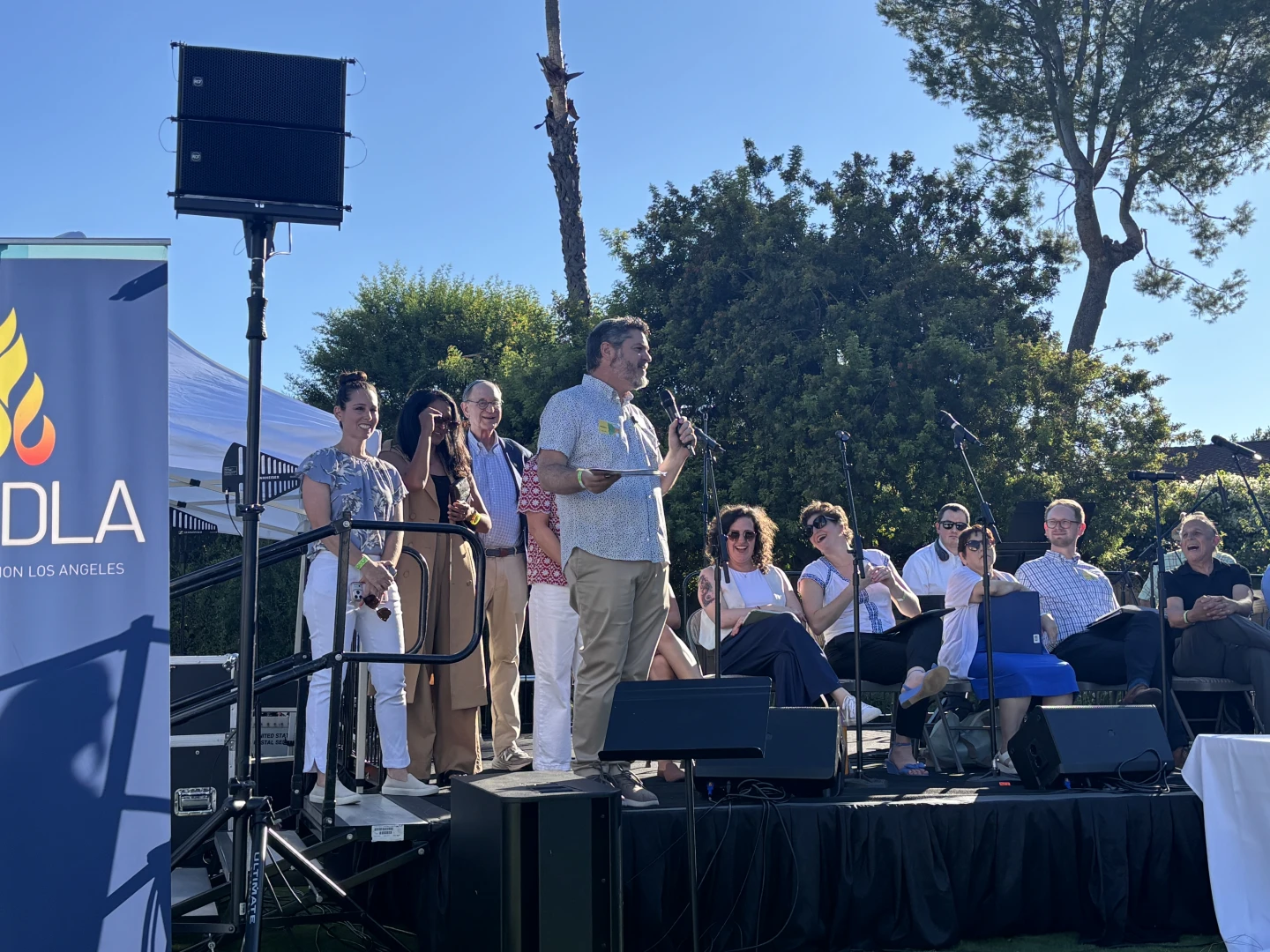
Wildfires
In January 2025, Farkas was speaking at a Federation conference near Los Angeles International Airport about crisis communications and disaster response when he saw out the window that the Palisades Fire had begun.
The rabbi, who had helped the community in Biloxi, Miss., rebuild in the aftermath of Hurricane Katrina, began assembling Federation staff at the conference to launch its emergency response system.
The Federation activated its text system, which it typically uses for “donors and things” and geo-located people in the Palisades and tried to help evacuate them.
“We had many staff members who either lost homes or displaced themselves in this process,” he said.
The Federation raised more than $9 million for the community and gave gift cards to those who were displaced, Jews and non-Jews alike, according to Farkas.
Farkas helped install Starlink on the roof of the Chabad of Malibu, which had no internet at the time and was the closest people could get to the fire zone. The Chabad had an office where people could speak to Jewish Family Service Los Angeles social workers and mental-health workers via video feed to guide them through their benefits.
The Federation also established funds to help families pay tuition for Jewish early childhood centers and summer camps, and to provide cash to synagogues and more than 29 families, which worked for Jewish organizations and lost their homes in the fire.
“I can say very proudly that all of the money we raised within 12 months was allocated,” he told JNS. “It wasn’t all spent because some of them are two-year contracts, but we allocated all the funds.”
The Los Angeles Federation also helped the Jewish Federation of the San Gabriel and Pomona Valleys raise money in response to the Eaton Fire in January 2025 and allocated it together as “one Federation system together,” according to Farkas.
The Los Angeles Federation provided funding to the Pasadena Jewish Temple and Center, the Conservative synagogue that burned down in the Eaton Fire, and to clergy who lost their homes, he said.
During this year’s High Holidays, the Federation has been running and amplifying programs around Los Angeles that have been “full,” Farkas told JNS.
“I would say that there is a surge into Jewish expression,” he said. “It might not mean congregational membership, but there is a surge in Jewish expressionism, Jewish engagement.”
During the High Holidays this year, Farkas has heard rabbis deliver sermons around Los Angeles on optimism, Jew-hatred, Jewish identity being more than something religious and “getting back to basics like family, friendship, community.”
“All of that makes sense to me,” he told JNS. “The truth is, no matter how glaring the headlines are, and how dark and gloomy news organizations try to make our lives feel, whether it’s about Jewish issues or the AI apocalypse or whatever, what matters most are the people that can hold your hand, the people that can sing songs with you and the stranger you haven’t seen in a year, that you give a kiss to and you catch up on what your kids are doing and what the kugel tastes like.”
“That’s actually what life is made of,” he said. “I want to thank the rabbis in the community for reminding us that what’s out there is noise, and what’s in here is signal.”
At the beginning of Farkas’s tenure, the Federation was “at its all-time low in its fundraising ability and how it was perceived in the community,” he told JNS.
“We have doubled our size,” he said. “We are raising more money from a broader and more diverse and younger audience than ever before.”
“We have built capacity to support our community like never before,” he said.
The Federation’s purpose, he said, is about more than the Federation.
“The purpose of the Federation is to support Jews,” he told JNS. “Because we provide the value that we do, the organization has grown exponentially and the community benefits from it.”
“That’s all that matters,” he said.