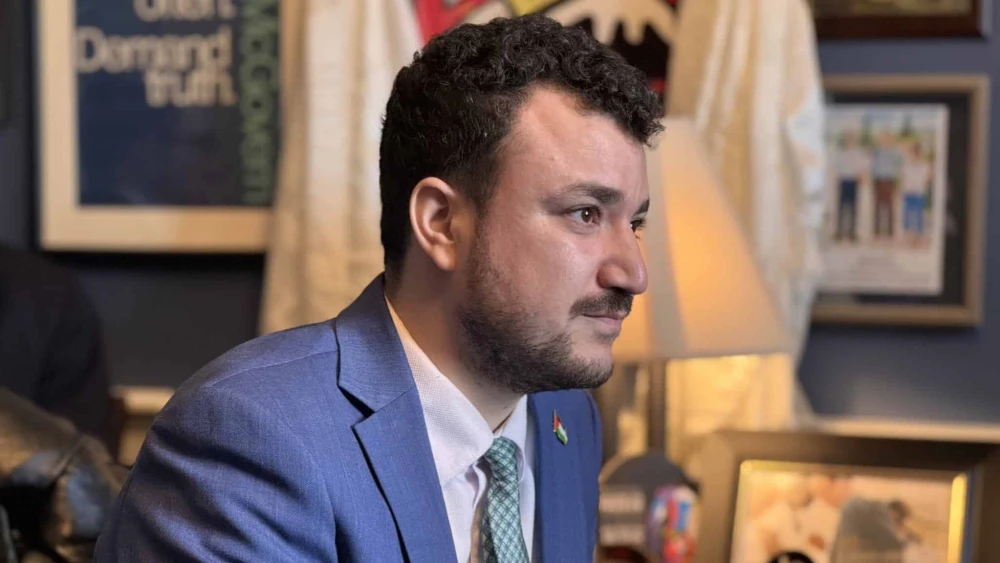
The National Jewish Advocacy Center is asking the U.S. Department of Justice to determine if a campus event scheduled for Tuesday night with anti-Israel activist Mahmoud Khalil, a former student, violates commitments under its $200 million Jew-hatred settlement with the federal government.
Columbia’s Center for Palestine Studies and Center for Global Journalism intend to host the discussion of Khalil’s book, “No Land to Stand On.” Attendance requires university identification.
When the private Ivy denied Khalil campus access in November 2025, it cited public safety concerns. Khalil sued in September, seeking restored campus access.
“Nobody is asking Columbia to cancel a book talk,” Mark Goldfeder, CEO and director of NJAC, told JNS.
“We have asked it one question, and we have put the same question to the Resolution Monitor and the Justice Department,” he said. “Did the university rescind its own safety determination and if so, who did it and why?” (JNS sought comment from the Justice Department.)
“Either the November decision was sound and someone overrode it for tonight, or it was never about safety, and Mr. Khalil’s lawyers will be glad to hear it,” Goldfeder told JNS.
A spokesperson for the university told JNS that “Columbia supports the right of faculty members to organize academic events.”
“An invitation to speak does not signify university endorsement of a speaker’s views,” the spokesperson said. “We remain committed to rigorous debate, inquiry, and respectful dialogue across differing perspectives.”
According to the spokesperson, when Khalil was rejected from campus previously, “campus access request was reviewed and declined based on the university’s ability to manage facilities and public safety on campus.”
The National Jewish Advocacy Center submitted a report to the settlement monitor on behalf of a Columbia professor, requesting records showing who approved the event and whether the earlier safety determination had been rescinded.
The federal settlement established three years of monitoring. It requires Columbia to apply its policies “without regard to identity or ideology” and review the Center for Palestine Studies for balanced educational offerings, according to an NJAC letter sent to university leaders.
The center also challenged if hosting Khalil is consistent with Columbia’s pledge against engaging Columbia University Apartheid Divest or its representatives. The organization identifies Khalil as the coalition’s former lead negotiator and spokesman.