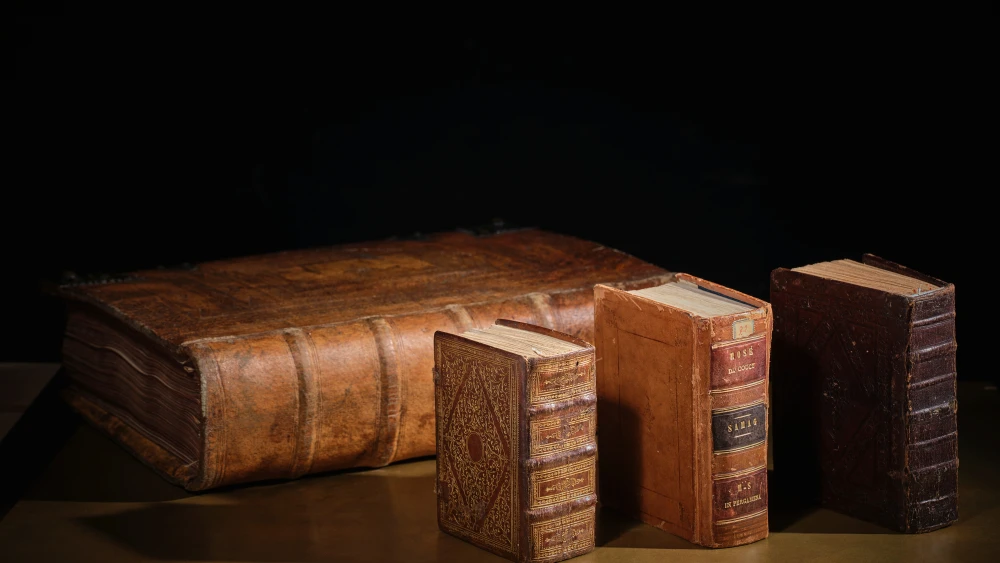
The international auction house Sotheby’s said that its December “magnificent Judaica” sale will include what it said is one of the “most significant” works in private hands by renowned medieval Jewish artist and scribe Joel ben Simeon.
The mahzor, or Jewish holiday prayer book, dates to about 1475 Italy, and Sotheby’s expects it to fetch between $3 million and $5 million. Its pages are “richly embellished with hundreds of drawings that engage directly with the text of the prayers,” it said. “The manuscript ranks among the most significant works by the celebrated scribe-artist remaining in private hands.”
The scribe-artist, whose works can be found at the Library of Congress, Israel Museum, Jewish Theological Seminary and British Library, among others, is one of very few Jewish medieval artists whose name is known.
The auction house is also offering a 15th-century Italian Roman rite mahzor and a “monumental” Hebrew Bible made around 1300 in Germany (each estimated to fetch $2 million to $4 million) and an illuminated manuscript of a work by Moses ben Jacob of Coucy, a 13th-century French rabbi who was part of the Tosafot Talmudic commentary, which has an estimate of $1 million to $2 million.

“Together, these works trace the evolution of Hebrew manuscript production from medieval Ashkenaz to Renaissance Italy and offer a rare glimpse into the cultural exchanges, artistic achievement and scholarly traditions that shaped Jewish life in Europe,” Sotheby’s said.
“I am so excited to share these treasures with the public, as they have not been seen in 100 years,” Sharon Liberman Mintz, international Sotheby’s senior Judaica specialist, told JNS.
The books are “filled with imagery for the High holidays,” Liberman Mintz said. (Rosh Hashanah begins on Sept. 11 at night.)
Joel Ben Simeon’s prayer book “demonstrates his engagement with the text throughout the manuscripts,” and his “playful illustrations of the blowing of the shofar and a faun holding a lulav and etrog enliven the text and guide the reader through the holiday liturgy,” she told JNS.
A c. 1500 mahzor from Ferrara, in Italy, in the sale contains “very interesting visual cues for the blowing of the shofar,” according to Liberman Mintz.

On the top of the right page, beneath the acronyms with 10 Hebrew letters suggesting a standard pattern of blowing the three main shofar sounds—the tekiyah, shevarim and teruah—the artist includes vertical lines that “echo the sounds of the shofar,” she told JNS.
“These manuscripts stand among the most compelling survivals of the medieval and Renaissance Jewish world,” Sotheby’s stated, of the upcoming sale, which will be on view at the National Library of Israel in November and at Sotheby’s London from Dec. 4 to 9.
“They are works of devotion, scholarship and artistic achievement in equal measure,” she stated. “From the imaginative illustrations of Joel ben Simeon to the monumental scale of the German Hebrew Bible and the opulent decoration of the Italian manuscripts, they demonstrate the extraordinary richness of Jewish book culture at moments of profound intellectual and artistic creativity.”
Sotheby’s called the upcoming Dec. 17 auction the “most valuable sale of its kind in Sotheby’s history.”


According to the auction house, the Joel ben Simeon mahzor, which is one of 22 manuscripts attributed to him, includes “one of the earliest visual records of a Chanukah menorah.” Just 12 of the works are signed by Joel. This manuscript is not signed, but Liberman Mintz told JNS that it is “unequivocally his, attributed to him by the leading scholars of Hebrew manuscripts.”
One image of the manuscript that Sotheby’s shared with JNS shows embellishments, including a man blowing a shofar, around 10 Hebrew letters suggesting the shofar sounds. Text beneath each set of sounds suggests that the configurations be blown thrice, for a total of 30 of the 100 shofar sounds on each day of Rosh Hashanah.
The shofar blower holds the instrument with his right hand and reaches below with his left for something that is difficult to make out. JNS asked Liberman Mintz if he was holding a bag traditionally used to store the shofar.
“We could not decide what was in the other hand of the shofar blower,” she said. “The bag that it goes in is as good a guess as any.”
Another page from the mahzor, which shows the beginning of the Mishnaic tractate of Avot, known as Chapters of the Fathers, depicts Moses on Mount Sinai receiving the Ten Commandments. The adjacent text begins “Moses received the Torah from Sinai and passed it to Joshua, and Joshua to the elders.”
The Ten Commandments emerge from a form that appears hydra-like, and Moses wears a similar hat to the shofar blower—perhaps a medieval coif.
“The figures are both wearing some sort of caps,” Liberman Mintz told JNS.
JNS asked how that sort of headgear tracks with economic class, and she said she wasn’t sure. “Sometimes Joel depicts Moses with a turban, so this is a departure from his usual,” Liberman Mintz said.
A third page, above text referring to the Biblical reference to the “15th day of the seventh month,” the holiday of Sukkot, contains an illustration of a faun, half man and half goat, bearing the four “types” that are central to the holiday: the lulav, etrog, hadas and aravah.