U.S. President Donald Trump said on Saturday that he had canceled a planned attack on Iran after Tehran had agreed in principle to reopen the Strait of Hormuz and negotiate an end to its nuclear program.
In a post on his Truth Social platform, Trump said the U.S. military was “locked and loaded” and prepared to launch an attack against the Islamic Republic with force “not seen since World War II.”
Trump said Iran and other regional countries had asked Washington to hold off because “the perimeters of a deal” had been agreed. He said the proposed terms would include the “immediate, complete, and total” reopening of the Strait of Hormuz and “an end to Iran’s nuclear threat.
“Based on this request, I have agreed, for the future benefit of the world and, likewise, the survival of a successful and prosperous Iran, to cancel the attack, subject to being able to rapidly make a deal,” the president wrote.
Israel “joins me in this commitment,” Trump said in the post, adding, “Get to work, everybody, and get it done.”
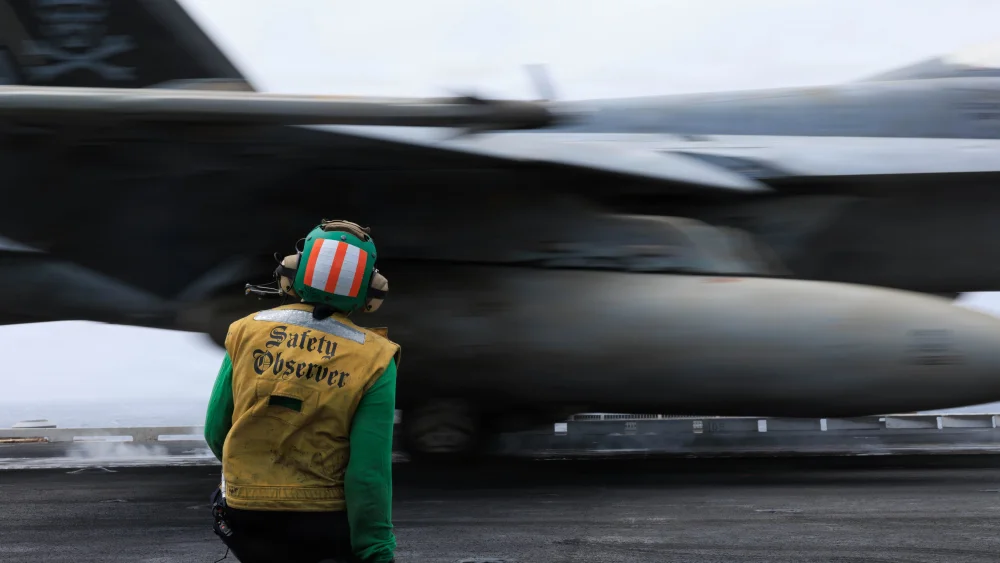
The American military and the Israel Defense Forces had been planning to restart joint attacks on Iran, targeting critical energy infrastructure sites, possibly beginning this weekend, CBS News reported on Saturday, citing unnamed U.S. officials.
Asked on Friday about talks to end the conflict with the Islamic Republic, Trump had said that Iranian negotiators were making him “angry.”
“I’m losing faith in them because they do lie and do, they do misrepresent,” he said.
Moshe Passal, a legislator for Israeli Prime Minister Benjamin Netanyahu’s ruling Likud Party, told JNS on Sunday that as long as the Islamic regime remains in power in Iran, it will continue to pose a significant threat to the world.
“As long as confronting the problem is postponed, the price we pay will only grow. When the world faced Hitler, there were those who said, ‘Let’s reach an agreement,’” Passal said.
“In the end, there was no choice—the world had to defeat him, and that came at a cost. People in Britain, the United States, Europe and around the world paid the price. I don’t believe any agreement can be reached with this regime.”
Meanwhile, U.S. Secretary of State Marco Rubio said that Iran is now willing to reach an agreement over denuclearization since it no longer has its “conventional shield” of drones and missiles to hide behind.
Speaking on Saturday night with Fox News’ Lara Trump, the daughter-in-law of the president, Rubio said that “I don’t think the Iranian regime has ever faced a president like President Trump, which is someone that actually takes action.”
Tehran still has drones and missiles, which can inflict damage, but degrading its military capabilities has allowed the U.S. to approach the Iranian regime “from a position of strength, not from a position of weakness,” the secretary of state said.
Likud Party Knesset member Amit Halevi told JNS on Sunday that the Iranian regime poses the greatest threat to the free world and would ultimately have to be defeated militarily.
“I think that in the last century, had the West not taken the initiative, Washington would still be locked in a major struggle against Hitler, Japan and others today. We are facing a barbaric, totalitarian and racist enemy, and we need to treat it accordingly,” Halevi said.
“I am sure that sooner or later President Trump—and whoever occupies the White House after him—will have to enter this battle, because it’s here, and it’s not going anywhere,” he added.
Brig. Gen. (res.) Amir Avivi, founder and chairman of the Israel Defense and Security Forum, told JNS on Sunday that while Trump appears willing to allow more time for diplomacy, he is unlikely to give Iran much of it.
“We have to remember that the attack may have been postponed, but Iran remains under a full blockade, so in a sense, the war is still ongoing. The big question is how long the president will be willing to negotiate and whether the Iranians are serious,” Avivi said.
He argued that the United States and Israel can cripple the Iranian regime by depriving it of its economic assets and its ability to sustain itself through a short military campaign.
“I don’t believe the Iranians are going to agree to anything, and I don’t think these talks will achieve anything on the nuclear issue. Ultimately, they are only postponing what is inevitable: striking the regime hard and bringing it to its knees,” he said.