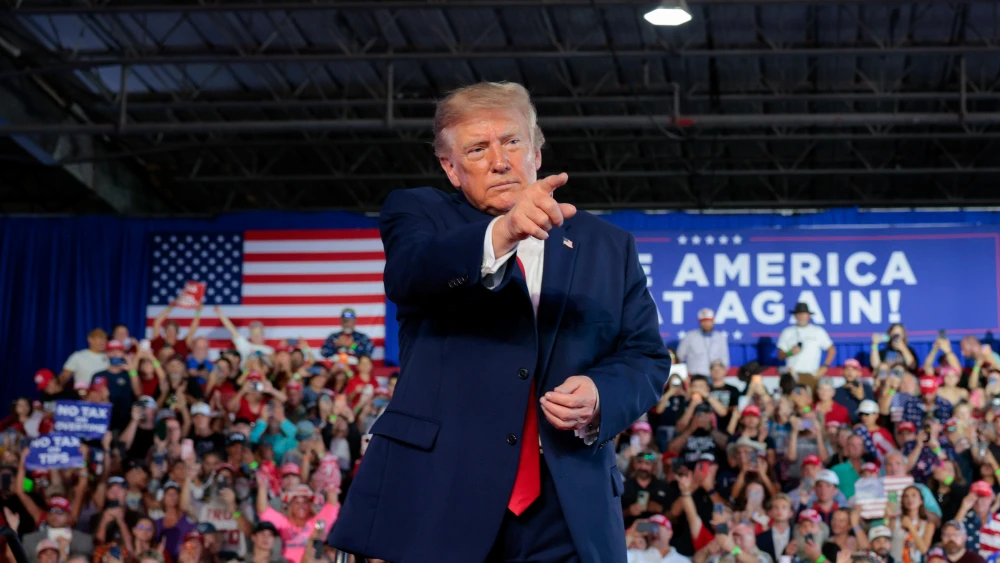
U.S. President Donald Trump said at a midterm campaign rally in Corpus Christi, Texas, on Tuesday, “We are now in the throes of having an even greater victory against Iran and stopping them from ever having a nuclear weapon.”
“America did not start the war with Iran. Iran has been waging this war against America since 1979,” Trump said. “They’ve killed thousands of our soldiers and wounded so many more.”
He accused previous U.S. leaders of lacking “the courage or intelligence” to confront Tehran.
.@POTUS: "Iran has been waging this war against America since 1979, killing many, many of our great people... Past leaders should've settled this problem long ago — but they didn't have the courage or intelligence to do it." pic.twitter.com/SNoFsauaoN
— Rapid Response 47 (@RapidResponse47) October 27, 2026
In separate remarks to reporters, Trump said Iran wanted to reach a deal but suggested Tehran might be waiting for the U.S. midterm elections. “It’s a question of when do I want to end it,” he said. “Maybe they’re waiting for the election or something—but that’s not going to help them.”
Trump also said the United States had “decimated” Iran’s military and finances. Asked whether he planned additional strikes against Iran after the election, he replied, “I can’t tell you that,” adding that “anything’s possible.”
.@POTUS on Iran: "It's a question of when do I want to end it... They've wanted to make a deal, but they like tapping it along. Maybe they're waiting for the election or something — but that's not gonna help them." pic.twitter.com/C76mduPuwf
— Rapid Response 47 (@RapidResponse47) October 28, 2026
U.S. forces and the Israel Defense Forces launched a joint military campaign on Feb. 28 against Iran’s nuclear facilities, ballistic missile program, arms-manufacturing factories and other regime targets.
At the Corpus Christi rally, Trump also said “more oil is right now flowing out of the Hormuz Strait” and floated renaming the waterway the “Trump Strait,” asking the crowd, “Should we do it?”
His comments followed an Oct. 25 visit to the Strait by Adm. Brad Cooper, commander of U.S. Central Command. The U.S. military said American forces had helped Gulf partners export more than 1.5 billion barrels of crude oil since summer, after clearing international shipping lanes of sea mines laid by Iran’s Islamic Revolutionary Guard Corps.
“Today, primary transit routes in the Strait of Hormuz remain free and clear of Iranian sea mines thanks to incredible efforts by our people,” Cooper said. “We remain intensely focused on keeping commercial traffic flowing as we work with our teammates in the U.S. interagency, Gulf Cooperation Council and shipping industry.”
Separately, Israeli Prime Minister Benjamin Netanyahu told supporters at Likud’s election headquarters at Jerusalem’s International Convention Center early Wednesday that Israel faced “a historic, once-in-a-lifetime opportunity, with our partner President Trump, to remove the existential threat from Iran once and for all.”
Speaking after the publication of initial exit polls in Israel’s national election, Netanyahu hailed the results as showing beyond any doubt that “Likud is the largest party in Israel.”
Likud led with about 21% of valid votes, with more than 4 million ballots counted, according to the Central Elections Committee’s latest update at 10:56 a.m. Wednesday. Netanyahu’s bloc had collectively garnered roughly 43%, compared with about 37% for Gadi Eisenkot’s Yashar party and its allies.
“Iran is weaker than ever, Israel is stronger than ever,” Netanyahu said, while warning that the threat would persist as long as the Iranian regime remained in power. “We must not let any extraneous considerations divert us from this sacred mission,” he added.