


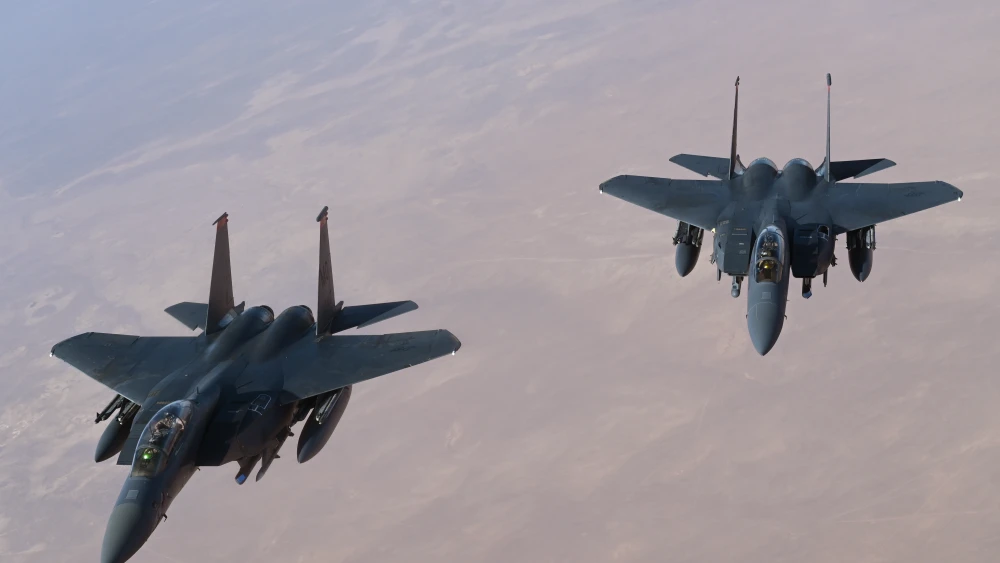
Gratitude was a recurring theme in the first public interview of “Bravo,” the U.S. Air Force weapons-systems officer, whose two-seat F-15E was shot down over Iran and who was rescued on April 5 after spending 50 hours evading capture behind enemy lines.
Speaking to CBS News on “60 Minutes” on Sept. 13, “Bravo” said that he appreciated his pilot, “Alpha,” who rescued him when their plane was hit by a shoulder-fired missile in the middle of Iran, and to the men and women of the U.S. military who rescued him.
“I think it’s important for America to hear what we’re capable of and remember that there are thousands of Americans that are out protecting us and defending us every day, and I want to make sure that they get their due credit,” he told Norah O’Donnell.
“Bravo” described the moment the plane was struck and his immediate realization that it was a catastrophic hit, like “getting hit by a freight train.”
Normally, airmen make every effort to save the aircraft but in this case, it was impossible. “Alpha” ejected them. “Bravo” explained that there’s a delay of about two seconds in the ejection system to create a distance between the pilot and the weapons-systems officer, which is why they landed apart.
The ejection seat of “Bravo” was damaged in the blast, but it worked. He thanked the airmen who had prepared the seat. “It outperformed the design specifications, and I call that a testament to their professionalism,” he said.
Unfortunately, the blast damaged his parachute. “Bravo” described the moment he looked up and saw no parachute as “the most terrifying thing I’ve ever seen.” He paused even as he plummeted to earth to pray, “Lord, Your will be done, but if I’m getting through this, I need help.”
He started to pull and unfurl the parts of the parachute attached to his seat. “I never want to become a victim of my circumstances,” he said.
O’Donnell asked how fast he was going when he hit the ground. “Professionals, based on my description and the injuries that I had,” he said, “think I hit the ground going somewhere between 70 and 100 miles an hour.” He called it “a modern day miracle” and credited God for bringing him through that moment.
He sustained a broken back, broken arm, broken shoulder and sprained ankle, along with cuts and scrapes to his head and face. He prioritized his next steps, determined to first move away from the crash site.
“Bravo” had landed in a valley between mountain ridges and decided to climb one, thinking he’d be safer from potential captors if he moved to high ground. “My objectives were to get away from my landing site and then find the best concealment I could in order to do the other things, like communicate,” he said.
“Never let a lack of motivation put you on Iranian TV,” he said that he thought. “My worst fear was letting the team that was working so diligently to rescue me down. I knew that they were going to come. I knew that America, whether it was one day or one year, was going to uphold its promise and rescue me. I had to do my part to give them time to effect that rescue.”
His survival kit, included in his seat, was destroyed in the blast, but he had a survival vest that included “basic signaling equipment, communication equipment, a very minimal amount of water and a couple of other tools to help me survive.”
Once he found a hiding spot, he set about communicating with colleagues. “I’m hurt. I’m moving. God is good,” he wrote.
The Iranian government had put a bounty out on his head, and Iranians scoured the mountain ridges looking for him. They came within a few hundred yards of his position, he said.
Six hours into the crash, “Alpha” was rescued by U.S forces. “Bravo” could see the rescue from his ridge.
“It was the proudest dad moment of my life. With apologies to my kids, I was deployed with many of those men and women on that rescue operation as part of my unit,” he told CBS. “I know they build an ethos around doing extraordinary activities so that others may live, and to see it firsthand made me incredibly proud of them.”
Bravo also said that “it was a dad moment” because he was at the point in his career as a fighter pilot that he should be “getting fitted for my rocking chair.”
“60 Minutes” credited the CIA with playing a key role in Bravo’s rescue. It launched a strategy to deceive the Iranians and employed technology to pinpoint Bravo’s location.
During the rescue, two planes landed on a makeshift desert airstrip. They unloaded small helicopters to reach “Bravo” on the ridge several miles away. Two Air Force Para-rescue operators reached him, but he wasn’t out of danger. At the makeshift airstrip, the rescue plane’s landing gear became stuck in the sand, and the planes couldn’t take off. A special unit of the U.S. Air Force arrived to take “Bravo” and the more than 90 special operators out of Iran. The United States then bombed its own aircraft to prevent its technology from falling into Iranian hands.
“Bravo” became emotional when speaking of his call to his wife after his rescue. “I was really proud of her, grateful for the strength that she showed and I looked forward to seeing her again,” he said.
“I don’t believe Americans even realize just how much of a lifetime of effort goes into accomplishing something that seems like it happened overnight,” he said. “It was a miracle that all of those individuals chose to do what they did for their lifetime and for their profession, and I get to be the recipient of that hard work.”
He added that he was “evidence of real-life miracles and the incredible professionalism of the United States military.”



