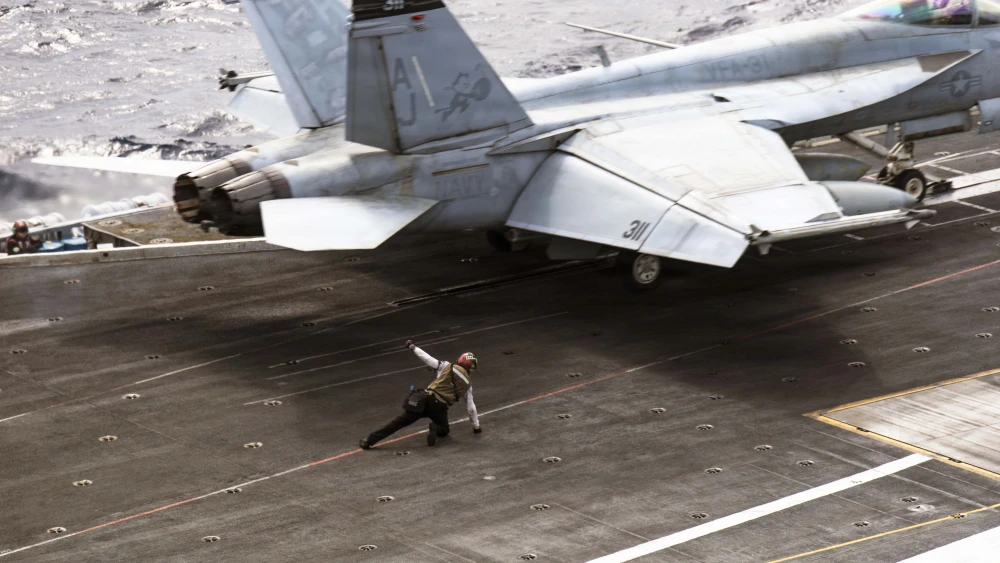
American forces carried out an 11th consecutive night of strikes against Iran on Tuesday, targeting military operations centers, maritime capabilities, aircraft hangars, drone storage sites and logistics infrastructure, U.S. Central Command said.
The strikes were intended to “further degrade Iran’s ability to threaten commercial shipping in the Strait of Hormuz,” according to CENTCOM.
The military said Iran has attacked more than 30 commercial vessels transiting the strategic waterway over the past three months, endangering “hundreds of innocent mariners” and undermining freedom of navigation.
“Despite Iranian aggression, the Strait of Hormuz remains open for commercial vessel transit,” CENTCOM said, adding that U.S. forces have helped facilitate the transit of some 900 commercial vessels and 450 million barrels of crude oil through the strategic shipping lane since early May.
Iran launched six ballistic missiles toward the southern Jordanian port city of Aqaba following the American strikes.
“Air defense systems detected six missiles launched from Iranian territory toward the kingdom and engaged them immediately upon their entry into Jordanian airspace,” an official Jordanian military source told the state-run Petra News Agency.
Four missiles were intercepted, while the remaining two landed in remote, uninhabited areas, the report said.
Earlier on Wednesday, Iran’s military claimed that it launched overnight drone attacks on U.S. military assets in Jordan and Bahrain.
The unmanned aerial vehicles targeted housing units and an equipment depot at a military base in Jordan, according to Fars News, an outlet affiliated with the Islamic Revolutionary Guard Corps.
Fars said additional drones targeted hangars and other buildings used by U.S. troops at a military facility in Bahrain.
The Jordanian military told the Petra News Agency that the country’s air defenses intercepted four Iranian drones. No injuries or damage were reported, an official said.
There was no immediate comment from authorities in Bahrain.
U.S. President Donald Trump told reporters at the White House on Tuesday that he would “soon” order an attack on Pickaxe Mountain, an underground Iranian site suspected to be used for nuclear activity.
“We’ll be hitting that area pretty soon, and very heavily,” Trump said, speaking during a meeting with Lebanese President Joseph Aoun.
“There’s not a thing they can do about it. You know, normally I wouldn’t say that. If I thought they could do something about it, I would never say that,” he added.
Trump said the U.S. believes the Islamic regime “may have” stored centrifuges at the facility but added, “We don’t have it on record.” Even if Iran did, he said, “it doesn’t mean anything unless they have the [nuclear] material.”
The Wall Street Journal reported on Monday that Israeli intelligence believes Iran moved thousands of uranium-enrichment centrifuges into tunnels deep inside Pickaxe Mountain last fall, a relocation Israeli and U.S. officials say could allow Tehran to reconstitute its nuclear program despite heavy American and Israeli strikes on three main nuclear sites during the 12-day war in June 2025.
Ohad Tal, a Knesset lawmaker for Israel’s Religious Zionist Party, told JNS on Wednesday that there was currently “no need for Israel to intervene” in the Iran war.
“The U.S. is striking Iran night after night, Iran’s economy continues to weaken and the regime is under immense pressure. It’s no coincidence that they are avoiding attacks on Israel and instead targeting weaker countries in the region,” Tal told JNS.
“Ultimately, our strategic objective should be the collapse of the Iranian regime, and that will be achieved through sustained pressure—not only military. We delivered devastating military blows to Iran during operations ‘Rising Lion’ and ‘Roaring Lion.’ Now is the time to ramp up the economic and diplomatic pressure,” he added.
Likud Party MK Eli Dallal told JNS that “Iran is not exclusively an Israeli problem—it is a global problem, and the United States is taking the lead on it.”
“The most important issue, and one that President Trump has said he will not compromise on, is Iran’s nuclear program. We see that Trump is determined to address the nuclear issue because, God forbid, if Iran acquires nuclear weapons, we understand that it would create a problem for the entire world and have a negative global impact,” he continued.
“As such, I believe Trump will resolve this issue in the coming months,” Dallal said. “Israel cannot intervene without coordination with the United States. As such, the issue must be coordinated between the leaders, Netanyahu and Trump. There must be coordination because it is the right thing to do for Israel.”