Newsletter
Newsletter Support JNS

US sanctions firms accused of helping Iran extort ships in Strait of Hormuz

“The United States will not allow Iran to hold global commerce hostage or use international shipping to finance the IRGC’s terrorism, aggression and repression,” the U.S. treasury secretary said.

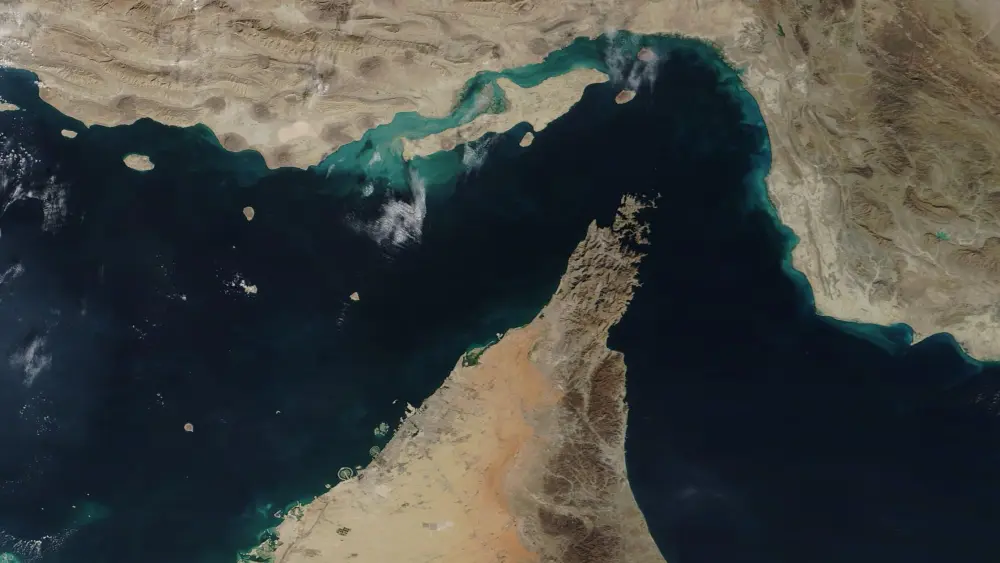
The Strait of Hormuz, which lies between the Persian Gulf and the Gulf of Oman, separating Iran (north) from the Arabian Peninsula (south), Dec. 2, 2020. Credit: MODIS Land Rapid Response Team/NASA.

The U.S. Department of the Treasury imposed sanctions on two companies it said are “integral” to an Iranian “extortion scheme” targeting commercial shipping in the Strait of Hormuz, one of the world’s busiest maritime chokepoints.

Treasury designated the Persian Gulf Marine Insurance Company and HormuzSafe Marine Services Authority, accusing them of brokering insurance policies approved by Iran’s Islamic Revolutionary Guard Corps “designed to extract revenue under the guise of maritime services, including payments in digital assets to evade sanctions,” the department stated.

According to Treasury, Iran is compelling commercial vessels transiting the Strait of Hormuz, which carries roughly 20% of the world’s seaborne oil trade, to purchase the policies to avoid harassment or attack by Iranian forces. The department stated that the risk necessitating the insurance policies is created by Iran itself.

“With its economy in freefall and inflation in the triple digits, the regime is desperate for cash,” Scott Bessent, U.S. treasury secretary, stated. “The United States will not allow Iran to hold global commerce hostage or use international shipping to finance the IRGC’s terrorism, aggression and repression.”

Treasury also imposed sanctions on eight vessels and multiple companies involved in transporting Iranian crude oil and petrochemical products in violation of U.S. sanctions. The targeted firms include entities based in China, Hong Kong and the Marshall Islands.


Mike Wagenheim is a Washington-based correspondent for JNS, primarily covering the U.S. State Department and Congress. He is the senior U.S. correspondent at the Israel-based i24NEWS TV network.
“Speakers—alleged or confirmed—of antisemitic remarks is not a protected class under Title VII,” the judge wrote in her findings.
“This attack might be a message to the Egyptians that we can reach the Suez Canal and we can really close the Suez Canal,” Ahmad Sharawi, a senior research analyst at FDD, told JNS.
“Neo-Nazi propaganda and the organizations that spread it should have no place in our Orange County,” Joey Good of the Jewish Federation of Orange County told JNS.
“They do nothing,” a state lawmaker said, of the committee, which has had a problem with antisemitic statements from members. “That doesn’t mean they can’t use the bully pulpit and try to shame people.”
The survey found declining support for the conflict and widespread skepticism that President Donald Trump’s negotiators can bring it to an end.
“The ruling rightly validates the state’s authority to direct resources toward protecting the Jewish community without it being considered discriminatory against other groups,” Carly Gammill of StandWithUs told JNS.