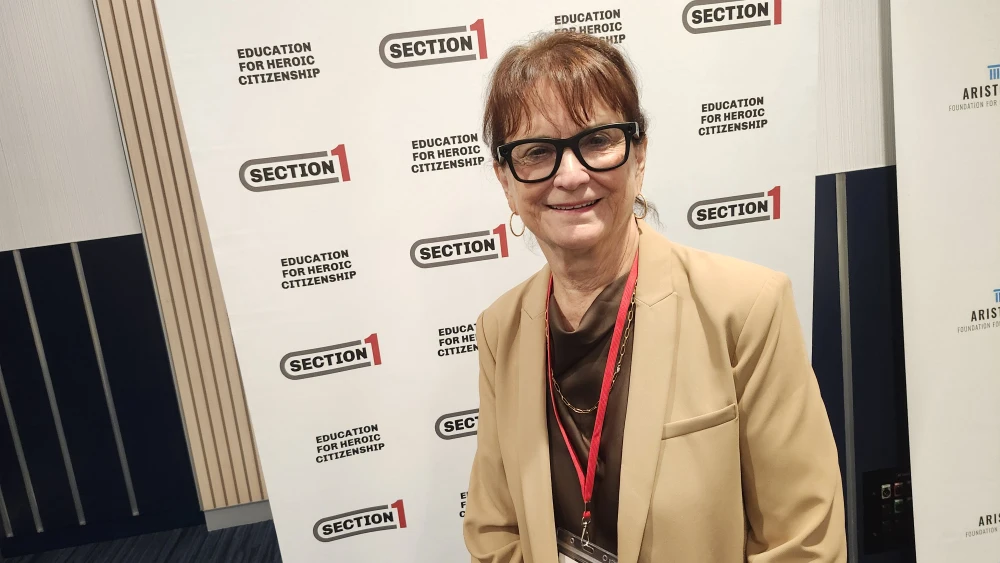
Jewish groups and police departments have expressed alarm at rising antisemitism in Canada, but Deborah Lyons, former Canadian special envoy on preserving Holocaust remembrance and combating antisemitism and a former ambassador to Israel, told JNS that she has seen promising signs from Mark Carney, the Canadian prime minister.
After he launched a national panel to fight hate in June and directed it to tackle Jew-hatred as its first focus, Carney attended one of the council’s early meetings. That is “very unusual, almost unheard of,” Lyons told JNS.
That kind of high-level attention “must translate into outcomes,” and the panel must issue “very solid recommendations” for government actions on Jew-hatred “before Chanukah,” she said.
Chanukah begins at sundown on Dec. 4 this year.
“The proof will be in the results that we see soon,” she told JNS, after speaking at a Toronto conference on Jew-hatred.
Lyons served as the Canadian special envoy on Jew-hatred from October 2023 until she retired in July 2025, several months before the Canadian government eliminated the office in February 2026. The non-Jewish diplomat told JNS that she faced “too many times when I felt like I was standing alone.”
She would have wanted “more courage” from government, business and religious leaders during her tenure “to stand beside me in the fight,” she said.
The change in the office came “with the understanding from today’s government that they would be looking at other approaches,” and those other approaches include the new panel, she said.
Lyons framed her Chanukah deadline as a test of whether the federal government’s replacement for her former office can convert a substantial body of pre-existing research, committee work and community expertise into an effective, actionable national response.
She rejected the idea that the Jewish community should just wait for the government to solve the problem or “be expected to solve it alone.” Her prescription was a broad, “trilateral coalition,” involving federal, provincial and municipal governments, alongside universities, business leaders, religious leaders and non-Jewish allies.
“The federal government and the provincial governments and municipal governments will never be absolved of responsibility in this matter,” Lyons told JNS.
‘A very useful instrument’
She urged those at the conference not to dismiss the current federal advisory council outright and to give it a chance to succeed. “You may not like the advisory council, and sure as heck, you and I don’t like the way in which it was launched,” she said.
The council’s membership drew sharp criticism from major Jewish groups, which argued that a body confronting antisemitism needs specialized expertise. The panel includes appointees whose past records have raised concerns about impartiality on Israel and antisemitism. B’nai Brith Canada called for two members to recuse themselves or be removed.
“I think that the establishment of the advisory council is a very useful instrument if it produces what it must produce, and Prime Minister Carney, the highest office in the land, has given them clear instructions,” Lyons told JNS.
“Frankly, I agree with most of those instructions,” she said. “I’m here to support the council to have success, and if they don’t have success, then we’ll deal with it.”
The former envoy said that the council has a secretariat and has been meeting regularly. Its task isn’t to begin from scratch but to consolidate work that Parliament, the Senate, her former office and researchers in areas including “education, universities and Canadian public opinion” have already completed.
Lyons told JNS the council has an important role to play in understanding antisemitism both as an issue affecting Jews and “an overall threat to Canada’s democracy.”
The former Canadian ambassador to Israel and Afghanistan, who was also the United Nations secretary-general’s special representative for Afghanistan, has largely stayed out of the public eye since her former office was eliminated.
Lyons plans to continue speaking and writing about the rise of Jew-hatred and aims to place op-eds in Canadian newspapers and focus on developing broader non-Jewish allyship, she told JNS.
She thinks antisemitism has “calmed a little bit” in Canada but said “that doesn’t mean that the crisis has subsided.”
“It doesn’t mean that the problems have gone away,” she told JNS.
“I’m hoping that what it means is that we have a bit more latitude,” she said. “If not a more comfortable environment, at least more space to work on the issues, and there are still many.”
The issues relate to law enforcement, training at schools and social media. “There is much more work that we’ve begun,” she told JNS. “We’ve got a foundation. Now we move forward.”
Ottawa must also remain alert to the groups and networks that foment Jew-hatred and other forms of hatred, according to Lyons. The government needs to remain “very vigilant” about Islamist groups “and continue to be very open-eyed about where this hatred is coming from,” she said.
“It’s not just disruptive, of course, to our Jewish community,” she told JNS. “It is incredibly dangerous to our democracy.”