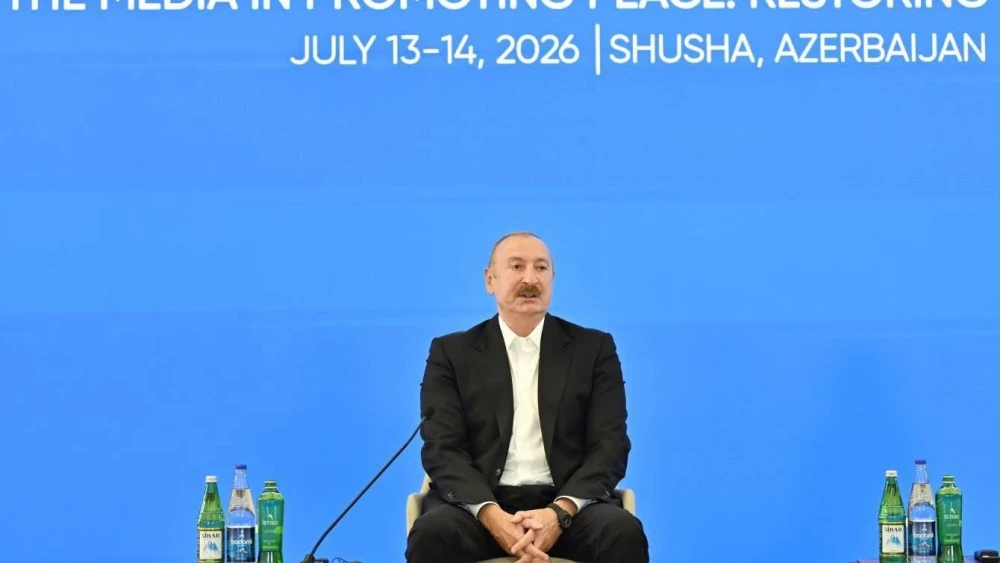
SHUSHA, Azerbaijan—U.S. President Donald Trump is uniquely positioned to make peace around the world, Azerbaijani President Ilham Aliyev said Monday.
The lavish praise of the American leader and upbeat assessment comes a year after Azerbaijan and Armenia signed a peace declaration in the White House, and even as the ceasefire with Iran crumbled over the Islamic Republic’s persistent attacks in the Gulf.
“President Trump is a person who loves peace and brings peace,” Aliyev said at the Shusha Global Media Forum. “This is his character, his vision and his policy.”
The Azerbaijani leader said that Trump played an instrumental role in initiating the August 2025 agreement between Azerbaijan and Armenia, which ended decades of conflict between the two former Soviet republics, and is leading to security, connectivity and regional cooperation.
“Trump wants peace and sees peace as an opportunity,” he said.
‘Unprecedented’ relations with United States
The longtime Azerbaijani president who has been in office for nearly a quarter century said that relations with the United States under the Trump administration are at an “unprecedented peak.”
“This is something we could have only dreamed about before,” he said.
Aliyev noted that during nearly three decades of conflict with neighboring Armenia, previous US administrations mainly pursued a policy of freezing the conflict and not resolving the conflict, including maintaining longtime Congressional restrictions and sanctions on arms sales to Azerbaijan, in order to use it as leverage on both countries.
Trump signed a waiver on the restrictions with the initialing of the peace deal last year, and the administration subsequently inked a strategic partnership agreement with Azerbaijan.
Urges Iran’s neighbors to de-escalate the conflict
As Iranian attacks and US counter-attacks persisted in the Gulf, the Azerbaijani leader expressed the hope that the war with Iran, with which it shares a 428-mile-long border and often tense relations, would end soon.
“We hope that this current eruption of conflict will not last long,” he said. “My message to neighbors is: be responsible and stop as soon as possible without escalating this process to a global conflict.”
A quiet mediator between Turkey and Israel
The predominantly Shi’ite Azerbaijan, which has maintained decades of close relations with Israel, has also served as a mediator itself in seeking to defuse tensions between its closest historical ally, Turkey, and the Jewish state, using the trust it has built up with both sides.
“We keep our mouths shut and do not leak any information,” Aliyev said, explaining the secret to Azerbaijan’s success. “If it leaked, it never leaked from us.”