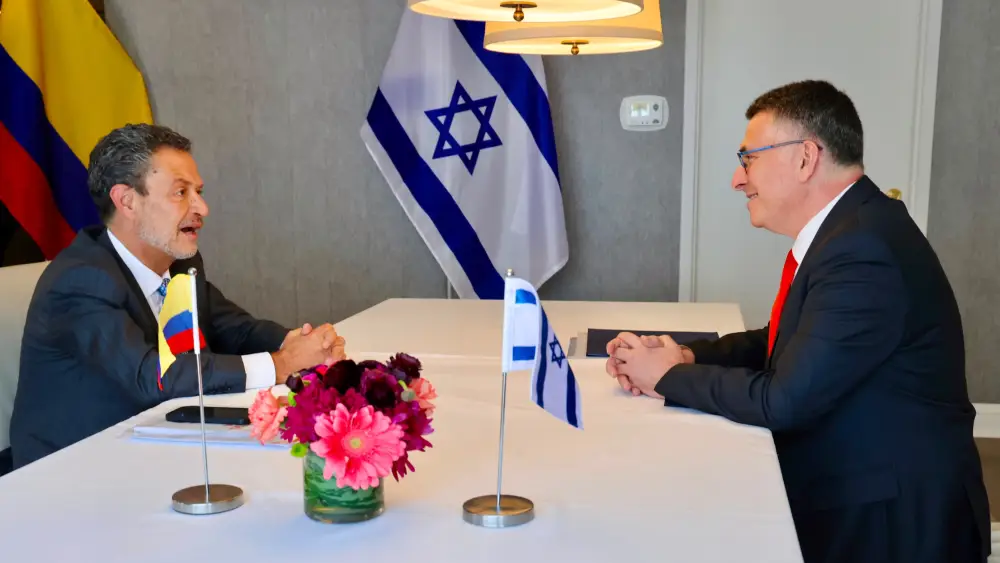
Colombia’s incoming foreign minister has told his Israeli counterpart that the South American country will open an embassy in Jerusalem, the Israeli Foreign Ministry said Wednesday, making good on President-elect Abelardo de la Espriella’s election pledge.
The move comes amid a right-wing wave sweeping across Latin America that is reshaping alliances with the United States and Israel.
Israel and Colombia have agreed to fully restore diplomatic and economic relations next month with the inauguration of the new government, reversing a two-year freeze initiated by outgoing left-wing president Gustavo Petro over the war in Gaza.
The agreement follows a meeting in Washington between Israeli Foreign Minister Gideon Sa’ar and Colombia’s Foreign Minister-designate Omar Bula Escobar.
Colombia’s historic relations with Israel nosedived after Petro severed diplomatic ties with Israel in 2024 over the Gaza war triggered by the Oct. 7, 2023, Hamas-led attack, and expelled Israeli diplomats from the South American country.
De la Espriella, a 47-year-old lawyer and political outsider nicknamed “El Tigre,” or “The Tiger,” who was elected last month with the backing of conservative and evangelical groups, pledged during the election campaign to open an embassy in Jerusalem and renew a strategic alliance with Israel.
He will be inaugurated on August 7.
The Colombian election heralds another gain for the right-wing wave sweeping across Latin America, whose leaders share U.S. President Donald Trump’s tough approach in dealing with drug traffickers and offer a marked shift in foreign policy alliances.
Israel’s top diplomat also held a joint meeting in the U.S. capital with his counterparts from Argentina, Paraguay and Bolivia.
Eight countries currently have embassies in Israel’s capital: the United States, Guatemala, Honduras, Kosovo, Paraguay, Papua New Guinea, Fiji and Somaliland.
All the other nations which have diplomatic relations with Israel maintain their embassies in Tel Aviv or its suburbs, due to the political sensitivities of Jerusalem.
U.S. President Donald Trump’s decision to move the American embassy to Jerusalem during his first term set the stage for other countries to follow suit, with at least two nations expected to do so by the end of the year.